Classified Israeli data
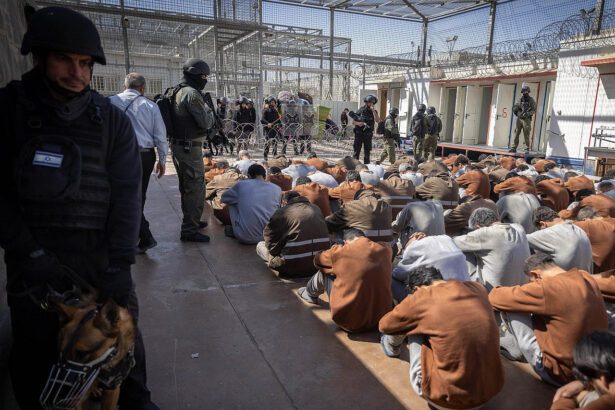
indicates the majority of Palestinians taken prisoner in Gaza during the war were civilians. Israel’s supreme court
ruled in 2019 that it was lawful to hold the bodies of Palestinians as bargaining chips for future negotiations, and rights groups have accused it of doing the same with living detainees from Gaza.
Unique abuse
Conditions for Palestinians were “horrific by intention” at all prisons, said Tal Steiner, the executive director of PCATI. Current and former detainees, and whistleblowers from the Israeli military, have all detailed systemic violations of international law.
However, Rakefet imposes a unique form of abuse. Holding people below ground without daylight for months on end has “extreme implications” for psychological health, Steiner said. “It’s very hard to remain intact when you are held in such oppressive and difficult conditions.”
It also affects physical health, impairing basic biological functions from circadian rhythms needed for sleep to vitamin D production.
Despite working as a human rights lawyer and visiting prisons at the complex in Ramla, south-east of Tel Aviv, where Rakefet is located, Steiner had not heard of the underground jail before Ben-Gvir ordered it back into service.
It was closed before PCATI was founded, so the legal team turned to old media archives and the memoir of Rafael Suissa, the head of the IPS in the mid-1980s, to find out more about the jail.
“[Suissa] wrote that he understood being held below ground 24/7 is just too cruel, too inhumane for any person to endure, regardless of what their actions have been,” Steiner said.
This summer, PCATI lawyers were asked to represent two men held in the underground prison, so Abdu and a colleague were able to visit for the first time.
They were led underground by masked, heavily armed security guards, down a flight of dirty stairs into a room where the remains of dead insects dotted the floor. The toilet was so dirty that it was, in effect, unusable.
Surveillance cameras on the walls violated the basic legal right to a confidential discussion, and guards warned that the meeting would be cut short if they talked about detainees’ families or the war in Gaza.
“I asked myself, if the conditions in the lawyers’ room are so humiliating – not just personally to us but also to the profession – then what is the situation for the prisoners?” Abdu said. “The answer came soon, when we met them.”
The clients were brought in bent over, with guards forcing their heads to the ground, and remained shackled at their hands and feet, she said.
Saja Misherqi Baransi, the second PCATI lawyer on the trip, said the two detainees had been in Rakefet for nine months, and the nurse began the meeting by asking: “Where am I and why am I here?” The guards had not told him the name of the prison.
Israeli judges who authorized the detention of the men at very brief video hearings, during which the detainees had no lawyer and did not hear evidence against them, said only that they would be there “until the war ends”.
The men described windowless cells with no ventilation, holding three or four detainees, and reported often feeling breathless and choking.
Prisoners told the lawyers they faced regular physical abuse, including beatings, assaults by dogs with iron muzzles, and guards stepping on prisoners, in addition to being denied adequate medical care and given starvation-level rations. Israel’s high court ruled this month that the state was depriving Palestinian prisoners of adequate food.
They have very limited time outside the cell in a tiny underground enclosure, sometimes just five minutes every other day. Mattresses are taken away early in the morning, usually at about 4 am, and only returned late at night, leaving detainees on iron frames in otherwise empty cells.
Their descriptions matched images from a televised visit to the prison made by Ben-Gvir to publicize his decision to reopen the underground jail. “This is terrorists’ natural place, under the ground,” he said.
He has repeatedly boasted about the mistreatment of Palestinian detainees, rhetoric that former hostages taken during the 7 October attacks say prompted an escalation of Hamas abuse when they were in captivity.
This included holding hostages in underground tunnels for months, depriving them of food, isolating them from news of relatives and the outside world, and inflicting violence and psychological torture, including being ordered to dig a grave on camera.
Israel’s intelligence services have warned that the treatment of Palestinian prisoners puts the country’s wider security interests at risk.
Misherqi Baransi said the detained nurse last saw daylight on 21 January this year, when he was transferred to Rakefet, after a year passing through other jails, including the military’s notorious Sde Teiman centre.
The nurse, a father of three, has had no news of his family since his detention. The only fragment of personal information lawyers can share with detainees from Gaza is the name of the relative who authorized them to take on the case.
“When I told him: ‘I talked to your mother and she authorized me to meet you,’ then I am giving him this tiny thing, at least telling him that his mother is alive,” Misherqi Baransi said.
When the other detainee asked Abdu if his pregnant wife had given birth safely, the guard immediately cut off the conversation to threaten him. As the guards took the men away, she heard the sound of an elevator, suggesting their cells were even deeper underground.
The teenager had told her, “You are the first person I have seen since my arrest,” and his last request to her was: “Please come see me again.” His lawyers were later informed he was released to Gaza on 13 October.
The IPS said in a statement that it “operates in accordance with the law and under the supervision of official comptrollers” and added that it “is not responsible for the legal process, classification of detainees, arrest policy, or arrests”.
The justice ministry referred questions about Rakefet and detainees to the Israeli military. The military referred questions to the IPS.
Emma Graham-Harrison is the Guardian’s chief Middle East correspondent, based in Jerusalem.
RELATED: