“Shame on you,” says Father Jacques Noble-Abed of Taybeh, in the occupied West Bank, referring to US evangelicals who support Israel. “Because this is not the teaching of Jesus in the Gospel.”
ZETEO EDITOR’S NOTE: Today, we’re publishing this deeply-reported piece from the occupied West Bank by reporter Delaney Nolan, who interviewed Palestinians on the ground and witnessed apartheid in action. Foreign reporting isn’t easy or cheap, especially in active war zones, but we believe these stories must be told – especially the under-reported scandal of Palestinian Christians being persecuted by far-right Israeli settlers. – Mehdi
TAYBEH, occupied West Bank – Father Jacques Noble-Abed stands at the edge of the stone wall surrounding the cemetery of Taybeh. Below his feet, gray ash in the shape of a burned cross lies on the black, charred ground.
“They are violent,” he says gravely, looking down at the damage near the ruins of the old Byzantine church. “They are acting like gangs.”
Taybeh, one of the last majority-Christian villages in the occupied West Bank, was long considered relatively safe. Here, the bell towers of three churches cast shadows on quiet stone streets. But amid a surge in Israeli settler violence across the West Bank, that has changed.
A little over a month ago, villagers say Israeli settlers set fires around the ancient ruins of St. George’s Cathedral and the village’s cemetery. When young men from the town rushed to extinguish the flames, the dozen or so settlers looking on threw stones at them, Noble-Abed says.
According to residents, some of the Israeli settlers attacking Taybeh’s Christians originate from the nearby Kochav HaShachar settlement, which has been supported by the One Israel Fund, a tax-exempt American nonprofit. One Israel Fund appears to enjoy the backing of Mike Huckabee, an evangelical Christian Zionist and the current US ambassador to Israel, who, less than a year ago, gave a speech at the group’s 30th anniversary gala.
That connection and the lack of concern among many evangelicals in the US over the increasing violence against Palestinians underscore the hypocrisy of Christian Zionists, who remain staunch supporters of Israel and its state-backed settlers even as their escalating violence harms fellow Christians across occupied Palestine.
That hypocrisy is unmistakable in Taybeh, where Noble-Abed tells me the village has received no support from American faith leaders: “Unfortunately, [many] American Christians are also pro-Zionist.”
To them, he says, “Shame on you. Because this is not the teaching of Jesus in the Gospel.”
Once Spared, Now Repeatedly Attacked
Before the last two years, Taybeh had largely been spared the settler and military violence that has wracked much of the occupied West Bank. The village, home to around 1,500 people, including some US citizens, occasionally welcomed Christian pilgrims visiting the ruins of the ancient church overlooking the valley below. On the side of a hill is Taybeh Brewery, the first microbrewery in the Middle East, and the town hosts an Oktoberfest each fall that welcomes thousands of visitors. The three churches here – Greek Orthodox, Latin Roman Catholic, and Melkite Catholic – typically work together for the good of the village.

But this spring, for the first time, soldiers stormed Taybeh, raiding a dozen homes, residents say. During the Israel-Iran war, black-clad Israeli commandos again burst into homes in the middle of the night, terrifying residents.
Then, on July 7, settlers “burned around the ruin of the Byzantine church from the sixth century, and the cemetery of the village,” says Noble-Abed. Weeks later, on July 28, settlers attacked again, burning three cars and leaving behind threatening graffiti in Hebrew.
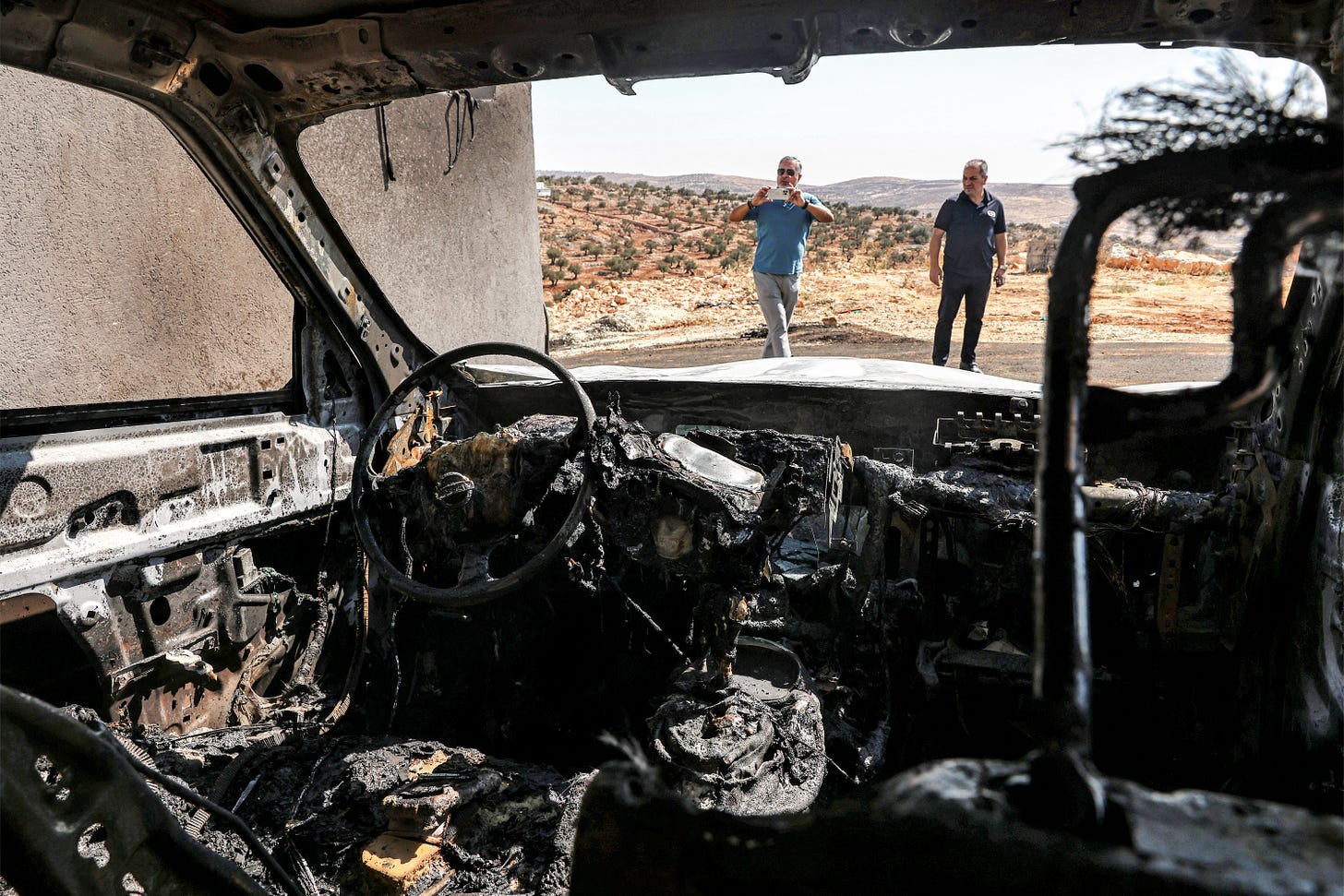
Reporting from Vatican News found that some of the attackers are linked to Neria Ben Pazi, an extremist settler who was previously sanctioned by the US under former President Joe Biden. Trump lifted those sanctions this year.
Ben Pazi, who grew up in the nearby settlement of Kohav Hashachar, runs an illegal farm outpost nearby. He also helped found several other illegal outposts near Kochav, which were previously sanctioned. I was unable to contact Ben Pazi. Elisha Yared, another Israeli settler previously arrested and temporarily banned from some parts of the West Bank over his suspected involvement in the killing of a Palestinian teen in 2023, claimed in an interview with Israel’s Channel 7 that the settlers from Ben Pazi’s farm were actually trying to extinguish the flames.
Kochav HaShachar, which is visible about 4km (2.5 miles) across the valley from Taybeh’s high points, is the original settlement from which other nearby ones have grown. Now home to around 2,500 settlers, Kochav HaShachar was established in the 1970s and has fed various outposts over the decades, some of which were later formalized by the Israeli government into settlements. Repeated attacks by settlers from Kochav and other nearby outposts forcibly displaced the entire Palestinian community of Ras al-Tin in 2022, according to a US State Department report, in “the first case of an entire Palestinian community evacuating their homes due to settler violence.”
Faith leaders in Taybeh say Israeli settlers from within and around Kochav have blocked villagers from accessing 80% of the olive trees planted across the community’s land. Settlers have previously attacked Palestinians on the outskirts of Taybeh. In 2023, they sent one man to the hospital for stitches to his head after beating him near the village.
Catholic Priest Bashar Fawadleh of the Latin Patriarchate tells me about another incident when settlers attacked a man visiting his family in Taybeh, sending him to the ICU for a week. But the recent attacks are an escalation, and part of a broader pattern of intensifying Israeli settler violence, often under the protection of Israeli soldiers, amidst calls by Israel’s far-right leadership to fully annex the West Bank. They also draw attention to the settlements and the US organizations and Americans who help support them.
The Yeshiva (Jewish religious school) in Kochav HaShachar, for example, is named on One Israel Fund’s website as a recipient of the organization’s support. Huckabee told the One Israel Fund’s 30th anniversary gala last December that Israel “will never be alone again in your fight for freedom and to preserve the country and the land and the heritage that God gave you.” Huckabee has been a longtime supporter of Israeli settlements, which are considered illegal under international law. He often refers to the West Bank by the Biblical term “Judea and Samaria,” and has in the past said there is “no such thing as a West Bank,” nor a Palestinian.
The US Embassy in Israel told me its office does not respond to press inquiries. One Israel Fund’s Director of Educational Projects did not respond to requests for comment.
In a rare acknowledgement of Palestinian suffering, Huckabee himself visited Taybeh shortly after the July 7 fire attack. In a statement, he asserted that any desecration of a holy place “is an act of terror” and that there “should be harsh consequences.” He told the village that “we will certainly insist that those who carry out acts of terror and violence in Taybeh – or anywhere – be found and prosecuted. Not just reprimanded.”
But he did not name Israeli settlers as the attackers, and he later underscored the fact that he had not attributed the fire to anyone after Israeli media cast doubt on claims that the arson was carried out by Israelis. The reports went as far as to suggest the settlers were carrying leafblowers in order to extinguish, rather than direct, the flames. Taybeh residents say this contradicts photo and video evidence of the attack.
Invisible
Despite Huckabee’s visit, Palestinians in Taybeh say they feel largely forgotten by Christians in the US, where Christian Zionism is a major force behind America’s unconditional support for Israel. Part of a subset of evangelicals, many Christian Zionists believe that when all Jewish people migrate to Israel, it will herald the Rapture and Jesus’ Second Coming.
One estimate puts the number of Christian Zionists in the US at 30 million, far outnumbering Jewish-Americans. White evangelical Protestants are also more than twice as likely as Jews to say that Israel was given to the Jewish people by God. This makes evangelical support for Israel arguably a more significant political pressure than Jewish Zionism. Huckabee comes from this camp: around the time of his Taybeh visit, he intervened on behalf of evangelical groups seeking Israeli visas.
Huckabee made history earlier this year when he became the first US ambassador to hold an official meeting with the Yesha Council, an umbrella group of municipal councils of Israeli settlements, in the West Bank. While in the West Bank settlement of Shiloh for the meeting, Huckabee reportedly began his visit by viewing five red heifers, which were sent by an evangelical from Texas in 2022. Some messianic Jews and Christian Zionists believe the sacrifice of a purely red heifer will herald the construction of the Third Temple on the site of the Al-Aqsa Mosque and the eventual coming of the messiah.
About 80% of white evangelicals voted for Donald Trump last year. It’s a powerful voting bloc: Christian Zionist groups like Christians United for Israel, founded by Islamophobic far-right Pastor John Hagee, claim over 10 million members. Such organizations are often accused of white supremacism and antisemitism – Hagee himself referred to Hitler as a “hunter” that “God sent” to hasten along the Bible’s prophecies (he later apologized).
But Christian Zionists have aligned themselves with an aspiring religious ethnostate that targets Christians, too – if they happen to be Palestinian. There are about 50,000 Palestinian Christians in the West Bank and fewer than 2,000 left in Gaza. Many of the Palestinian Christians who once lived in the region were driven out by Israeli militants in the 1948 Nakba. Others began leaving following Israel’s occupation in 1967. More recently, Israel has bombed multiple churches in Gaza, including one of the world’s oldest. An Israeli sniper killed a mother and daughter outside Gaza’s only Catholic church in 2023, and struck it again with tank fire last month.
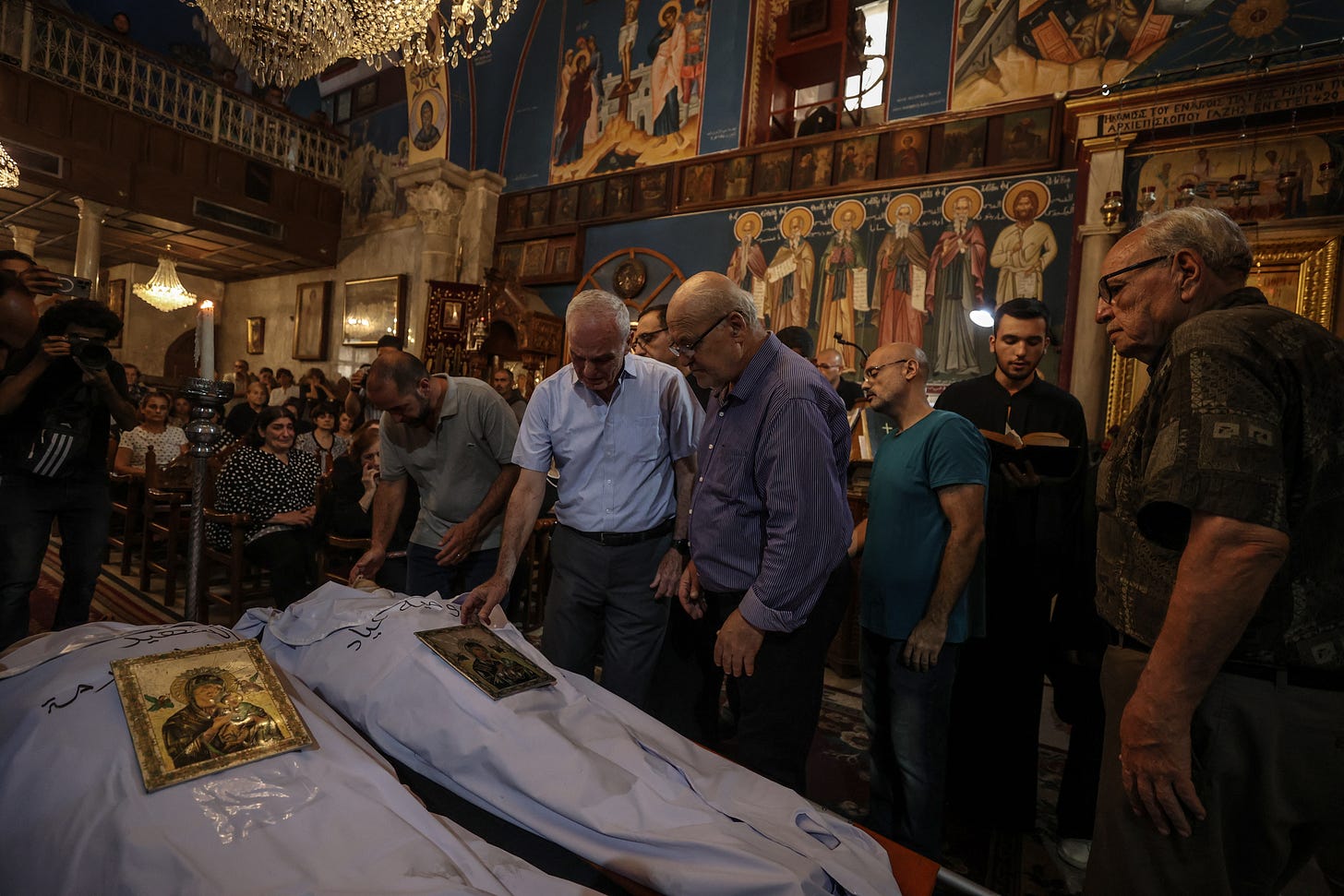
Christian Zionists have largely remained silent over these attacks, disappointing Taybeh’s faith leaders.
“We have been rooted here for thousands of years,” says Father Fawadleh, “and we have a particular identity in Taybeh, being the last and only 100% Christian village” in the West Bank.
“We are the living stones,” he adds, using a common term for Palestinian Christians, a reference to their long endurance in the region.
Despite the lack of support and concern from Christian Zionists, Taybeh has found support from other religious leaders. In a July 29 statement, the Latin Patriarchate of Jerusalem described “an alarming pattern of settler violence” and condemned the “reactionary disinformation campaign by Israeli settler-affiliated groups,” warning that the lack of accountability not only threatens Christian communities but also weakens the moral and legal foundations that uphold peace.” The leaders of the Anglican, Catholic, and Lutheran churches in Jerusalem have long made clear their opposition to Christian Zionism.
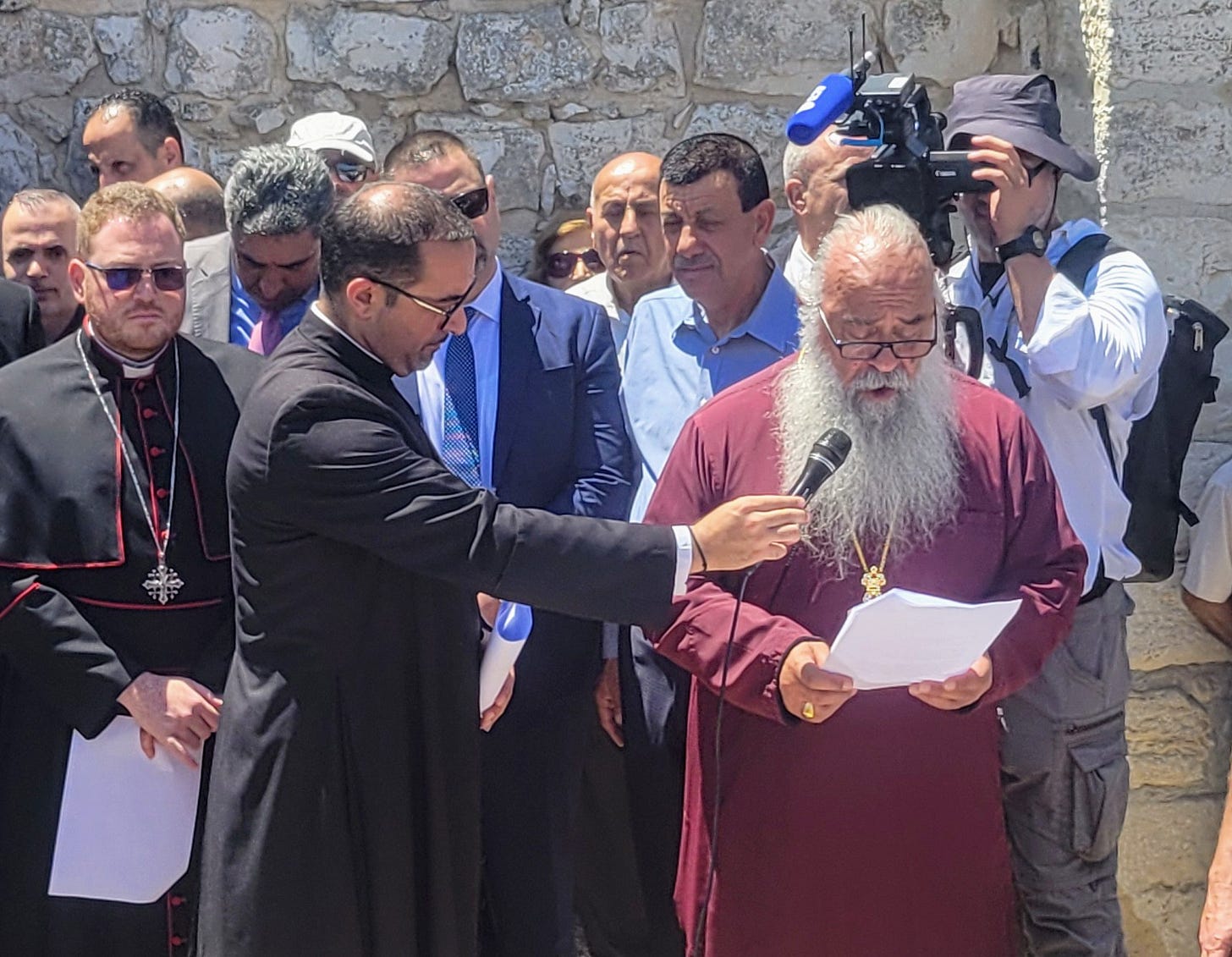
Still, Palestinians in Taybeh warn that the violence is only getting worse. “Because of the fanatic and extremist mentality coming from the Ministry of Ben-Gvir and Smotrich,” settlers from nearby feel empowered, Fawadleh says, referring to the ultra-nationalist Israeli Ministers Itamar Ben-Gvir and Bezalel Smotrich. “They are not respecting any international law.”
But ultimately, Fawadleh recognizes that “our conflict is not a religious cause. We are Palestinian here, we’ve been here [for] thousands of years, and that’s why they attacked us… not because we are Muslims or we are Christian, but because we are Palestinian.”
Delaney Nolan is a journalist based in New Orleans, recently reporting from the Occupied West Bank. A contributor to Al Jazeera, The Guardian, The Nation, and elsewhere, she currently reports for The Lens.
RELATED:
- Pax Christi priest denied entry to Israel
- You’re Losing Me’: As the Evangelical Backlash Against Israel Grows Inside MAGA, Trump Officials Threaten Reprisals
- The suppression of Christianity in Jerusalem – its birthplace
- Christians come under attack as Israeli leaders get more extreme
- Prominent Israeli Settler Says Spitting on Christians ‘Ancient Jewish Custom’
- Christians in Gaza—A Little-Known, Embattled Minority