Illegal Siege, Brutal Abuse: Our Detention and Assault at the Hands of Israeli Prison Guards
By Noa Avishag Schnall and Anna Liedtke, Reposted from Drop Site News, March 2, 2026
In April, a new flotilla set off for Gaza, once again attempting to break the Israeli siege. Late Thursday, Israeli forces intercepted 22 vessels of the Global Sumud Flotilla. More than 170 participants were detained before being taken to the Greek island of Crete. Two participants were taken to Israel for questioning.
Journalist Noa Avishag Schnall covered last year’s flotilla for Drop Site, before it was illegally boarded in international waters, all participants were abducted by Israeli forces, and Noa was abused in Israeli detention. On board the Conscience, she met German journalist Anna Liedtke. Liedtke, too, was abducted by Israeli forces and raped by female guards during her time in Israeli custody, abuse she first made public in December 2025 via the women’s organization ZORA.
The brutal treatment came despite—or, perhaps, because of—the fact that Liedtke is from Germany, a country unapologetically supportive of Israel no matter what it does to Palestinians or even to Germans, and Schnall is American and Jewish, a fluent Hebrew speaker of Yemeni descent who had renounced her Israeli citizenship. The detention of those aboard the Conscience straddled negotiations over the so-called ceasefire, likely also contributing to the increasingly violent mood of the Israeli guards.
As another flotilla embarks, we asked Noa and Anna for a first-person reported account of their time on the water and in detention. They both wanted to be clear that the abuse they endured pales in comparison to that meted out on a daily basis to the some 10,000 Palestinians in custody, many of them held indefinitely without charge. Thirty-two Palestinian prisoners died in detention in 2025, and at least one has already died this year.
A first-person account with two authors creates unusual narrative challenges, but we wanted to explore the format, and Noa and Anna agreed to collaborate on the piece you’re reading below. The article is based on their observations as well as their additional reporting based on documents linked to their detention. When they were separated, the piece makes clear whose perspective is being shared.
What follows is the story of how the Israeli government treated two journalists from the two nations most supportive of its genocide. The Israeli government did not respond to a request for comment.
Noa, meanwhile, is covering this year’s flotilla for Drop Site News. Follow her updates on Instagram or our Drop Site social channels.
*You can read the rest of the article here.*
Flotilla Activists Report Injuries, Abuse
Reposted from IMEMC, May 2, 2026
The Global Sumud Flotilla reported that 31 international activists were injured during the Israeli naval interception of the humanitarian fleet that was sailing toward the Gaza Strip last Thursday in an effort to challenge the ongoing blockade.
Israeli authorities announced that naval forces had seized the vessels in international waters and transferred those on board to detention facilities inside Israel.
In a detailed statement, flotilla organizers said the injured activists included four participants each from New Zealand and Australia, three from Italy and the United States, and two from Canada, the Netherlands, Spain, Britain, Colombia, and Germany.
🚨 URGENT: GSF PARTICIPANTS BRUTALIZED BY IOF AFTER 40 HOURS AT SEA 🚨
Global Sumud Flotilla participants have just survived 40 hours of calculated cruelty aboard an iOF navy vessel in Greek waters.
They were denied adequate food and water. They were forced to sleep on floors… pic.twitter.com/FAlM0SZfHR
— Global Sumud Flotilla (@gbsumudflotilla) May 1, 2026
Additional injuries were reported among activists from Hungary, Ukraine, France, Poland, and Portugal. One of the wounded holds dual Turkish‑German citizenship, while efforts remain underway to confirm the identities of three additional participants.
A separate statement said that activists who were taken into custody were subjected to harsh treatment aboard an Israeli naval vessel for nearly 40 hours.
According to the flotilla, detainees were not provided adequate food or water, were forced to sleep on a floor deliberately soaked with water and were kept under restrictive conditions throughout the transfer process.
The flotilla added that Israeli forces used physical force against participants who attempted to prevent the abduction of Saif Abu Kishk, a Palestinian‑origin activist holding Spanish citizenship, and Brazilian activist Tiago Ávila
Testimonies collected by the organizers described beatings, kicking, and dragging, with one participant stating that he believed his nose and ribs were broken and that activists were “kicked, punched, dragged on the floor,” while hearing gunfire used as intimidation.
On Thursday, the Israeli Ministry of Foreign Affairs announced that 175 activists had been detained after the navy seized more than 20 boats in international waters as they sailed toward Gaza carrying humanitarian supplies.
Maritime‑law specialists and humanitarian organizations have noted that intercepting civilian vessels in international waters raises legal concerns, particularly when the ships are unarmed and engaged in humanitarian work.
We were kidnapped by israelis in int’l seas because they say they own the Mediterranean, says #GlobalSumudFlotilla member, Suayb Ordu pic.twitter.com/sG2ZuIpZrf
— Sarah Wilkinson (@swilkinsonbc) May 2, 2026
The flotilla—known as the “Spring Mission 2026”—departed from the Italian island of Sicily on Sunday after completing final preparations. Organizers said the mission aimed to deliver humanitarian aid to Palestinians in Gaza and to challenge the blockade, which international agencies, including the United Nations, have repeatedly described as a form of collective punishment.
Flotilla officials reported that Israeli forces seized 21 boats during the assault, while 17 vessels reached Greek territorial waters, where they were met by local authorities. Another 14 boats were still en route toward Greek waters at the time of the statement.
Activists from the Global Sumud flotilla, who were released by Israel after being abducted by the Israeli navy and beaten, are calling for freedom for Thiago Avila and Saif Abu Keshk, who are still in Israeli detention pic.twitter.com/BKUg7bYEHx
— الـشـبـ𓂆ـراوي #غـزَّة (@M_shebrawy3) May 1, 2026
This mission is the second major initiative by the Global Sumud Flotilla. The first, launched in September 2025, ended in October of that year when Israeli naval forces intercepted the vessels in international waters, detaining hundreds of international activists before beginning deportation procedures. Human‑rights organizations at the time criticized the operation, citing violations of maritime law and the use of excessive force.
🚨BREAKING: Israeli Navy Intervenes with Global Sumud Flotilla‼️
Mediterranean Sea / April 30, 2026The Israeli Navy has begun intervening with the Global Sumud Flotilla in international waters. The flotilla is heading to Gaza to deliver humanitarian aid and break the blockade.… pic.twitter.com/KN3kSTfluT
— Gaza Notifications (@gazanotice) April 29, 2026
Humanitarian groups monitoring the current mission expressed concern over the latest incident, noting that the flotilla was carrying medical supplies, food, and other essential items intended for civilians in Gaza, where UN agencies continue to warn of severe shortages and a deepening humanitarian crisis.
The flotilla organizers said they will continue to pursue legal avenues and international advocacy, emphasizing that their objective remains to challenge the blockade and deliver humanitarian assistance to a population facing prolonged deprivation.
‘I will not stop fighting for Palestine’: After Israel’s sea raid, Gaza flotilla activists prepare to sail again
By Tamara Davison, reposted from The New Arab, May 1, 2026
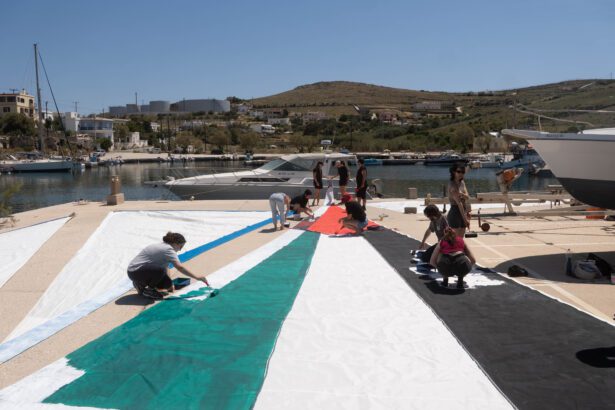
As a gentle breeze sweeps across the Greek island of Syros, a giant Palestinian flag adorning the docked sailboat begins to stir. Activists here are busy at work, stocking up supplies and tightening the ropes ahead of what is meant to be a historic mission to Gaza.
Among those still gearing up to break the siege with the Global Sumud Flotilla is 34-year-old Navid, a Belgian activist who is making this journey for the second time. He knows all too well what waits beyond the harbour’s calm waters: surveillance, potential interception, and even a chance that this mission could end before reaching its goal.
“I think they are more afraid of us than we are of them,” says Navid resiliently about his second mission.
“What we saw last time is that they are not as strong as they want us to believe. They are not as organised as they want us to believe,” he tells The New Arab.
Navid is one of many activists rejoining the Global Sumud Flotilla for a second attempt, aiming to break the siege, deliver aid, and reignite international focus on Palestine, which has waned in recent months.
The last flotilla was intercepted in October 2025, with activists recounting days in prison and abuse at the hands of the Israeli military, but in many cases, it seems to have hardened the resolve.
For activists like Navid, coming back a second time is a message to Israel that their intimidation failed.
“I will not stop being an activist for Palestine,” Navid continues. “Every time we need to reassess the methods, but whether this mission is a success or not, it will not be the end of the fight against fascism.”


Navid is joining the flotilla from Greece, where a number of boats are still preparing to meet the broader fleet, which embarked from Spain and Italy in the weeks prior.
“Breaking the siege is only one step,” he adds. “Opening the humanitarian corridor is the goal.”
Up to 1,000 participants were expected to join this year’s flotilla, with nearly 100 boats anticipated to make their way to Greece in early May in what would be the biggest flotilla to date.
The sheer scale of its operation was one of the main drivers that many participants believed would enable them to reach Gaza’s shores.
However, the flotilla has encountered unexpected hurdles much earlier than planned this year.
On 29 April, the flotilla was rocked by an unprecedented interception by Israeli military boats, internationally condemned as an act of “piracy”, resulting in the violent detainment of around 175 activists in international waters as they made their way toward Greece, more than 600 nautical miles away from Gaza.
A number of boats may have been put out of action as a result, but others were able to evade the overnight military raid and find sanctuary by the shoreline of Crete.
It’s understood that Greek coast guards were present during the interception, with most of the kidnapped activists later handed over to Greek authorities.
There remains significant uncertainty about what is evolving, but many participants seem resolved to push ahead despite Israel’s latest action, with hopes the flotilla will regroup in Greek waters and proceed with sailing to Gaza.
Among the second-time comrades preparing to board in Greece is Greek nurse Anna, 36, who took several weeks off work from the public sector to sign up again to sail to Gaza and help in a medical capacity.
“We have to fight because this is unjust — the situation here is very unjust,” she said, adding that the Greek government is “very corrupt.”


Anna is one of many friendly faces deeply involved with the Greek movement, preparing to sail from Syros.
International participants have also arrived on the island in recent years from countries like the Netherlands and Ireland. Like many second-time participants, Anna is returning with lessons from her first mission to help others prepare.
“I feel that I have a responsibility to [other comrades],” says Anna, who dutifully performs health checks on participants meant to board in the days running up to departure.
“I have to prepare them to share with them what I have experienced, so they will know what’s about to happen.”
This year is also unfolding under different circumstances, with the movement receiving pushback from some former supporters and criticism over organisational issues.
Those on the ground remain undeterred, with many saying this year’s flotilla feels more structured and organised thanks to new training and preparation.
One of the latest setbacks, however, was news from Thousand Madleens, a fellow flotilla movement, that it would not sail with GSF in the spring movement.
“The context is not the same, the support is not the same, the necessity is the same, so we are still doing it,” Navid explains.
Despite what appears to be mounting obstacles, it is the ordinary people who choose to take part in the face of all the odds that give this movement its momentum.
Navid is a dedicated activist and was hard at work in Belgium before arriving in Greece, raising awareness of the movement and sharing insights from his last mission, when he joined the Madleen alongside Greta Thunberg, Thiago Avila, and others.
One of his biggest takeaways was that last year the boats were just one part of a much bigger movement — a message he carries forward into the upcoming journey.

“The last action was not performative,” Navid continued. “We were at the sea, but millions of people were in the street. And that’s what made the strength of the flotilla,” he said. “It was not the boat, it was the boat being carried by the rest of the actions.”
Urging for a similar momentum this year, he added: “We need to keep putting the pressure where it hurts — we need to hurt the system.”
Like many of those returning for a second time this year, there is a sense that those detained this week by Israel could be driven by a similar conviction — that returning to the flotilla again itself is an act of resistance.
Tamara Davison is a British freelance journalist reporting across the Middle East on humanitarian issues, post-conflict resolution and migration. She is currently in Syros reporting on the flotilla mission
Noa Avishag Schnall is an Yemeni author, journalist, photographer and human rights activist based in Paris, born and raised in Los Angeles. better on insta: @noavi. Anna Liedtke is a German journalist and activist. Tamara Davison is a British freelance journalist reporting across the Middle East on humanitarian issues, post-conflict resolution and migration.
RELATED:
- Global Sumud Flotilla to launch ‘largest relief operation in history’ for Gaza
- History of flotilla campaigns to end Israel’s siege of Gaza
- Israel conducts farthest-ever strike in long history of attacks on Gaza humanitarian aid flotillas
- ‘Of Course’: IDF Drops Case Against Soldiers Accused of Raping Palestinian Prisoner
- Sorry If This Is Antisemitic But I Think It’s Wrong To Train Dogs To Rape Prisoners