Witnesses to the weekend raid on the community of Khirbet Humsa, involving dozens of settlers, describe a nightmare that lasted about an hour and also included violence against young girls in front of their bound parents and the looting of livestock and jewelry
By Matan Golan, Reposted from Haaretz via Archive, March 16, 2026
Settlers who raided Khirbet Humsa, a Palestinian community in the northern Jordan Valley, over the weekend, severely sexually assaulted a man in front of his family, according to witnesses.
Testimonies say the settlers also beat girls and teenage girls in the community, and one of them threatened to kill the children and rape the women. Four men from the community and two female human rights activists were evacuated for medical treatment. Haaretz has learned that the Shin Bet is involved in investigating the incident.
Residents of Khirbet Humsa who were present during the attack, along with a human rights activist who was with them, described to Haaretz what they said was a severe series of abuses lasting about an hour. According to their accounts, the raid began around 1 A.M., when dozens of masked settlers arrived. Several testimonies indicate that the settlers split into groups of three to six assailants and simultaneously stormed structures throughout the community.
“I woke up to the settlers’ shouts. They slapped me and dragged us outside, bound us, tore off my head covering, and ripped some of my clothes,” a woman from the community testified. “They pulled the girls out and beat them, even the little ones. They mocked us and celebrated our humiliation.”

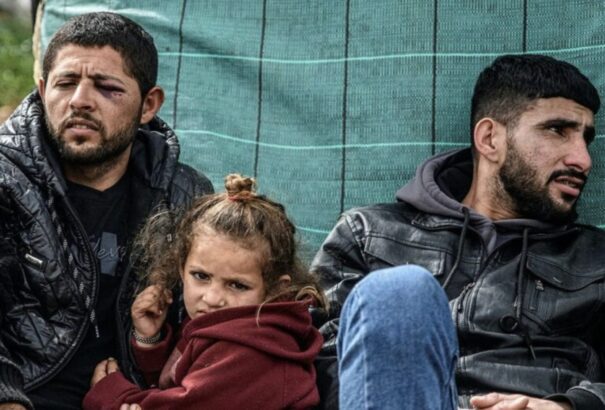
Another resident, whose face was covered in fresh bruises and now requires a walking stick after the attack, recounted: “They came to my home, and I tried to escape, but they caught me. They cut me with a knife above the wrist and bound my hands and feet with a zip tie.”
During the conversation, about 36 hours after the attack, he still had an improvised bandage wrapped around his hand, and the marks of the zip ties were still visible on his skin.
The man said one group of settlers began releasing the livestock from the pen while another group attacked his brother.
“They poured cold water on us and threw us to the ground while we were bound, then piled us on top of each other inside the structure, men, women and children,” he said. “The women were bound as well, and the children were beside us. They had knives and clubs.”
Another resident said settlers beat him on the head and legs, then slammed him against an iron pole before dragging him to a tent where he was bound.
The eldest family member, 74, described how four settlers entered his tent.
“Three of them beat me hard on the head, hands and stomach. The other smashed the security cameras, the router and the lights,” he said. “I started to lose consciousness. They poured water on me, and during this time one settler stole the watch from my hand.”
Afterward, he said, the rest of the family members were dragged to the tent, which became a kind of central holding point.
“I was sure they were going to rape me”
Meanwhile, in another tent were one resident and two human rights activists volunteering in the West Bank as part of a protective presence program – one American and one Portuguese.
One of them, an American citizen, testified to Haaretz:
“I woke up… to my friend screaming at us to get up before immediately being swarmed and trapped in the tent by about six masked Israeli settlers armed with heavy wooden sticks. They immediately beat the three of us to the ground, smashing our faces with their fists and clubs. They zip-tied our hands and feet and were yelling things like, ‘We are going to kill you!'”
At this point, she said, she witnessed the severe sexual assault of the man in the tent. He confirmed the details but asked not to share them in full.
“They pulled down the Palestinian man’s pants, poured water all over him and brutally beat him into the dirt,” she said. “All he could do was curl into a fetal position and scream when they beat him with their clubs.”
“It was one of the worst things I’ve ever seen,” she added.
At the same time, the activist said, others began searching through their belongings.
“Others ransacked our bags, stealing our wallets and passports. One asked me for my phone, and every time I said I didn’t know where it was – because the whole tent was a mess and I couldn’t move – he hit me in the face.”
At some point, she said, the settlers found their phones. The two activists were then dragged outside while still bound.
“They dragged my friend out by her ankles because she couldn’t stand with the zip ties on her legs,” she said. “They pulled me up and dragged me out of the tent by my hair. One of them kept grabbing my ear and pulling downward as if he was trying to tear it off.”
The settlers continued beating them with clubs as they dragged them toward the center of the compound. There, she said, they saw the scale of the attack.
“We saw the chaos. The family’s flock of sheep had been let loose, and about 30 illegal Israeli settlers were running around beating the rest of the Palestinian family. All you could hear was shouting and screaming.”
Afterward, she said, the settlers moved her and her companions to another tent while repeatedly striking her on the buttocks with a club, leaving a large bruise.
“They blindfolded my friend and shoved all three of us to the ground in the tent with the other Palestinian men. They kept hitting and kicking all of us, but the Palestinians were receiving the most brutal blows.”
The tent where the activists were taken belonged to the elderly family member, where most of his relatives had been gathered.
“I lay there shaking, with my hands over my face to protect my face,” she said. Next to her was an elderly family member. “He was curled up in the fetal position, zip-tied, with a bleeding gash on his swollen cheek. He looked unconscious.”
All of the children, she said, were forced to watch.
At some point, she recalled, “the Israeli settlers threw cloth over my face and kept kicking and punching us, terrorizing [us].” She added that amid the violence she heard the children whispering prayers. “In a whisper you could hear the kids praying. It was one of the few things that pulled me through the horror.”
According to the activist, at one point the settlers noticed rings on her fingers and on her friend’s.
“They screamed at us to remove our rings, saying, ‘I will break your fingers if you don’t take them off faster,’ and they kept hitting my face while I struggled to remove mine with my hands zip-tied. Every so often they asked our names and where we were from.”
She said the settlers then poured water over them.
“At first I thought it was gasoline, and the thought of being burned alive in the tent with the Palestinian family flooded my mind.”
“Someone ripped my jacket open with a knife, aggressively cutting from my left armpit to my hip. One settler started messing with my belt, and I screamed because I thought they were going to rape me.”

“The children were forced to watch”
Residents repeatedly gave Haaretz identical testimony, saying they recognized one settler whose face was uncovered.
“He spoke in Arabic and threatened that we should leave,” they said. “Otherwise they would return, burn the houses, kill the children, and rape the women.”
They said these threats were made in front of the women and young girls.
One of the women in the family testified that while she was bound, “the settler threatened they would return tomorrow and take my daughters, and that they would live with them, with the settlers. Then he grabbed my eldest daughter, who is 14, and slapped her,” she said. “I could do nothing to protect her because I was bound and bent over. They enjoyed humiliating us and mocking our situation.”
She added that the settlers used obscene and degrading language but asked that the words not be repeated.
According to testimonies, the settlers left after about an hour, leaving the residents bound. When they were gone, the sheep pens were empty, food and milk had been spilled in the homes, and valuables had been stolen.
The mother said that immediately after they left, she ran to the tent where her four-month-old daughter had been left, covered in her cradle. She believes the settlers never noticed the baby.
“I lifted the blanket and she smiled at me,” she said. “I breathed a sigh of relief and said, ‘This is from Allah.’ All that time I was afraid she would start crying and I wouldn’t be able to reach her.”
At the same time, the less severely injured men began climbing the hill toward where the stolen livestock had been driven, hundreds of animals including goats and lambs, in an attempt to find them.
“When the army arrived, they detained us. That gave the settlers time to get away with the herd,” one of the men said. “About an hour and a half later an ambulance arrived. The army detained us so the healthy men couldn’t pursue the settlers.”
An activist who arrived after the settlers fled said soldiers provided initial medical aid to the injured until ambulances arrived. The Red Crescent evacuated six injured people, the two activists and four men, for treatment in Tubas. All were described as lightly injured. The eldest required stitches to his head.
Later, the activist accompanied the force commander up the hill to search for evidence. They found vandalized security cameras, a flashlight, and numerous vehicle tire tracks leading toward the settlement of Beka’ot.

Khirbet Humsa is a grazing community in the northern Jordan Valley that, like neighboring communities, experiences repeated attacks by settlers. The situation worsened in January after residents of the Ras al-Ein al-Auja community fled the southern Jordan Valley.
Until July 2021, Khirbet Humsa residents lived on nearby land that Israel had declared a military firing zone decades earlier. After several evictions, security forces destroyed the homes of the community, where 11 families lived, and residents rebuilt farther away, near Khirbet Humsa – the house where the attack took place on Friday is the only one that still lies within the firing zone
Overall, 45 percent of the land in the Jordan Valley has been declared a military firing zone, pushing Palestinians to the margins. As a result, their grazing areas have shrunk significantly, and many families have been forced to leave.
A report by left-wing NGOs Peace Now and Kerem Navot indicated that 41 percent of the land taken over by the farms in the West Bank is in military firing zones.
Over the weekend, the police and the Israel Defense Forces said that “upon the arrival of forces, searches for the suspects began, along with the collection of testimonies, evidence and findings.”
They added that forensic investigators from the Judea and Samaria District Police were called to the scene and began an investigation to identify those involved.
Authorities said the investigation is ongoing and that “the Israel Police and the Israel Defense Forces strongly condemn acts of violence and crime and will continue to work to maintain the security of residents and order in the area.”
Regarding residents’ claims that soldiers detained them to prevent them from pursuing the settlers, the IDF Spokesperson’s Unit did not respond.
Matan Golan is an Israeli journalist that has written for Frontiers, Libération, Europa Press, Haaretz, Science Magazine, HackerNoon, Cell Press, and Pearls and Irritations.
RELATED:
- Palestinian Boys Allege Sexual Assault, Torture by Israeli Jailers
- Shocking testimony: Torture in Israeli prisons, “sexual assaults even using dogs”
- Israeli interrogator sexually assaults Palestinian child detainee
- Israeli settlers join ‘safari’ tour of Palestinian prisoners
- Former Israeli PM: Settlers are Aiding and Abetting Jewish Rioters in the West Bank