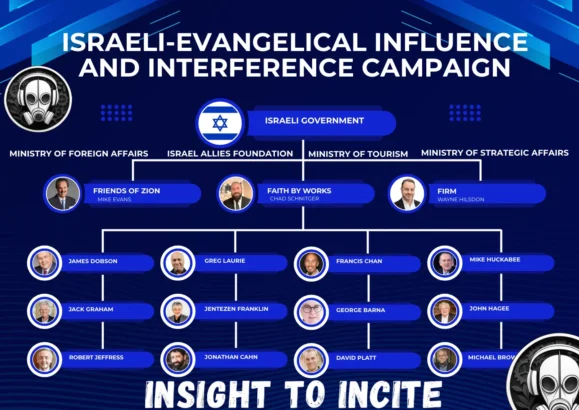
It goes deeper than you can imagine. Almost everything you see from evangelicals in support of Israel is paid for by the Israeli government and serves as foreign propaganda.
By JD Hall, Reposted from Insight to Incite, December 11, 2025
Ask a typical American evangelical why they support Israel, and you will hear the same script every time. It is about the Bible. It is about blessing Abraham. It is about standing with the people of God. They imagine their loyalty rose naturally from their reading of Scripture and from a vague sense of shared morality. They picture it as a grassroots conviction, not as the end product of a coordinated program. In their minds, there is no architect. There are only sincere believers, grateful Israelis, and a relationship that just happened.
What I’m about to reveal to you at Insight to Incite is that behind the sentimental language lies a set of institutions that treat evangelical support as a strategic asset. The Israeli state does not look at tens of millions of politically engaged Christians and see only prayer partners. It sees a voting bloc that can make or break policies in Washington. It sees donors, influencers, university boards, and megachurch networks that can normalize whatever Israel needs normalized in American life. They’ve built an influence infrastructure in America that’s astounding, once you see it.
It’s no surprise a foreign government wants to influence us. What’s so astounding is the way that planning reaches directly into American churches. The engine sits inside the government, not on the fringe. The messaging is not primarily run by romantic Christian tourists with a love for the Holy Land. It is guided by cabinet-level offices, national ministries, and government-aligned entities that track evangelical sentiment and adjust tactics when support starts to slip.
For years, the church has been told to think about Israel in prophetic terms. What it has not been told is that Israel thinks about the church in strategic terms. That asymmetry is exactly what this series is meant to expose. To do that honestly, you cannot start with famous pastors or emotional trips to Jerusalem. You have to start at the top. I’ll put the words, names, and titles in bold that you need to remember.
Before I get to the details, let me do something different and give you FIVE NUCLEAR FACTS that my research has confirmed:
FIVE NUCLEAR FACTS THAT WILL CHANGE HOW YOU SEE ISRAELI-EVANGELICAL RELATIONS
1. A foreign government is running an influence operation on American churches.
The Israeli Ministry of Foreign Affairs paid more than four million dollars to a U.S. contractor for the explicit purpose of mapping, profiling, segmenting, and digitally targeting American Christians and Christian universities. This was not a humanitarian initiative. It was not faith-based outreach. It was a foreign state building a psychological and political operation on American soil with the church as the chosen field.
2. The targets are the most powerful churches and universities in evangelical life.
The spreadsheet produced through this operation is a catalog of evangelical influence in America. It includes First Baptist Dallas, Gateway, Elevation, Saddleback, Passion City, Lakewood, Liberty University, Oral Roberts University, Regent University, and Cedarville. More than fifteen hundred institutions appear in the list. These are not fringe communities. They are the institutions that shape the political instincts of the Christian Right. They were treated not as brothers in the faith, but as strategic assets in a foreign campaign.
3. Israeli-aligned ministries are producing theology for American churches.
FIRM functions as the doctrinal arm of the network. It does not simply host events or encourage goodwill. It produces Sunday school material, small group guides, apologetics content, youth discipleship tracks, and pastoral training resources. It tells Christians not only that they should support Israel, but that their spiritual health depends on it. The theological content is presented as biblical instruction while quietly reflecting the priorities of a state that does not confess Christ.
4. The entire system scaled upward after Barna revealed evangelicals were drifting.
When data showed that younger evangelicals were abandoning automatic support for Israel, the response inside Israel was immediate. FOZ expanded its pastor programs. Faith By Works ramped up its digital influence operations. FIRM intensified its production of corrective theology. These were coordinated responses to a measurable decline in evangelical loyalty. A foreign state watched sentiment fall among American Christians and deployed an organized solution.
5. The ministries involved are not parallel movements. They are coordinated parts of the same machine.
Faith By Works targets the congregations. FOZ courts the pastors. FIRM shapes the doctrine. Each performs a separate function, yet all move in alignment with the priorities of the same government ministries. The pattern is unmistakable. A pastor is cultivated. His congregation is targeted. His theology is supplied. The church becomes the end point of a strategy conceived in secular government offices thousands of miles away.
Let me explain in a more detailed way…
THE GOVERNMENT MACHINE ABOVE THE MINISTRIES
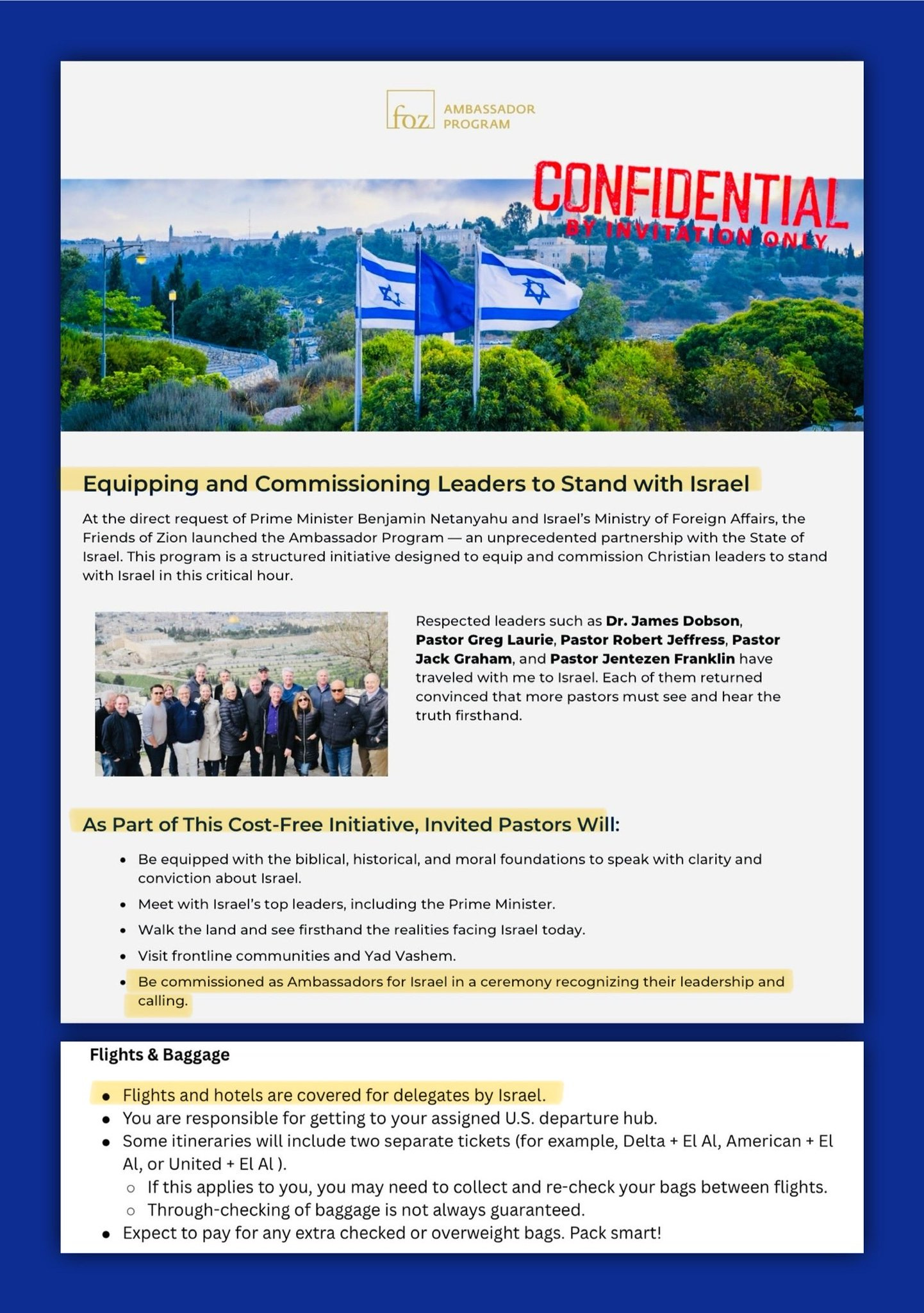
At the highest level of the structure sits the Prime Minister’s Office. The PMO is not just a ceremonial address on the letterhead. It is the coordinating center for national messaging, coalition management, and high-value foreign relationships. When the Friends of Zion Ambassador Program began publicly commissioning pastors as “Ambassadors for Israel,” it did not do so as a free-floating hobby. It did so with explicit blessing from the PMO. That is the first layer of the architecture. The pastor on the stage, receiving his plaque, is looking at a ministry logo. The ministry, in turn, is looking back at the Prime Minister’s Office.
Next comes the Ministry of Foreign Affairs. The MFA is the official channel through which Israel hires foreign agents and funds operations on United States soil. When Show Faith By Works filed its FARA paperwork, the disclosure did not list a random donor in Tel Aviv. It listed Israel’s Ministry of Foreign Affairs as the client. More than four million dollars flowed from the MFA to a U.S.-based firm for the express purpose of influencing American churches, Christian universities, and evangelical demographics. This is not conjecture. It is a matter of public record. The same government office that manages embassies and international diplomacy paid to map your denomination, segment your age brackets, and refine messages for your congregation.
Alongside the MFA sits the Ministry of Strategic Affairs. This body exists to monitor threats to Israel’s image and to design response campaigns. It tracks the rise of boycotts, the drift of younger voters, and the erosion of automatic sympathy in Western countries. When polling began to show that younger evangelicals were less reflexively pro-Israel than their parents, that was not treated as a random statistic. It was treated as a strategic warning. You can see the fingerprints of that ministry in the way the new campaigns focus heavily on Gen Z, Christian colleges, and “next generation leaders.” You do not pour money into geofencing Christian campuses and micro-targeting church members unless someone inside the system has flagged evangelicals as a vital but vulnerable asset.
Even what looks like simple tourism has a place in the structure. The Ministry of Tourism is not just trying to fill hotel rooms in Jerusalem. It understands that a pastor who has been flown to Israel, guided through curated sites, and introduced to the right officials will return as a volunteer lobbyist. He will preach the narrative he was given. He will lead tours of his own. He will defend policies he never voted on because he now feels personally invested. Tourism functions as emotional infrastructure. It binds church leaders to the state with memory, gratitude, and flattery.
Around these central ministries are state-adjacent groups that operate as bridges into foreign religious communities. Organizations like the Israel Allies Foundation connect sympathetic Christian politicians and pastors to Israeli priorities and talking points. They convene summits, prayer breakfasts, and strategy calls that blend spiritual language with policy objectives. They are not technically ministries of the government, but they function in harmony with it, often staffed by former officials or figures with direct access to the cabinet. Their job is to keep a pipeline of influence open and well supplied.
Even the Israeli Defense Force (IDF) has its own channel into this world. The military’s communications officers do not restrict themselves to briefing foreign journalists. They appear at Christian conferences, give live updates to pastors, and feature prominently in content aimed at evangelical audiences. That is not accidental. It invites Christians to see Israeli military action as their own cause, to interpret battlefield events through theology rather than through cold policy analysis. The IDF understands that if it can place its story directly in front of American believers, church loyalty will bear political fruit.
Taken together, this cluster of ministries, offices, and state-aligned organizations forms the top tier in a three-level system. The top tier sets the agenda, approves the budgets, and defines the problem. The problem, in simple terms, is that Israel needs American evangelicals locked in as a reliable support base even as demographic trends push in the opposite direction. The solution is not to argue with every twenty-year-old on social media. The solution is to capture the institutions that discipline them.
FROM CABINET TABLE TO CHURCH PEW
Once the state has identified evangelicals as a strategic audience and allocated money to reach them, it does not send bureaucrats into Sunday school classrooms. It builds a second tier of intermediaries that look, sound, and feel like organic Christian ministries. This is where the architecture becomes subtle. Friends of Zion, Faith by Works, and FIRM are positioned between the Israeli state and the American pew. They translate cabinet-level objectives into sermons, study material, and leadership training. They are marketed as ministries, but they function as delivery systems.
Friends of Zion focuses on cultivating pastors and influencers. It creates awards, titles, and “ambassador” language that flatter church leaders into seeing themselves as part of a sacred diplomatic project. Faith by Works functions as a data and targeting arm. Through its FARA work, it assembled massive lists of churches, categorized them by denomination, size, and demographic profile, and used digital tools to reach specific congregations and campuses. FIRM plugs into the theological bloodstream. It produces curricula, conferences, and “discipleship” resources designed to reshape how Christians think about Israel, covenant, and prophecy. Each of these entities interfaces directly with believers, yet each sits downstream from the same pool of state-driven priorities.
The structure is vertical. At the top sits the Israeli government, through ministries like the PMO, MFA, and Strategic Affairs. In the middle sit the big three intermediaries that operate inside Christian space. At the bottom sit the pastors, churches, and students who encounter this as “biblical teaching” or “standing with Israel.” Most believers never see the upper levels. They only see the brochure, the guest speaker, the Israel tour, or the small group study. To them, it feels like normal Christian activity. On a diagram, however, the lines run straight back to state institutions.
Recognizing that architecture does not require assuming that every person in the chain is malicious. Many of the pastors involved are simply flattered, ignorant, or theologically conditioned to say yes. Many of the staffers inside these organizations may believe they are serving God by serving Israel. The point is not to psychoanalyze every participant. The point is to show that the system as a whole is designed and funded by a foreign state with clear political goals. The effect on the American church is the same whether the individual actors are naive or cynical.
THE PUBLIC FACING ARM OF A HIDDEN SYSTEM
When most Christians encounter pro-Israel ministries, they assume they are looking at independent organizations staffed by believers who simply love the Holy Land. They do not imagine a pipeline that begins in government ministries and ends in their church bulletin. Yet once the structure above the surface is understood, the middle tier becomes easier to see. The Israeli state does not place cabinet officials in American pulpits. It creates or blesses organizations that carry its priorities into Christian spaces. These groups adopt church language, hire well-known figures, and present themselves as faith-based allies. Behind the polished branding, however, they function as intermediaries between government strategy and evangelical reception.
The first and most visible of these intermediaries is the Friends of Zion organization (which I wrote about recently about here). To summarize, FOZ presents itself as a ministry that celebrates Christian support for Israel. It offers awards, hosts ceremonies, and invites pastors to Jerusalem for what appear to be devotional trips. The messaging is warm and spiritual. And churches, they’ve been working on? These include the biggest in the United States:
-
First Baptist Dallas
-
Gateway Church
-
Passion City
-
Liberty, ORU, Cedarville
-
Elevation
-
Saddleback
The graphics are framed around Bible verses and historical reflections. What many pastors do not realize is that FOZ’s Ambassador Program was not invented by a tour guide or a philanthropist. It was initiated with public endorsement from Israel’s Prime Minister and promoted as a program that the state considered vital. When a pastor is brought to Israel under FOZ, he is not simply taken on a sightseeing tour. He is woven into a network designed to cultivate long-term advocacy. He receives curated briefings, strategically arranged meetings, and a narrative of modern Israel shaped by state-aligned partners. He returns home convinced that he has discovered the truth for himself. In reality, he has been shown a version of the truth designed for him.
The second of the intermediaries is Show Faith By Works, the organization that registered under FARA when the Ministry of Foreign Affairs contracted it to run persuasion operations inside the United States (which I’ve also written about here). Faith by Works did not preach sermons or hand out flyers. It built lists. It built maps. It built models of influence. The organization identified churches by denomination, membership size, and leadership profile. It geofenced congregations and Christian universities. It targeted the devices of churchgoing Americans with promotion, persuasion, and sentiment-based content. These efforts were not funded by private donors. They were funded by the Israeli state.
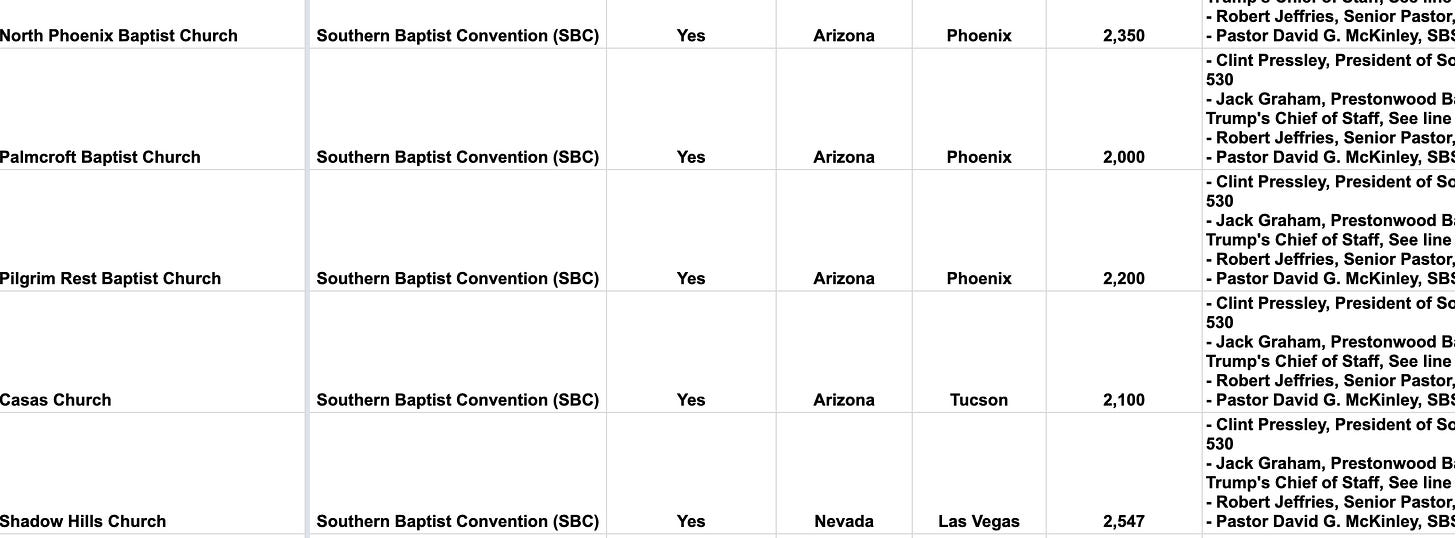
The spreadsheet that emerged from this operation (see here) reads like a digital census of evangelical Christianity. The churches listed are not small gatherings of obscure believers. They include prominent Southern Baptist congregations, charismatic megachurches, well-known denominational ministries, and influential networks that shape regional and national politics. Faith By Works was tasked with understanding and influencing them because the MFA viewed them as key leverage points inside the American electorate.
Although Faith By Works focused on digital persuasion and targeting, its map of American Christianity reveals a useful insight. The churches most heavily targeted are the same ones courted by FOZ in its pastoral outreach. The pastors brought to Israel by FOZ often lead the congregations identified by Faith By Works. The two streams converge naturally. The pastor is cultivated through FOZ. His congregation is reached digitally through Faith By Works. The connection is not accidental. It is what happens when two intermediary organizations answer to the same set of priorities above them.
That convergence sets the stage for the third and most consequential intermediary, and this one I have not written about before, but you need to know about it. FIRM, the Fellowship of Israel Related Ministries, does not focus primarily on trips or digital marketing. It focuses on theology. It produces resources, conferences, small group materials, study guides, youth curricula, and apologetic frameworks. It does not limit itself to telling Christians to love Israel. It tells them why they must. It builds a doctrinal system in which support for the modern state becomes a form of faithfulness. Old Testament promises are reinterpreted to fit geopolitical policy. Criticism of Israeli actions is framed as a spiritual deficiency. Concerns about Palestinian Christians are recast as a misunderstanding of divine election. All of this is presented as biblical teaching prepared by friendly ministries. Few pastors realize that the group shaping these materials exists downstream from the same network that funded Faith By Works and elevated FOZ.
The public face of FIRM includes recognizable names. Francis Chan appears at their events. Jentezen Franklin lends his voice to their messaging. George Barna offers the data that frames the crisis. Well-known pastors, authors, and worship leaders attend their conferences or record endorsements. The list is not a marginal group of fringe figures. It is a significant cross-section of evangelical influencers who have entered the orbit of an organization that exists to embed Israeli political priorities inside American theological formation. Their willingness to participate signals to ordinary Christians that FIRM is trustworthy. The average layperson sees familiar faces and assumes the teaching must be harmless.
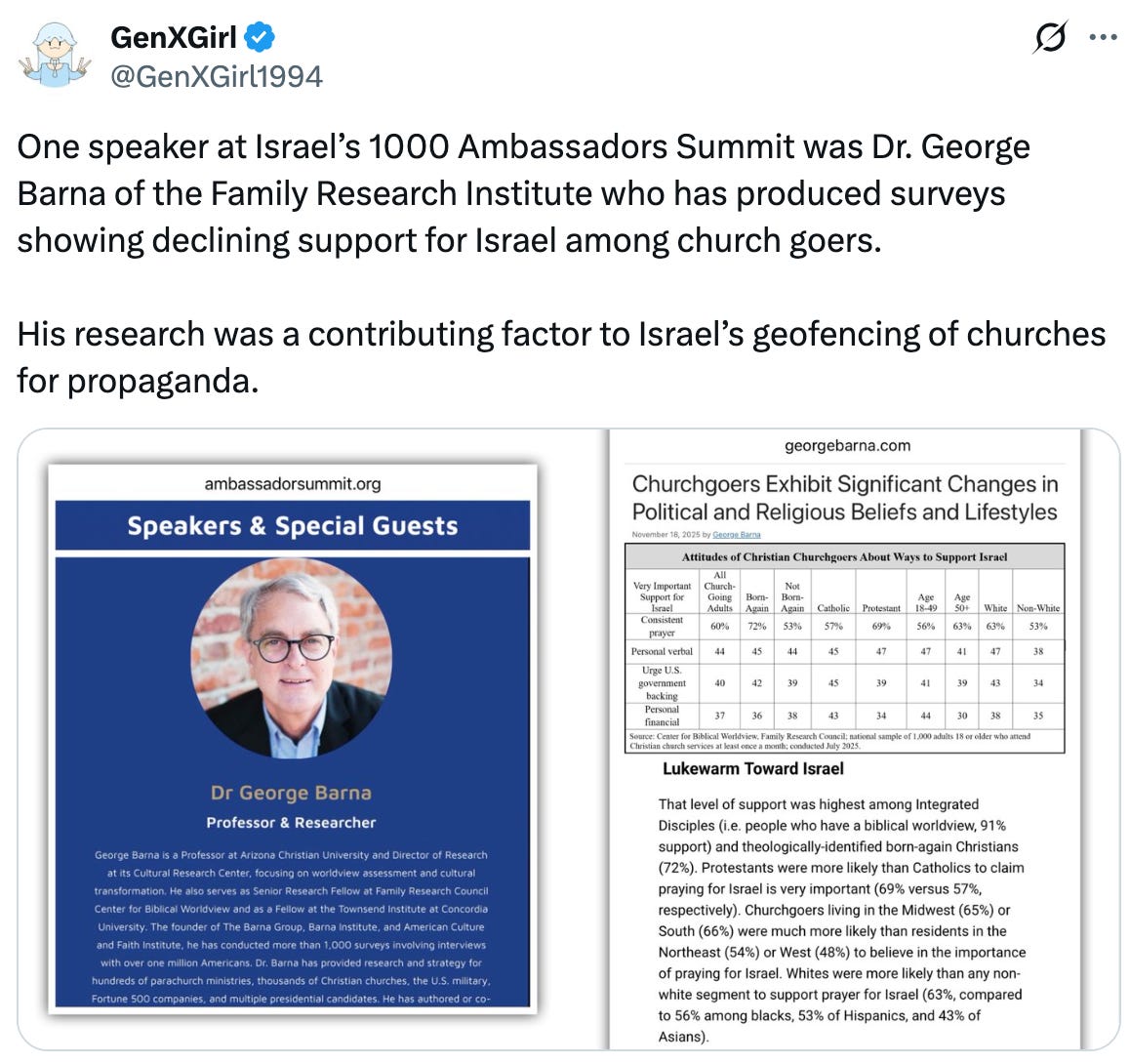
The presence of these figures, however, raises the stakes. With Faith By Works, churches were being studied and targeted, often without their knowledge. With FIRM, pastors and leaders are not merely targets. They are participants. They record videos. They host seminars. They write endorsements. They integrate FIRM material into their discipleship structures. They stand on platforms that present support for Israel as a core component of Christian orthodoxy. Whether they understand the geopolitical implications or not, they lend their credibility to an operation that marries faith to foreign policy with remarkable efficiency.
The most troubling element arises when FIRM’s materials are examined closely. The organization does not distribute travel brochures or tourist devotionals. It distributes theology. It produces frameworks designed for church consumption. It encourages pastors to confront what it calls “Christian anti Zionism” and to correct it with doctrinal teaching that matches the interests of the modern Israeli state. It recommends texts like Arnold Fruchtenbaum’s Israelology, which reframes Christianity in a way that elevates national Israel to a central role in the believer’s worldview. It publishes guides that instruct churches on how to counter rising skepticism among younger Christians. It positions itself as a theological corrective to trends that concern Israeli strategists. Firm’s stated goals include:
-
Reinterpret Scripture
-
Silence skeptics
-
Discipline dissent
-
Reframe political disagreement as spiritual rebellion
The significance becomes clear. Faith by Works targets the people. FOZ targets the leaders. FIRM targets the doctrine. Through these three points of contact, the larger system reaches every layer of the American church. The pastor is honored abroad. The congregation is influenced at home. The theology is shaped in between. None of this looks political from the inside. It looks like a ministry. It looks like discipleship. It looks like biblical instruction. The believer who encounters it sees Christian imagery and hears Christian vocabulary. The source, however, traces back to state-aligned priorities and government-funded operations.
Critics who dismiss this connection often point out that these organizations are not government agencies. That objection misses the point. Influence does not require direct control. It requires funding, shared objectives, and structural partnerships. All three intermediaries operate downstream of the same governmental concerns. They attract the same pool of pastors. They reinforce the same narrative. They respond to the same data about evangelical drift. They address the same anxieties inside Israeli ministries about long-term American support. Their efforts interlock because they spring from the same soil.
What emerges is not a conspiracy, but a strategy. The church believes it is choosing its relationship with Israel. In reality, Israel has chosen the relationship it wants with the church.
JD Hall is a reporter on Faith & Spirituality.
RELATED:
- In This Palestinian Christian Village, the Hypocrisy of Christian Zionism Is Unmistakable
- The Scofield Bible: The Book That Made Zionists of America’s Evangelical Christians
- Infiltration: A Cardinal Function of the Zionist Movement
- I Helped Israel Propagandize American Christians
- Faith, politics and armed resistance: A Palestinian-Christian perspective