International organizations say that the Israeli government insists on the organizations buying baby formula through Israel and paying customs duty, leaving much aid stuck outside Gaza.
Israel denies the allegations, but according to UNRWA, the percentage of Gazan children suffering from malnourishment has doubled since March.
By Nir Hasson, Reposted from Haaretz, July 11, 2025
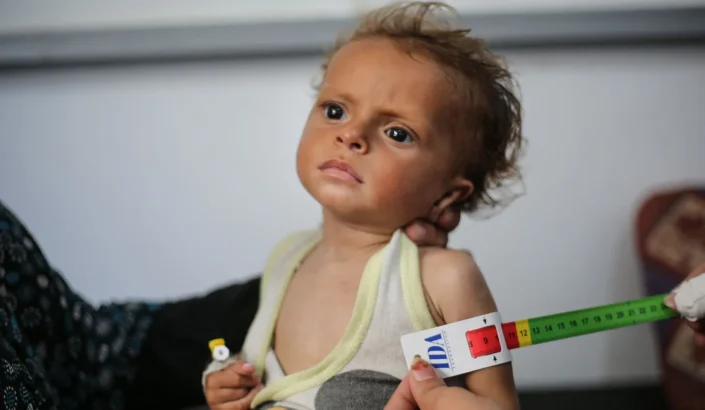
A seven-month-old infant girl named Salam was brought to a United Nations Relief and Works Agency for Palestine clinic in the Rimal neighborhood of Gaza City this week. At first sight, it was clear she was suffering from severe malnutrition. Her bones and skull were poking out from her skin, and the diameter of her arm was just 8.3 centimeters. Malnourishment for a girl her age is defined as having an arm diameter of under 12.5 centimeters, and severe malnutrition is less than 11.5 centimeters.
The doctors gave her urgent treatment for malnourishment, but on Wednesday (July 09) she died. Salam was one of at least 57 children who died from malnutrition in Gaza since March, according to figures from the United Nations.
UNRWA employees regularly measure the arm diameter of tens of thousands of children in the Gaza Strip to examine their state of their diet. Data gathered by these UN workers show the percentage of children suffering from malnourishment during the cease-fire period rose from 5.2 percent to 10.7 percent in recent days. “I fear that we are facing an exponential increase in malnutrition for children,” said Dr. Akihiro Seita, the director of health for UNRWA.
Even though almost two months have passed since Israel allowed the renewal of aid and food to Gaza, the problem of hunger, especially for small children, continues to get worse. A constant shortage exists of baby formula and nutritional supplements for pregnant women, nursing mothers, and children.
The problems in providing an adequate supply of baby formula and nutritional supplements begin even before they arrive in Israel. According to a number of international organizations, since the humanitarian aid was restarted, Israel decided to impose customs duties on food and humanitarian aid purchased outside of Israel. Officials in international aid organizations say Israeli authorities are pushing them to buy the necessary products in Israel, even though the price is significantly higher than purchasing them in the West Bank, Jordan, or in other places around the world.
This policy is in contrast to previous Israeli policy and is different than what is accepted around the world. For example, the countries bordering Ukraine do not charge customs duty on goods they provide for humanitarian needs related to the war with Russia. Most of the countries around the world (136) have also signed the international agreement that calls on nations not to collect customs duties on humanitarian goods, but Israel is not a signatory to this treaty.
Officials in some humanitarian organizations said some of these groups are unable to pay the customs duties because of a lack of funds, or because they are not registered in Israel, and as a result, a large amount of humanitarian aid cannot even enter Israel and is stuck in Jordan, the West Bank, or at the Ashdod Port.

Another problem is the rate of releasing the goods entering the Gaza Strip at the Kerem Shalom crossing. This is very slow and depends on permits from the Coordinator of Government Activities in the Territories unit, as well as the combat forces in the area. Many times, the requests from the UN and other international organizations to transfer goods from the Kerem Shalom crossing into Gaza for distribution are denied.
Another problem is that the collapse of civil security in Gaza, coupled with the pressure of hunger, has resulted in almost every aid truck that enters the territory being looted by a hungry mob. Consequently, few of them reach the distribution centers.
Aid organizations have reconciled themselves to the loss of some goods on the theory that this would ultimately ease the hunger. But they are reluctant to send in trucks carrying expensive goods like baby formula and nutritional supplements, because these products need to reach the people who need them and can’t be allowed to fall into the mob’s hands like flour or other staple foods can.
According to the World Health Organization, 90 percent of pregnant and nursing mothers in Gaza suffer from severe malnutrition that undermines their ability to produce breast milk. It also causes premature births and spontaneous abortions.

Doctors Without Borders says that one out of every five pregnant or nursing women in Gaza is in danger of dying from malnutrition. And UNICEF reported last month that on average, 112 children a day have been hospitalized in Gaza due to severe malnutrition since the start of this year.
A forum comprised of 60 Israeli experts on nutrition and public health policy issued a report this week that warned about the worsening condition of pregnant women and children in Gaza. The report noted that even if the women manage to get baby formula for their children, they have no access to clean water with which to prepare it, so the children are exposed to infections.
The experts recommended swiftly sending nutritional supplements into Gaza for women and children, including vitamins, folic acid, iron, and protein. It urged that the amount of clean water available to Gazans be increased.

“Data reported from the field indicates a systemic collapse in the living conditions of pregnant and nursing women in the Gaza Strip,” the report said. “The current crisis poses a real threat not only to the health of these women, but also to the health of the next generation. Providing an immediate humanitarian response – nutritional, medical and sanitary – is essential, and this is required by the basic rules of medical ethics, public health and international humanitarian law.”
Meanwhile, the Jordanian air force plans to resume airdropping aid to Gaza, as it did at the start of the war. Donna Baranski-Walker, the founder and executive director of the American aid organization Rebuilding Alliance, which has been active in Gaza for more than 20 years, said the Jordanian air force has asked her organization to help it find a way to distribute aid safely from the air in an effort to ease the hunger crisis.
The goal is to drop hundreds of thousands of nutritional energy bars, she said. Each bar will be dropped individually. The operation’s planners said they were inspired by maple seeds, each of which spirals gently to the ground because of a winglike structure on one side.
“The crisis situation that we all feared is now happening in Gaza,” Baranski-Walker said. “The Jordanian air force asked Israel to allow the air drop operation for three weeks. I truly hope this will start in a few days. My team in Gaza is providing what food we are able to find to the families of children suffering from severe malnutrition. People there are truly eating just one meal a day. There isn’t enough food.”

The Coordinator of Government Activities in the Territories, the army unit that coordinates humanitarian aid, said that “contrary to what is claimed, Israel doesn’t prevent or restrict the entry of baby food, including milk substitutes and baby formula, into the Gaza Strip. As evidence, in recent weeks, more than 1,400 tons of baby food have been brought in through the crossings, as per the requests of international aid organizations, following stringent security checks.
“We stress that Israel does not collect customs on humanitarian aid brought into Gaza.
“Regarding the security checks,” it continued, “the increased stringency of checks at the crossings is due to credible information that Hamas is exploiting the aid for smuggling purposes. The goal is to prevent continued smuggling of goods that Hamas uses to finance terrorist activity.”
Nir Hasson is an Israeli journalist for Haaretz.
RELATED:
- Trump sanctions on UN Special Rapporteur Francesca Albanese are illegal and represent further U.S. complicity in genocide
- ‘Like a video game’: Israel enforcing Gaza evacuations with grenade-firing drones
- Palestinian testimonies of deliberate Israeli killings at U.S.-run ‘aid’ sites were ignored until the perpetrators admitted to it
- Israel Besieges 2.3 Million Palestinians in Less Than 15% of Gaza, Amid Escalating Starvation and Mass Killings
- The Israeli Plot to Extinguish the Journalists Documenting Genocide