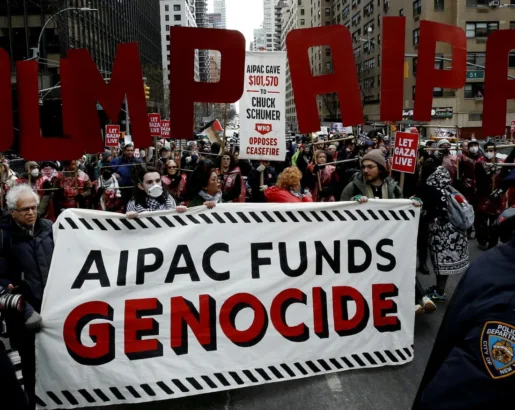
American Priorities, a progressive super PAC formed earlier this year, is the most significant attempt yet to rival AIPAC’s spending power. Three New York races offer the most hyper-focused tests of how effective it can be.
By Ben Samuels, reposted from Haaretz, June 16, 2026
WASHINGTON – Next week’s congressional primaries in three districts across New York City present a rare opportunity for the Democratic Party’s progressive flank: to elevate the national profile of up-and-coming politicians whose opposition to U.S. support for Israel is foundational to their worldview.
The races in question will also serve as a consequential case study on whether pro-Palestinian super PACs can put lessons gleaned from American Israel Public Affairs Committee’s deep-pocketed electoral spending efforts into practice.
Those focused on the future of the Democratic Party as it relates to Israel will have their eyes squarely fixed on three races in New York’s 7th, 10th and 13th congressional districts, where central to the campaigns of progressive upstarts have been the outspoken condemnations of Israel’s alleged genocide against Palestinians in Gaza and the role of pro-Israel organizational spending in U.S. politics.

American Priorities, a super PAC established in February, is the most significant attempt ever to compete with AIPAC’s United Democracy Project, pledging to spend at least $10 million over the course of the 2026 cycle.
It has already pledged at least $2 million to support the candidacies of Claire Valdez, Brad Lander and Darializa Avila Chevalier, three progressive congressional candidates all endorsed by Mamdani in their respective districts.
New York is not pro-Palestinian spending’s first foray into the 2026 cycle, with similar efforts helping catapult progressive candidates to success, like Chris Rabb in Pennsylvania and Adam Hamawy in New Jersey. The New York races, however, are the most hyper-focused tests for how replicable AIPAC’s playbook may be for groups that seek to counter its influence.
In addition to American Priorities, like-minded groups, including the IMEU Policy Project and its PAL PAC, plus Justice Democrats, have since bolstered outside spending and used their endorsement power to co-sign their favored candidates.
For one, the districts in question lean heavily blue and contain sizable Jewish populations, and also form part of Brooklyn’s Bay Ridge, often called ‘Little Palestine.’ Progressive victories would indicate either the popularity of positions inherently hostile to the U.S.-Israel status quo or the viability of progressive candidates in spite of such views. The vast majority of polling and returns in key races elsewhere, however, indicate it may lean toward the former.
Further, local New York politics capture significant national attention, more than any other state or city. Part of this is due to the sheer population size and diversity represented, though it can be also attributed to the outsized personalities involved. Regardless of why, New York is often seen as a vibe-setter and prediction indicator for national party trend lines – as was the case with the ascendancy of Representative Alexandria Ocasio-Cortez in 2018 or Mayor Zohran Mamdani last year.
This is not the first time AIPAC’s opponents have attempted to fight back since UDP’s 2022 founding. Other liberal groups have funneled their spending into independent expenditures, as well as broad-based coalitions in an attempt to combine their organizing power when outspent by AIPAC.
The 2026 cycle, however, has proven to be different. For one, Israel has become increasingly toxic for Democrats, thanks to Prime Minister Benjamin Netanyahu and his far-right government.

AIPAC has become a convenient scapegoat for many Democratic lawmakers who condemn the pro-Israel group’s unpalatable electoral strategy, its polarizing effect on issues and its brash communications. It’s also become the poster-child for the ills of the current campaign-finance reality, which grants significantly more power to corporations, super PACs and other third-party, big-dollar spenders.
AIPAC and like-minded groups, such as the Democratic Majority for Israel, have subsequently found themselves on less of a glidepath in recent races. This was clear in New Jersey, where its efforts against Tom Malinowski dramatically backfired, followed by Illinois, where significant spending via third-party groups led to mixed results.
Playing by AIPAC’s rules
Pro-Palestinian groups like American Priorities are showing increased willingness to play by AIPAC’s rules – the same ones they previously deemed so objectionable in recent years.

For example, progressives have long critiqued the name “United Democracy Project” as being intentionally opaque for voters who may not otherwise be motivated by Israel. Yet “American Priorities” certainly does not make one think of Palestinian self-determination. The latter has also accepted significant donations from donors who have also given to Republican candidates – a common critique leveled at AIPAC.
Many of these donors (such as Texas businessmen Hussein Mahrouq and Moiz Ali) have primarily given to controversial, Israel-critical GOP lawmakers, such as outgoing Representative Thomas Massie and former congresswoman Marjorie Taylor Greene. Other American Priorities donors that are more modest in scope have donated to GOP candidates who are otherwise unabashed supporters of Israel.
Meanwhile, Valdez (who has otherwise been outspoken against super PAC spending) has shifted gears by placing a so-called red box on her campaign website, which provides instructions for outside spenders while technically abiding by coordination guidelines.
AIPAC’s deployment of UDP has been significantly more selective this cycle. Since UDP’s inception, critics and supporters alike have insisted that AIPAC will only involve itself in races it knows its spending can produce results – whether that means swinging a race in its favor or punctuating an already guaranteed victory depends on one’s perspective.
By this logic, it makes sense that UDP has spent record numbers to unseat vulnerable incumbents like Representatives Jamaal Bowman and Cori Bush while avoiding taking on popular incumbents like AOC or Rashida Tlaib.

Its hesitancy in 2026, despite a limitless war chest and enthusiastic megadonors wanting to speak with their dollars, could reflect either an alarming reading of its own immediate political horizon or saving its money for campaigns with more national significance, such as Michigan’s agenda-defining Senate primary in August, or Election Day races, like Maine’s Senate seat.
The AIPAC model has already been replicated by progressives in Michigan, who have been consolidating support from these outside groups through third-party super PACs with vague names – like the “Fighting For Michigan PAC.”
Progressives are now focused on exposing every potential emergent third-party super PAC as being an AIPAC shell operation – accusations that AIPAC explicitly denies. While some of these PACs may share some back-end linkage, detailed after the fact via federal disclosures, accusations of deep coordinated ties are more speculative than fact-based.
For now, both pro-Palestinian advocates and their pro-Israel opponents will have their eyes fixed on Valdez, Avila Chevalier and Lander and whether the progressive flank will expand with a new batch of generation-defining candidates in Congress.
Ben Samuels is the U.S. correspondent for Haaretz, based out of Washington, D.C.
RELATED:
- Pro-Israel Donors Power Last-Minute Surge of Espaillat Spending
- Massie Recognizes USS Liberty Attack. Here’s Why That Matters
- The Pro-Israel Lobby’s Quiet Cash Shuffle
- Why Are Crypto Billionaires and AIPAC Spending $8+ Million to Elect Adrian Boafo?
- Why the Mainstream Media Should Stop Using the ADL as Their Go-To Antisemitism Source