There has been no relief for Gaza as wars raged in Iran and Lebanon. Below are three articles on Gaza’s crises – healthcare, water, and bread.
1. Palestine’s Health System on the Brink
The Palestinian health system—particularly in the Gaza Strip—has reached a level of collapse unprecedented in modern history.
Reposted from IMEMC, April 7, 2026
Gaza’s Medical Infrastructure Collapses as West Bank Services Struggle Under Pressure
The Palestinian Central Bureau of Statistics (PCBS) marked World Health Day 2026 with a stark assessment of the health situation across Palestine. Under this year’s theme, “Together for Health: Standing with Science,” the bureau warned that the Palestinian health system—particularly in the Gaza Strip—has reached a level of collapse unprecedented in modern history.
A Health System Barely Standing
Updated figures through March 2026 show that nearly every hospital in Gaza has been damaged. A total of 94% of medical facilities have sustained destruction or severe impairment, leaving all 36 hospitals operating far below capacity. Only 18 hospitals remain partially functional, and even these face crippling shortages of staff, fuel, equipment, and essential supplies.
Primary healthcare has nearly vanished. Just 1.5% of clinics can operate at full capacity, while more than half of all essential medicines have completely run out.
Doctors report having to ration the last doses of antibiotics and painkillers, while thousands of patients with chronic illnesses go untreated.
PCBS noted that the gap between global health standards and the reality in Gaza has widened into a humanitarian emergency—one driven by siege, destruction, and the mass displacement of nearly the entire population.
Hunger and Malnutrition Deepen the Crisis
The Integrated Food Security Phase Classification (IPC) report for late 2025 and early 2026 highlights the scale of the crisis:
- 1.6 million people—77% of those assessed—faced severe food insecurity.
- 96% of agricultural land has been destroyed.
- Unemployment has reached 80%.
- Nearly half the population lacks access to basic health services.
Even after a limited ceasefire, the situation remains extremely fragile. Aid agencies warn that any disruption in humanitarian access—or a renewed escalation—could push Gaza back toward famine within weeks.
By mid‑October 2026, IPC estimates showed:
- 101,000 children suffering from acute malnutrition.
- 31,000 children are at risk of severe, life‑threatening malnutrition.
- 37,000 pregnant and breastfeeding women are facing acute nutritional shortages.
Medical teams report a sharp rise in premature births, with one in five newborns now requiring intensive care. Miscarriages and complications linked to hunger have also increased dramatically.
Read more from this article here. Next, an article on finding clean water from Al Jazeera:
2. ‘Dying of thirst’: Inside Gaza’s al-Mawasi water crisis
UN officials have noted that “people are receiving far less water than they need”, leading to the spread of waterborne diseases amid rising temperatures and deteriorating sanitation conditions. The water crisis “was not only predictable; it was predicted”, the experts said.
By Maram Humaid, reposted from Al Jazeera, April 7, 2026
Khan Younis, Gaza Strip – Nawaf al-Akhras begins his day by carrying bottles and jerrycans with his eldest son to a water filling station about one and a half kilometres (0.9 miles) from his tent in southern Gaza’s al-Mawasi camp.
Upon arrival, they are met with thousands of people crowding the station, waiting under the scorching sun for their turn.
Nawaf, a father of seven who was displaced from Rafah to al-Mawasi two years ago, describes the daily round trip, which can stretch for five hours or more, as a torment for his family, and for other Palestinians displaced as a result of Israel’s genocidal war on Gaza.
“My entire day with my son is spent waiting in line to fill water, with people coming from very far distances,” Nawaf tells Al Jazeera. “It’s daily suffering, just so that we can drink water.”
Water shortages have recently worsened in several areas across Gaza, including al-Mawasi, after Eta – a company that provided clean and potable water, serving displaced people across the Strip from Rafah to Beit Hanoun – stopped operating due to what it said was a lack of funding.
“Water trucks used to come almost daily near the tents and eased the burden of collecting and transporting water,” Nawaf says.
“But for several weeks now, these trucks have stopped, and our struggle to obtain drinking water has doubled.”
Nawaf explains that he can barely fill two small jerrycans due to the overwhelming crowd and intense competition among displaced people to access the filling stations.
“We died from hunger, and now they are testing death by thirst on us… this is what’s left,” Nawaf says.
Read more from this article here. Up next, an article on Israel’s imposed starvation from the New Arab.
3. With aid falling short, Gaza families are left struggling each day to put bread on the table
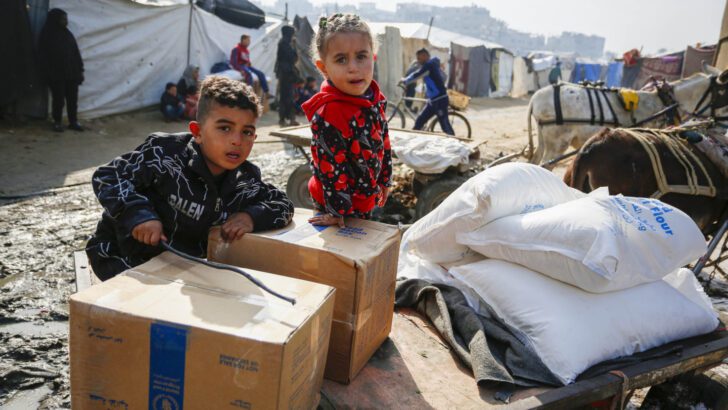
With roughly 95% of Gaza’s families dependent on humanitarian aid, the strip’s most basic food has become its most visible crisis. The queues outside bakeries form before dawn. By the time most residents arrive, the bread is often already gone. What remains is a choice between paying black market prices or going without, a choice that repeats itself every day, with no resolution in sight.
By Ansam Al Qitaa, reposted from The New Arab, April 8, 2026
Every morning, Mai Murshid wakes up to the same thought: “How am I going to get bread for my children?”
The 37-year-old mother of four tells The New Arab, “It’s the first thing on my mind. Every day I wake up to the bread crisis.”
For most of Gaza’s history, bread was an unexceptional staple, but it has now become a scarce, priceless commodity.
A loaf cost three shekels ($0.80) under the World Food Program’s subsidized distribution scheme. Today, that same loaf sells in the market for between seven and fifteen shekels ($1.85–$4.00), a markup of up to 400%, while a bag of flour has jumped from 25 to 70 shekels ($6.70 to $18.70).
For families whose income has collapsed, and aid dependency runs close to universal, the arithmetic is brutal: bread has shifted from a right to a commodity, and for many, an unaffordable one.
With roughly 95% of Gaza’s families dependent on humanitarian aid, the strip’s most basic food has become its most visible crisis.
The queues outside bakeries form before dawn. By the time most residents arrive, the bread is often already gone.
What remains is a choice between paying black market prices or going without, a choice that repeats itself every day, with no resolution in sight.
Mai used to consider baking at home a fallback. She no longer does. “If I bake at home, it’s physically exhausting, and sometimes it costs more than buying ready bread, especially with the shortage of gas and firewood,” she shares.
Even so, she finds herself doing it because the alternative is joining the queues.
She goes herself when she can, reasoning that women face shorter waits than men. “But even then, the crowds are huge, and the waiting is long and tiring,” she adds.
Her 14-year-old son goes too. “He usually comes back empty-handed, either the queues are too long, or the bread runs out.”
When she does reach the front, she often cannot complete the purchase. “Most of the time I don’t have small change, so I go home without bread, or I’m forced to buy at a higher price,” Mai tells The New Arab.
The shortage of small-denomination currency has become a crisis within the crisis, a practical barrier that blocks transactions even when bread is nominally available.
Ibtisam Mahdi, a mother of two, puts it simply: “Bread is no longer ordinary bread. It has become a dream that is hard to reach.”
A loaf that once cost three shekels ($0.80) now sells for ten ($2.65). “And you usually need exact change and cash,” Ibtisam adds.
For Ibtisam, the daily difficulty has curdled into something larger. “Are we facing the beginning of a famine?” she asks. “Or have we already entered one without announcing it?” She does not offer the question rhetorically.
Read more from this article here
Maram Humaid is Al Jazeera English’s digital correspondent in Gaza. Ansam Al Qitaa is a freelance journalist based in Gaza. For years, she has covered the successive wars in Gaza and their humanitarian and social impacts for international and local outlets
RELATED:
- Rep. Randy Fine Tells Palestinians To ‘Starve Away’ as Babies Die of Malnutrition Under Israeli Blockade in Gaza
- The Madeleine ship: A message of solidarity with Gaza and resolve to break the blockade
- After 15 years of blockade, 4 of 5 children in Gaza struggle with depression, grief & fear
- Under Israeli blockade, Gaza’s families suffer malnutrition and misery
- Gaza incendiary balloons are ‘distress signals’ against Israel’s cruel blockade