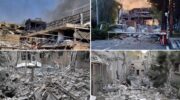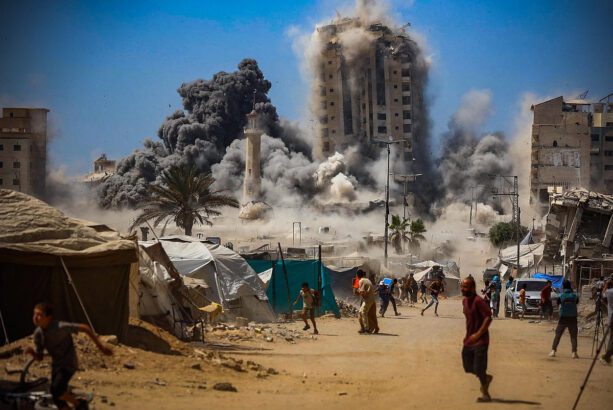
Centuries-old mosques, churches, and ancient artifacts all face obliteration as the Israeli military systematically flattens what remains of the city.
Palestinians in Gaza City are facing an impossible choice, as the Israeli army works to annihilate what remains of northern Gaza’s last bastion from the air and the ground. Hundreds of thousands of residents have already fled in recent days amid the intensification of Israel’s assault, forced to pay up to $5,000 to relocate in the knowledge that they will likely never see their homes again. Others are staying put, unable or unwilling to flee to areas that they know will provide no safety or dignity, preferring to die at home than in an overcrowded tent encampment in the south.
As residents scramble to escape death, there is little capacity to mourn the destruction of their city. But the Israeli army’s systematic erasure of Gaza City — flattening one neighborhood after another, as it did already in Rafah, Jabalia, Beit Hanoun, Beit Lahiya, and much of Khan Younis — is wiping out thousands of years of Palestinian and Arab heritage, representing a crime against history itself.
Many of the Gaza Strip’s multi-civilizational treasures have already been obliterated over the course of Israel’s two-year genocide. But Gaza City’s ancient origins, along with its centrality in the formation of Palestinian national identity and resistance against the Israeli occupation, make its ruination more than simply a human tragedy.
The city’s history dates back many thousands of years, and it is referenced in the Book of Genesis as having been inhabited by Canaanites. Its strategic location between Africa and Asia has made it a vital port and a target of conquest for the Assyrians, Babylonians, Greeks, Persians, Hasmoneans, Romans, and Ottomans.
As the Palestinian historian and former mayor of East Jerusalem, Aref Al-Aref, wrote in his 1943 book “History of Gaza,” Gaza City was “not built in a certain century, nor is it a result of a certain period, but rather of all the generations that have passed, from the day when the first pages of history were written to the present day.”

Before the Nakba of 1948, the city was the central hub of the Gaza Governorate, which included all of present-day Gaza in addition to Al-Majdal, Ashqelon, and Isdud — towns that were depopulated of their Palestinian residents and upon whose ruins the Israeli cities of Ashkelon and Ashdod now stand. “Beit Hanoun and Beit Lahiya in the north, Khan Younis and Deir Al-Balah in the south, and all the villages and towns in the area all developed and expanded along with the expansion of historic Gaza City, which remained the center of the region,” Mahmoud Yazbak, a historian at the University of Haifa, told +972.
Since the 1950s, several Palestinian resistance movements have been launched from Gaza City, including the First Intifada in 1987. The city subsequently became home to the earliest institutions of the Palestinian Authority after the signing of the Oslo Accords, as well as to various cultural and academic institutions — many of which have already been decimated as a result of Israel’s onslaught over the past two years.
Now, all of the history that remains, both ancient and modern, is on the brink of being reduced to rubble.
Mosques, Churches, and Ancient Artifacts
Gaza City is often referred to as “Gaza of Hashim” after the Prophet Muhammad’s great-grandfather, who is buried there. His tomb, housed within the already badly damaged Sayyed Hashim Mosque, is one of many sites imbuing Gaza with Islamic significance that are now vulnerable to destruction.
The Great Omari Mosque, the largest and oldest mosque in the city, was also nearly destroyed by Israeli airstrikes earlier in the war, though part of it is still standing. Built in the seventh century on the remains of a Byzantine church and a pagan temple, it is the third largest mosque in all of Palestine.
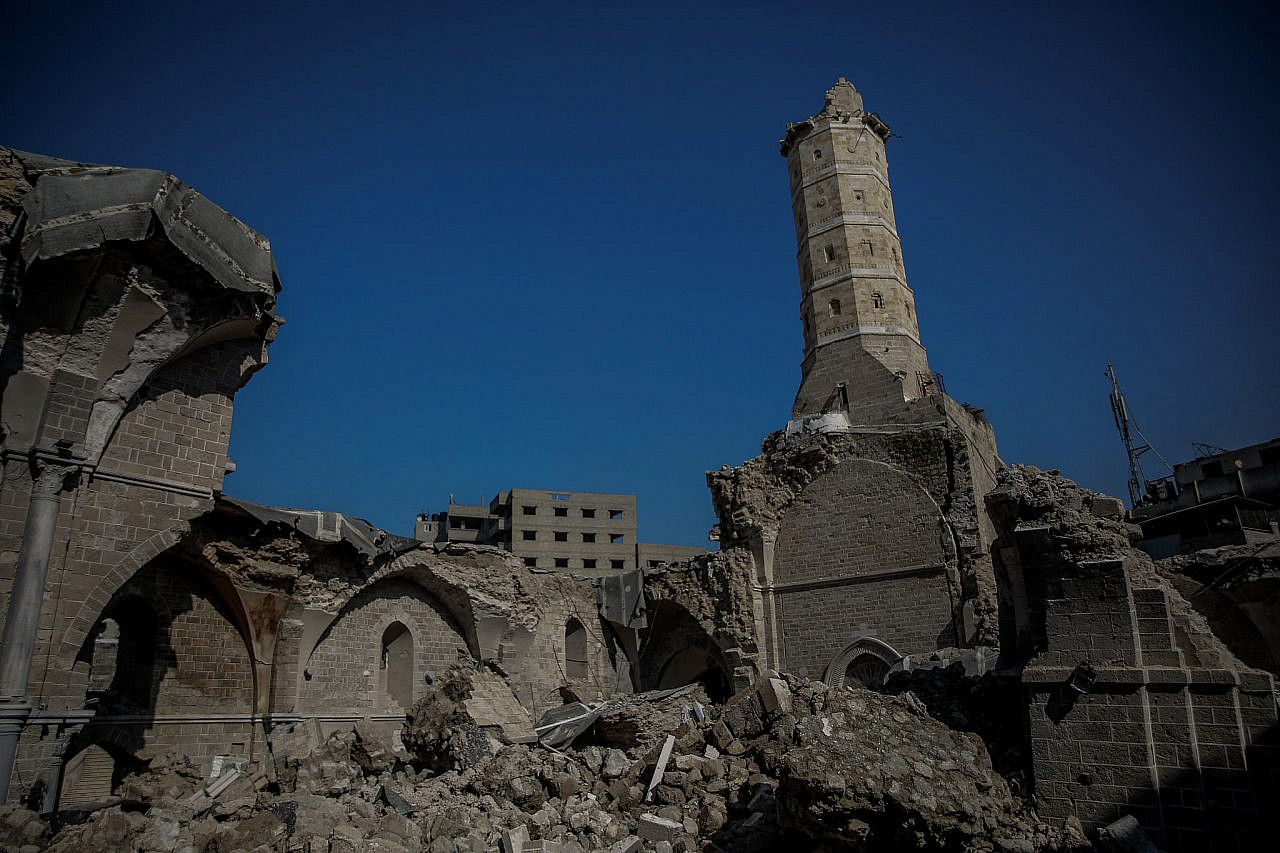
“Omari Mosque was at certain times an educational institution, something resembling a university,” Yazbak explained. “The most prominent figure who studied there was Imam Al-Shafi’i, one of the four imams who founded the religious schools of Sunni Islam.”
The mosque also housed an archival collection of rare manuscripts, which were destroyed by Israel’s bombing. “As far as I know, only materials that were digitized before the war, and what was taken out of Gaza, were saved,” Yazbak explained.
Evidence of Gaza City’s early Christian presence, which dates back to the religion’s first days, has also been damaged by Israeli bombings. The Church of St. Porphyrius, built in the fifth century, has been repeatedly attacked since the start of the war. The nearby Catholic Church of the Holy Family, built much more recently in the 1960s, was also shelled earlier this year, but clergy are vowing to defy Israel’s evacuation orders and remain in the city.
Longstanding efforts to preserve Gaza’s ancient heritage are also now coming under fire. Last week, Israel issued an immediate evacuation order for the 13-story Al-Kawthar building, home to a warehouse of thousands of ancient artifacts from archaeological sites across Gaza. The collection, owned by the French Biblical and Archaeological School of Jerusalem, contains items found at the St. Hilarion Monastery near Deir Al-Balah, a UNESCO World Heritage site.
Pressure from the French government, in coordination with UNESCO and the Latin Patriarchate in Jerusalem, succeeded in obtaining an extension to the evacuation period, earning enough time for staff to frantically remove most, but not all, of the artifacts held in the building — including fragile ceramics, mosaics, and centuries-old skeletons — before an Israeli airstrike crushed the rest.
According to UNESCO, over 100 sites of religious, historical, or cultural importance in Gaza City have been damaged over the past two years. What will become of them, and of the few sites that remain intact, as Israel’s assault ramps up?
Baker Zoubi is a journalist from Kufr Misr currently living in Nazareth.
RELATED:
- ‘Render it unusable’: Israel’s mission of total urban destruction
- Israel carries out systematic erasure of Gaza’s historical landmarks and cultural heritage
- A visual guide to the destruction of Gaza
- Gaza genocide: There is nothing to occupy. The city itself no longer exists
- ‘Every Atrocity Imaginable’: Litany of Israeli War Crimes Continues
- The Destruction, Starvation and Death in Gaza Are Israel’s Defeat