Israel’s tightened restrictions on the entry of aid into Gaza since the U.S.-Israeli war on Iran have led to shortages of basic necessities and an astronomical rise in prices, raising fears of a return to famine.
By Tareq S. Hajjaj, Reposted from Mondoweiss, March 19, 2026
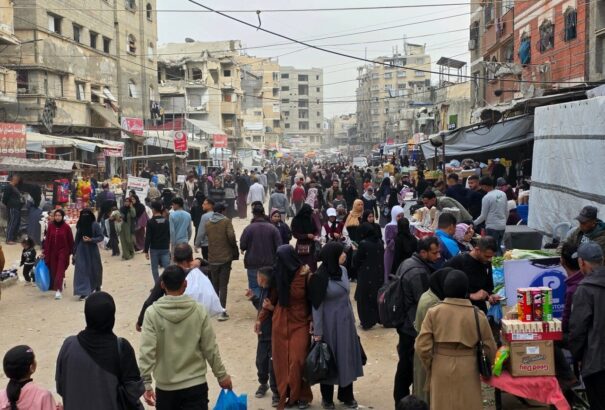
Yousef al-Lahham, 54, walked through the Khan Younis market last week looking for food, but was unable to find anything even remotely affordable. Prices for basic necessities in the Gaza Strip have continued to rise ever since the U.S. and Israel started their war on Iran. For Palestinians in Gaza, who have lived through repeated waves of food shortages, man-made famine, and soaring food prices, this all feels familiar. Gazans have begun to face difficulties in piecing together enough food to make a proper meal for their families, al-Lahham tells Mondoweiss, raising fears that famine might soon return to the Strip.
In late February, the Israeli government ordered the total closure of all border crossings into Gaza as the Iran war started, which included cutting off food and humanitarian aid. Prices immediately skyrocketed, further exacerbated by people flooding markets to stock up on necessities in anticipation of eventual shortages.
On March 3, Israel began allowing small quantities of food into the Strip through the Karam Abu Salem crossing in the south, while the Rafah crossing with Egypt and the Zikim crossing in the north have both remained closed. Yet the number of trucks allocated to enter in a single day — over 200 carrying dairy products, soft drinks, fruits, vegetables, chocolate, frozen food, cookies, and cakes — was spread across the first two weeks of March. Between March 1 and March 10, a total of 214 trucks entered, effectively reducing the daily count to 40-50 trucks.
On March 6, the UN Office for the Coordination of Humanitarian Affairs (OCHA) reported that the closure of the crossings raised concerns about “the availability of humanitarian supplies and services, and private sector goods.”
The closures have not only affected the entry of aid, fuel, and commercial supplies, but also extend to the “coordination of humanitarian movements in and near areas where Israeli troops remain deployed, medical evacuations, the return of residents from abroad, and the rotation of humanitarian staff in and out of the coastal enclave,” according to OCHA.
Al-Lahham says the most immediate effect has been on the cost of all essential commodities, with local merchants raising prices soon after the war began, sensing that their products would soon disappear from the market.
Al-Lahham recounts that when he walks through the markets, his aim is to find one type of vegetable and one type of animal protein, either chicken or meat. That would be enough for the iftar meal during Ramadan. But on most days, he comes back empty-handed after making several rounds through the market. The markets themselves are sparse, and what is available is prohibitively expensive. On a typical day, he might be able to find green onions and parsley, enough to add some color to a dish.
Munis Abu Jazar, a worker at Helmi Barbakh Trading Company, says that an important reason for the dramatic rise in prices is past experience. Last Ramadan, Gazans were experiencing famine (which was later officially declared by the world’s leading famine-monitoring body). This Ramadan, once Israel announced the closure of the crossings, there was a panicked rush to the markets.
“The increase in demand drove up prices,” Abu Jazar tells Mondoweiss. “People began hoarding food supplies to ensure they’d be able to find food, especially during Ramadan.”
Abu Jazar says there are still goods in warehouses that have not yet run out, but the ongoing demand is keeping prices from falling. If the crossings remain closed, supplies are projected to run out within weeks.
Still, he says, humanitarian institutions have begun bringing in basic supplies, which have helped ameliorate, but not resolve, the price hike. They also haven’t stopped shortages; cooking oil has completely run out, especially since it is also used as fuel to light fires, and even to run cars, while some have also taken to mixing cooking oil with regular diesel to operate bulldozers for rubble removal.
Abu Jazar notes that goods currently entering through the crossings are arriving at a trickle and fall far short of meeting the population’s needs. So far, it is supplemented by reserves, he says.
Another result of the change in aid delivery is the steep rise in so-called “coordination fees” that facilitate the entry of goods through border crossings. This is based on a preexisting system at the border in which designated merchants responsible for importing goods and delivering them to local vendors charge a fee, which many in Gaza consider a formalized form of bribery. These merchants have now started demanding higher fees, which they justify by citing the instability brought about by the war. This also contributes to driving up the base price of imported goods.
Local authorities attempt to institute price controls
Most Gazans do not accept Abu Jazar’s explanation. Younes al-Lahham says the markets are empty, and most merchants are now hoarding their goods, waiting for prices to rise even further to extract greater profit. “I walk through the market again and again, but all I find are foods selling at double the original price,” he says.
“Our lives are dictated by these fluctuations,” al-Lahham complains. “If merchants hear that the crossing will close, they raise prices or hoard goods. If they hear about a war, they raise prices.”
Al-Lahham says that on some evenings, he can only offer his family bread with tea. “And even the tea we drink is without sugar, because sugar isn’t available at affordable prices,” he says.
The price hikes have prompted governmental interventions, including market sweeps aimed at imposing price controls on goods.
The Gaza Government Media Office released a statement during the second week of March confirming that it had launched a campaign meant to prevent monopolies and price gouging, stressing that it will not tolerate any violations that may lead to the “exploitation of citizens.”
According to the statement, during a field inspection tour in the Khan Younis governorate, about 3,511 kilograms of vegetables and fruits were seized from a merchant who deliberately raised their prices. The quantity was then sold at the official price approved by local authorities, the statement said.
The Media Office also listed a number of other punitive measures local authorities took against merchants accused of price gouging; a frozen food merchant was ordered to sell 800 kilograms of meat and 160 kilograms of chicken at the sanctioned price; 250 kilograms of meat were confiscated from another merchant; and in Rafah and the central governorates, local authorities detained merchants who had raised prices and took “necessary measures” against them, including confiscating food products or compelling them to sell at the official price.
Tareq S. Hajjaj is the Gaza Correspondent for Mondoweiss and a member of the Palestinian Writers Union. Follow him on Twitter/X at @Tareqshajjaj.
RELATED:
- Palestinians in Gaza fear famine returning as Israel cuts off food amid Iran war
- Israeli Lawmakers Demanded Better PR to Conceal Gaza Famine. Google Obliged.
- The New “Free Press” Editorial Defending its Famine Denial Includes Fundamental Errors
- Anatomy of a famine: how Gaza has starved
- Vatican Secretary of State to Trump, Israel: End the war as soon as possible