By Prem Thakker, Reposted from Zeteo, April 28, 2026
A memo is circulating in Congress detailing five laws and international standards that obligate the United States to stop sending or selling weapons to Israel.
Sent by the Institute for Middle East Understanding Policy Project, the memo has been distributed to offices across Capitol Hill. A source familiar with the effort says the memo was sent to every Democratic office in Congress.
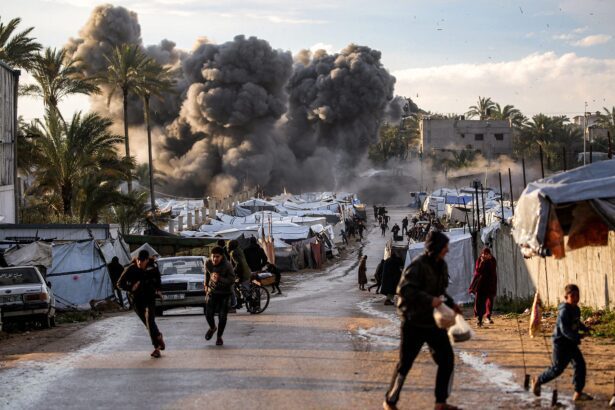
The memo comes after 40 senators voted to block some arms sales to Israel in mid-April – a record number. Still, the entire Republican Party and a handful of Democrats prevented Congress from fulfilling its legal obligations and blocking some weapons transfers to Israel in response to its genocide in Gaza, and its ramped-up violence in the West Bank, Lebanon, and Iran.
One of the votes – which ultimately failed to pass – was simply to block the sale of bulldozers to Israel. The Israeli government has used these bulldozers to demolish homes in the West Bank, as it seeks to illegally expand there and steal even more land. Israeli soldiers also used a bulldozer to kill 23-year-old American peace activist Rachel Corrie in 2003, as she stood against such demolitions.
The high mark of support to block arms transfers to Israel underscores how drastically public support for Israel has cratered, particularly among rank-and-file Democrats, but also among independents and even some Republicans. With that collapse, public pressure is at an all-time high for Congress to follow the law and stop using US tax dollars to aid Israel’s violence.
Accordingly, an upsurge of politicians and organizations is shifting on the issue of arming Israel. Everyone from Rep. Alexandria Ocasio-Cortez, to likely 2028 candidate Rahm Emanuel, to pro-Israel and pro-peace organization J Street has come out in opposition to US aid to Israel. However, the new rising consensus still leaves open the opportunity for Israel to buy US weapons with its own money. While cutting aid to Israel may be a radical shift from the status quo, it still falls short of fully blocking all weapon transfers to Israel.
Here, as per the memo, are five laws and standards obligating Congress to do so:
1. Section 502B of the Foreign Assistance Act
The Foreign Assistance Act (FAA) holds that “no security assistance may be provided to any country the government of which engages in a consistent pattern of gross violations of internationally recognized human rights.” The FAA defines gross violations of human rights to include “torture or cruel, inhuman, or degrading treatment or punishment, prolonged detention without charges and trial, causing the disappearance of persons by the abduction and clandestine detention of those persons, and other flagrant denial of the right to life, liberty, or the security of person.”
The IMEU memo cites the Israeli human rights organization B’Tselem’s damning report, “Welcome to Hell: The Israeli Prison System as a Network of Torture Camps,” which details how the Israeli government has created “a network of camps dedicated to the abuse of inmates as a matter of policy,” facilities “in which every inmate is deliberately subjected to harsh, relentless pain and suffering,” and which operate “as de-facto torture camps.”
B’Tselem has found that at least 84 Palestinians have died in these Israeli detention centers, often due to “systematic abuse, including physical and psychological violence, inhuman conditions, deliberate starvation and denial of medical treatment.” Thousands of Palestinians are remanded to such facilities, often with no semblance of due process through a system called “administrative detention,” in which Israeli authorities detain Palestinians for months on end without charge or trial.
Israel’s regime of torturous prisons moreover flouts the International Court of Justice. In January 2024, the court issued provisional measures mandating Israel to take all measures possible to prevent the following acts, in regards to Palestinians: “killing members of the group; (b) causing serious bodily or mental harm to members of the group; (c) deliberately inflicting on the group conditions of life calculated to bring about its physical destruction in whole or in part; and (d) imposing measures intended to prevent births within the group.”
Alongside its genocide of Palestinians more broadly, Israel’s documented torture of Palestinian prisoners (again, often held with no charge or trial, making such detainees more appropriately dubbed as hostages), would hold it in violation of these measures.
2. The Arms Export Control Act
The Arms Export Control Act holds that the US can sell or lease weapons to countries for internal security, self-defense, to prevent the proliferation of weapons of mass destruction, support in participating in United Nations arrangements, or for support in public works or other development pursuits.
Israel’s usage of US weapons, the memo states, to maintain its illegal military occupation of Palestine, and to commit potential war crimes and crimes against humanity in Gaza, the West Bank, Lebanon, and Iran “clearly constitute unacceptable usage of US weapons under the AECA.”
3. Convention on the Prevention and Punishment of the Crime of Genocide
In the aftermath of World War II and the Holocaust, the US joined the rest of the world in voting for the Convention on the Prevention and Punishment of the Crime of Genocide, and ratified it in 1988, alongside passing a domestic law that designated genocide as a federal crime.
In 2007, the ICJ ruled that nations part of the Genocide Convention must “employ all means reasonably available to them, so as to prevent genocide so far as possible.” While a nation would not be responsible just by virtue of “the desired results” not being achieved, it would be responsible if it “manifestly failed to take all measures to prevent genocide which were within its power, and which might have contributed to preventing the genocide.”
Given that Israel has explicitly conducted its genocide with US weapons, the nation is currently failing to take measures to prevent it, and is thus responsible for it.
4. Article 1 of the 1949 Geneva Conventions
Article 1 of the Geneva Conventions of 1949 states, “The high contracting parties undertake to respect and to ensure respect for the present convention in all circumstances.”
In 2016, the International Committee of the Red Cross (ICRC), which serves as the watchdog over the Geneva Conventions, stated that nations have both a “negative and positive obligation” to “ensure respect” for the convention.
Under the negative obligation, the ICRC said, nations “may neither encourage, nor aid or assist in violations of the conventions by Parties to a conflict.”
Under the positive obligation, nations “must do everything reasonably in their power to prevent and bring such violations to an end.”
When it comes to weapons transfers specifically, the ICRC states that, in order for nations to honor Article 1, they are prohibited from transferring weapons to a party where there is a clear risk that it would contribute to violations of international humanitarian law.
Given the parameters from the ICRC, and Israel’s documented violations of humanitarian law, the US would be obligated to stop sending weapons to Israel.
5. Articles on Responsibility of States for Internationally Wrongful Acts
The International Law Commission of the United Nations adopted these articles in 2001, as a backbone for how international law can customarily deal with legal accountability for wrongful acts.
Article 16 of the papers establishes that “a state which aids or assists another state in the commission of an internationally wrongful act by the latter is internationally responsible for doing so,” if “that state does so with knowledge of the circumstances of the internationally wrongful act,” or if “the act would be internationally wrongful if committed by that state.”
Article 41 also obligates states to “cooperate to bring to an end through lawful means any serious breach” of international law, and for states to not aid or assist other states in breaking international law.
The ICJ cited these articles in July 2024, when it issued an opinion deeming Israel’s occupation of Palestinian territory to be illegal. The court said Israel was obligated to end its illegal presence “as rapidly as possible.”
With regards to the culpability of other states, the ICJ held that they are “under an obligation not to render aid or assistance in maintaining the situation created by Israel’s illegal presence in the Occupied Palestinian Territory.”
Given Israel uses US weapons to maintain its illegal occupation of Palestine, the US would be obligated to stop sending weapons to Israel.
These five laws and standards do not even include the Leahy Law, which bans US aid to specific military units that commit gross human rights violations. The US, including under former President Joe Biden, has blatantly refused to enforce this law in the past. It also does not include the National Security Memorandum-20 report, which is supposed to pause weapons transfers if the US finds recipient nations are not providing credible assurances they are complying with international law and allowing humanitarian aid access. That’s another mechanism that the US, under Biden, outright flouted with regards to Israel’s conduct in Gaza.
There is no shortage of laws and international standards that mandate the US stop sending weapons to Israel. And there is no shortage of public outcry that the US continues to do so anyway. With popularity for the US-Israeli War on Iran in the gutter, and US positive sentiment toward Israel continuing to plummet, the question is rapidly becoming what will end first: the US’s current relationship to Israel, or the careers of politicians who refuse to follow the law.
Prem Thakker Zeteo Political Correspondent & Columnist
RELATED:
- Senate again fails to block weapons to Israel
- Israelis don’t pay for the weapons we ‘sell’ to them — US taxpayers do
- US Arms Control Official Refuses To Comment When Asked If Israel Has Nuclear Weapons
- Israel used weapons in Gaza that made thousands of Palestinians evaporate
- Pentagon Makes Largest Known Arms Purchase From Israel — For Banned Cluster Weapons
- Israel’s Decades of Economic Espionage in the United States