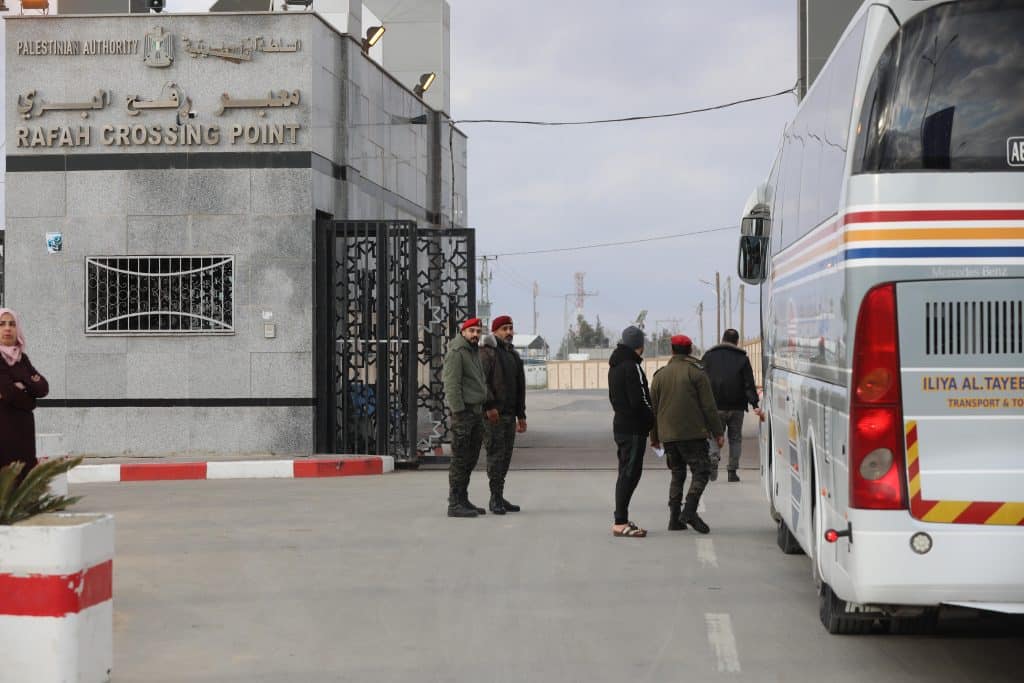
Gaza’s Rafah border crossing was supposed to reopen in October as part of the ceasefire agreement. But the border remains closed, keeping Gaza shut off from the outside world and preventing families from reuniting with loves ones.
For many long months, the Rafah crossing had been a central issue in the ceasefire talks. So, when a ceasefire agreement was finally signed in mid-October 2025, with the reopening of Rafah listed among its main terms, hope swept across Gaza. The agreement clearly stated that Rafah would reopen to allow civilians to move safely and to restore the one lifeline Gaza relied upon for travel, treatment, and study.
Months have passed, however, and the crossing remains shut.
On December 3, Israel announced that the crossing would open in days, but Egypt denied that steps were being taken to open it. This had been Israel’s first comment on the crossing in months.
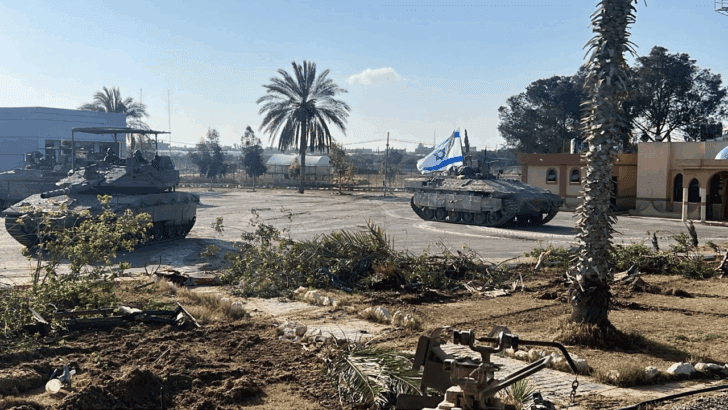
Before the genocide, Rafah was Gaza’s only border crossing with the outside world, and the process of traveling through it, even then, was laborious and degrading for Palestinians. But Israel has occupied the Palestinian side of the border crossing with Egypt since May 2024, destroying and burning down its facilities and blocking Palestinians from traveling through it. These hopeful travelers include patients and critically wounded civilians waiting for treatment, students waiting to travel on scholarships, and families waiting to be reunited with their loved ones.
Despite the ceasefire terms, Israel refuses to reopen the crossing, claiming Hamas would use it for military purposes. Meanwhile, Israeli bombings and artillery shelling continue every day across Gaza. The Gaza Center for Human Rights reports that more than 340 Palestinians have been killed and almost 800 injured during the so-called ceasefire. This makes it clear that the ceasefire exists only in name.
This violation has caused severe humanitarian consequences. Tens of thousands of people now live in a suspended reality, as critically ill patients wait for medical transfer abroad, university students watch their scholarships expire, and families are split across borders with no date for reunion.
Injured and waiting for survival
The World Health Organization reports that over 16,500 patients in Gaza are waiting for medical transfer to receive treatment. Among them is Raed Khalifa, now sheltering with his family in the Rimal neighborhood west of Gaza City after having lost his home in al-Zaytoun.
In August 2025, Khalifa, a father to three sons and two daughters, was shot in the head by Israeli gunfire after warplanes targeted a nearby house. He had been trying to reach his home in al-Zaytoun — which at the time had been declared a “red zone” by the Israeli army — to retrieve a sack of wheat flour for his family. This was during the height of the famine that had taken hold in Gaza as a result of Israel’s policy of deliberate starvation between March and October 2025.
As debris flew in every direction, a bullet partially penetrated Khalifa’s skull, causing several fractures. Doctors did not expect him to survive. He did, but the bullet remains lodged in his skull.
With crossings closed and medical supplies depleted, doctors have been unable to remove the bullet. “We don’t have the necessary equipment to open your head,” they told him. Their warning was simple. “Pay attention to your head. Any movement could cause your death.”
Shortly after, the injury left Khalifa almost entirely paralyzed. He cannot sit, stand, or walk, as his legs do not respond to his commands. His left hand remains motionless, and only recently did his right hand begin to move again. “It was miraculous,” he says.
According to the World Health Organization (WHO), by late September 2025, nearly 42,000 people in Gaza had sustained life-changing injuries requiring long-term rehabilitation. Many of them are expected to result in permanent disabilities.
Before the war, Khalifa’s life was simple. “I was a street seller of fruits and vegetables,” he says. “I used to walk from one street to another on my own two legs, talking to people and meeting customers. I loved dealing with people.” His voice tightens when he remembers those days.
“I used to make a living with my own two hands. Now I cannot feed myself or my family,” he admits. “I cannot buy them clothes or mattresses. I cannot even buy medicine for myself.”
He adds, “I lost my home and all of my belongings. Now I just hope for aid and charity from people.”
Now Khalifa lies in a small shelter with his children and wife, whom he relies on to feed him, to take him to the bathroom, and everything else. “I am totally paralyzed. I can’t sit, stand, or move at all,” he says. “I’m just lying on my back all day long.”
“It’s very hard for my wife to take care of me on her own,” he laments. “A wheelchair would alleviate the burden on her. But I don’t have one.”
Wheelchairs have entered Gaza only in very limited numbers since the start of the war. The United Nations warned in June 2025 that thousands of assistive devices remain stuck at the crossings due to restrictions. More than 3,330 wheelchairs are among those blocked from entering.
Months of immobility have brought more harm. Painful skin ulcers spread under his arms, across his legs and hands, and along his back. They deepen every day, untreated, and with no source of income, he cannot afford the necessary medicine. “My wife just tries to disinfect the sores using antibiotics and saltwater,” he says.
With risk threatening his life every day, just like many others, Khalifa’s survival is linked to the Rafah crossing.
Students lose their scholarships
Earlier in October, more than 110 students with master’s scholarships were finally able to leave Gaza through the Erez crossing after months of waiting. Their travel was possible only because the countries offering the scholarships coordinated directly with Israel. But while those students managed to escape, dozens of others remain stranded in Gaza with scholarships in places like Qatar and Tunisia. Some have already come close to losing their opportunities entirely.
One of them is Shayma Abu al-Hawa, a distinguished media graduate who earned a scholarship to study media and communication at the University of Doha in Qatar.
“I was supposed to travel in 2024 to pursue my dreams,” Abu al-Hawa says. “But the war came, shattering all my dreams.”
From the early days of the war, Abu al-Hawa faced a long and punishing journey of displacement. Her family fled their home in Tal al-Hawa in western Gaza City to central Gaza, where even basic communication became a challenge. “My phone broke as we almost came out from under the rubble when the Israeli army bombed our neighbor’s home,” she says. “And the internet was almost cut across the entire city.”
Connecting online was nearly impossible. “In North Gaza at that time, people had to walk long distances just to activate an e-SIM connection because of the communication blackout under heavy bombardment,” she recalls.
Abu al-Hawa did not manage to access the internet until March 2024, when she finally saw several emails from her university requesting documents to complete her application. “The email was sent in January, but I read it in March,” she says.
Even then, she hesitated. “I didn’t pay much attention to it, even though this scholarship was my biggest dream and I had worked so hard for it,” she admits. “The war was at its peak, and there were no signs it would end anytime soon. I didn’t want to raise my hopes only to be disappointed.”
With North Gaza besieged and all crossings closed, Abu al-Hawa knew she had no chance of leaving. She stopped following up, even though turning away felt like losing a part of herself. She recently lost the scholarship.
A similar fate confronts Islam Mustafa, a 27-year-old graduate of the Arabic Language Department who earned a scholarship for a master’s program in Algeria. He received his acceptance during the war. His future now depends entirely on the Rafah crossing.
“We, the students with scholarships in Arab countries, can only leave through Rafah,” Mustafa explains. “Otherwise, there is no way.”
Because Algeria has strained relations with Israel, he cannot receive permission to travel through the Erez crossing at all. His hopes now rest on a crossing that has remained shut despite repeated promises to open it.
Mustafa, Abu al-Hawa, and dozens of other people have the requisite talent, acceptance letters, and determination to succeed. What they lack is a functioning crossing, and every day that passes sees the fading away of their dreams.
Families torn apart
Aya Abed was among the few who were granted medical evacuation to Egypt for treatment in mid-March of 2024. But that opportunity came with a heavy cost.
Her family was trapped in northern Gaza behind Israeli checkpoints and barriers that had blocked movement along al-Rashid and Salah al-Din Streets since the earliest days of the war. Abed could not take any of them with her or say goodbye. Her husband was also denied permission to leave, without explanation. She traveled with one of her husband’s relatives and began a long, exhausting journey through hospitals in Egypt.
Her treatment eventually ended, but her suffering did not. Abed is stuck in Egypt, unable to return home to Gaza, unable to reunite with her husband or family, and unable to bring them out to safety. Her life has been split in two by a border she cannot cross.
“I miss them so much,” Abed says. “I long for the day I meet them again.”
Abed married only a few months before the war and everything was turned upside down. She and her husband tried every possible way for him to follow her to Egypt, but like many others, he remains stuck in Gaza. His fate is tied to the Rafah crossing, which remains closed.
Abed finished her treatment almost six months ago, yet she still cannot return home, her life on hold until Israel decides otherwise.
The crossing was supposed to reopen last October as part of the first phase of the ceasefire agreement, which began on October 10. Israel has still not complied with the terms of the agreement.
Noor Alyacoubi is a Gaza-based translator and writer. She studied English and literature at al-Azhar University in Gaza.
RELATED:
- ‘Global March to Gaza’: Activists from 31 countries plan march to Rafah border
- Haaretz: Israel Preparing to Turn Rafah – One-fifth of Gaza – Into Part of Buffer Zone
- Rafah Attack: Netanyahu’s Lies Expose The Truth About Israel
- Not even the US government knows the US government line on Rafah
- A smaller cage: Israel’s ‘two-state solution’ on Gaza’s ruins