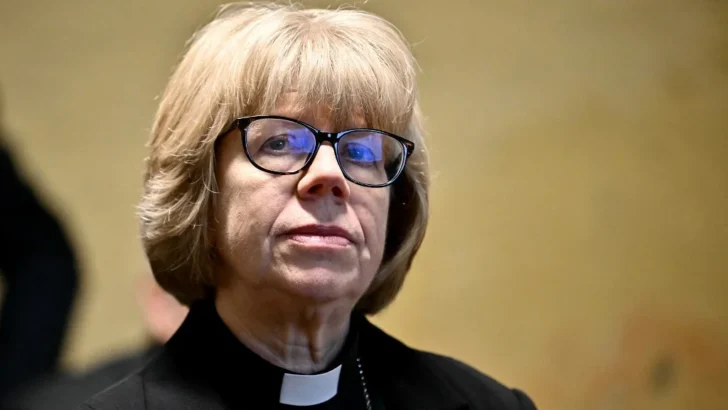
Sarah Mullally, the head of the Church of England, has a powerful message after a pilgrimage in which she met Palestinians attacked by settlers and others detained without trial (2 articles).
Reposted from Middle East Eye, June 25, 2026
The archbishop of Canterbury has pledged to help Palestinians achieve “the peace you desire and the freedom you deserve” and praised their “faithful resistance” on a visit to the occupied West Bank.
Dame Sarah Mullally, the head of the Church of England, made the comments last Sunday during a sermon at St Peter’s, an Anglican church in the Palestinian Christian town of Birzeit.
She told the congregation that “your faithful, hopeful resistance is also visible as fathers and mothers navigate the web of checkpoints daily to provide an income for their family, or to get their children to school to provide for their future, or as you gather to break bread together week by week in this church.
“All these acts of faithful resistance point to our hope in Jesus Christ and reflect your ongoing struggle for freedom and dignity.”
The archbishop added that she was aware that she enjoys certain freedoms that Palestinians don’t, such as “being able to cross borders and checkpoints, spending time in neighbouring communities, and going to Jerusalem”.
“I will use my role as archbishop to seek the peace you desire and the freedom you deserve,” she said.
“I hope that, through my visit, you may also know that you are not forgotten by the wider body of Christ.
“The church is called to rejoice with those who rejoice and to weep with those who weep. The church stands with you in your right to live in freedom and dignity.”
Meeting with Palestinian detainee
On her trip, Mullally met Layan Nasir, a 26-year-old Palestinian Christian woman who has been detained three times by Israel in the past five years.
“I’m grateful to Layan’s family for their hospitality in their home,” Mullally said.
“I will pray for them, and for God’s blessing and healing for Layan after the terrible ordeal of her incarceration. I pray for the release of all people who have been unjustly imprisoned, here in Palestine and Israel and around the world.”
The archbishop also visited Jerusalem, Nazareth and Bethlehem. She travelled with Archbishop Hosam Naoum, the Anglican archbishop in Jerusalem.
Mullally said: “This visit is an opportunity to listen to both their hopes and fears, their joys and immense challenges, and to pray with them for justice and peace that will bring healing to their lives and to this land.”
Four senior bishops in the Church of England last year called on the British government to take urgent action against Israel’s escalating settler violence, warning it was undermining Palestinian life and threatening the Christian presence in the Holy Land.
“As the war in Gaza persists, the situation in the West Bank is in freefall,” they wrote, citing “increasing levels of settler violence and intimidation” – including attacks on land and churches in Taybeh, a Christian-majority town in the occupied West Bank.
In December 2025, Stephen Cottrell, the archbishop of York, said in a sermon that he was stopped at checkpoints and told by “militias” that he could not visit Palestinian families in the West Bank.
“It was sobering for me to see this wall for real on my visit to the Holy Land, and we were stopped at various checkpoints and intimidated by Israeli militias who told us that we couldn’t visit Palestinian families in the occupied West Bank,” he said.
A delegation from the Higher Presidential Committee for Church Affairs in Palestine warned European Union officials last month that Israeli policies pose a serious threat to the survival of the historic Palestinian Christian presence in the region.
(2/2) Archbishop of Canterbury calls for end to Israeli occupation of Palestine
Sarah Mullally ends visit to region with call for two-state solution that allows Israelis and Palestinians to live in peace
By Chris Osuh, Reposted from The Guardian, June 25, 2026
The archbishop of Canterbury has called for an end to the Israeli occupation of Palestine after a pilgrimage in which she met Palestinians attacked by settlers and others detained without trial.
Sarah Mullally, the head of the Church of England, and Hosam Naoum, the Anglican archbishop of Jerusalem, issued a joint letter on Thursday urging Anglicans around the world to press politicians “to take all necessary measures to establish a credible path towards ending the occupation”.
“This must lead to a viable two-state solution enabling Israelis and Palestinians to live in peace, dignity, and security. Jerusalem’s status should be determined through negotiation as a shared capital,” the letter read.
The pair said they feared for “the long-term future of the indigenous Christian Palestinian presence in the Holy Land that stretches back to the time when our Lord walked this land”. They also said Gaza’s health system was in a state of “catastrophic collapse”.
The letter was published after a five-day pastoral visit in which Mullally spoke of the “immense hardships” and “web of checkpoints” Palestinians faced in the West Bank, Gaza, and East Jerusalem, and preached that Jesus had lived under foreign occupation.
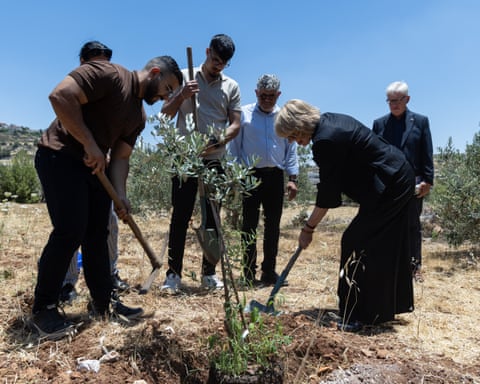
She also planted an olive tree with the family of Daoud Nassar, Palestinian Christians who have been fighting Israeli attempts to seize their land in the West Bank since 1991 and have faced repeated settler attacks.
Mullally said that “when many Palestinian Christians are leaving, olive trees are a symbol of their deep roots in this land” and that the Nassars were an example of “Christian resistance to injustice”.
Lambeth Palace said the visit had been intended to encourage Palestinian Christians at a time when “communities are being violently forced from their land, and illegal settlements are rapidly expanding across the West Bank”.
Mullally and Naoum wrote in their letter that they had “met families who feel unmoored and traumatised by endless conflict” across Palestine and Israel.
“In Israel, the simultaneous fighting of many conflicts at one time, and the deep-seated aftermath of the horrifying atrocities of 7 October, have created a state of intense sensitivity to potential danger that has transformed society and politics,” they wrote.
“In the West Bank, unchecked settler violence, forced displacement, systemic discrimination and expanding checkpoints have left the Palestinian population impoverished, desperate and powerless to enact change. Annexation is already taking place in all but name.
“Meanwhile, the profound suffering in Gaza continues. The international community must not look away; it bears a moral responsibility to relieve this agony and help rebuild Gaza’s society.”
Mullally said the Middle East conflicts were “symptomatic of a deeper political and spiritual crisis – an abandonment of international law and an increasing recurrence of military force”.
During her visit, she met Layan Nasir, 26, a Palestinian Anglican community worker freed after being jailed by the Israeli military, and the parents of Natalie Abu Dayeh, a Christian student who had been held without charge.
In the Christian West Bank town of Birzeit, Mullally told worshippers at St Peter’s church she would use her role as archbishop to seek “the peace you desire and the freedom you deserve”.
In her sermon she said: “In the Gospel of Matthew, Jesus is speaking to a community living in fear: his own people living in an occupied land and under foreign rule … I can only imagine how these words may sound to you today.”
The Church of England’s annual assembly, the General Synod, will debate a motion to review investment policies in the region next month.
The bishop of Chelmsford, Guli Francis-Dehqani, said the debate would be about “justice and human dignity for everyone”.
RELATED:
- Greek Orthodox Patriarchate denounces Israeli seizure of church land in Jerusalem
- 88 attacks against Palestinian Christians recorded since start of year
- Israel has no mercy on Christian communities in West Bank, Lebanon: 2 Articles
- Who on Earth Feels Threatened by a Nun?
- “Spitting and humiliation are daily. People are afraid to walk in Jerusalem with Christian symbols.”