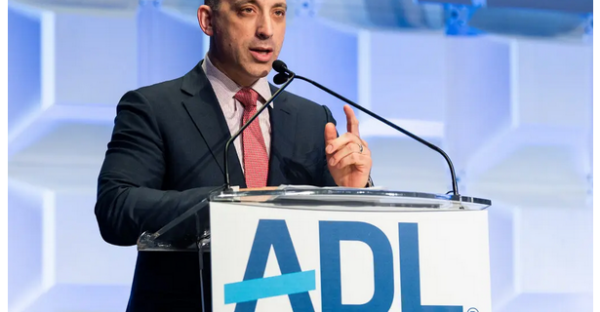
While it frames itself as a civil rights organization, the ADL has a long history of actively spying on critics of Israel and collaborating with the Israeli government.
Media outlets continue to print headlines about antisemitism based on Anti-Defamation League statistics known to be faulty and politicized. In doing so, they grant undeserved credibility to the ADL as a source.
Producing statistics helps the ADL to claim objectivity when they assert that antisemitism is increasing dramatically, prevalent in all fields of society, and emanating from the left as well as the right. Those “facts” are then used to justify policy recommendations that fail to respond to actual antisemitism, but succeed in undermining the free speech rights of Palestinians and their supporters, including those of us who are Jews.
Smearing Israel critics as antisemites
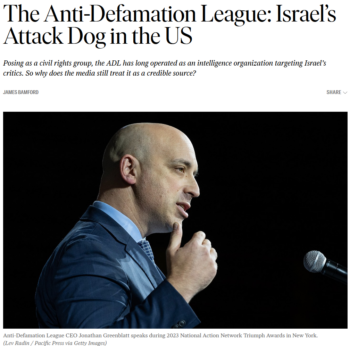
While it frames itself as a civil rights organization, the ADL has a long history of actively spying on critics of Israel and collaborating with the Israeli government (Nation, 1/31/24). (FAIR itself was targeted as a “Pinko” group in ADL’s sprawling spying operation in the ’90s.)
Though it professes to document and challenge antisemitism, it openly admits to counting pro-Palestinian activism as antisemitic: In 2023, the ADL changed its methodology for reporting antisemitic incidents to include rallies that feature “anti-Zionist chants and slogans,” even counting anti-war protests led by Jews—including Jewish organizations the ADL designated as “hate groups.”
The ADL’s political motivations are clear in its advocacy for the International Holocaust Remembrance Alliance’s definition of antisemitism, which alleges that criticizing Israel based on its policies (e.g., “claiming that the existence of a State of Israel is a racist endeavor,” or “drawing comparisons of contemporary Israeli policy to that of the Nazis“) is antisemitic. The ADL and their allies also deem speech supporting Palestinian human rights to be coded antisemitism.
Criticism of the ADL is increasing. In 2020, activists launched #DropTheADL to raise awareness among progressives that the ADL is not a civil rights or anti-bias group, but rather an Israel advocacy organization that attacks Palestinians and supporters of Palestinian rights in order to protect Israel from criticism. Last year, a campaign to Drop the ADL From Schools launched with an exposé in Rethinking Schools magazine, and an open letter to educators, titled “Educators Beware: The Anti-Defamation League Is Not the Social Justice Partner It Claims to Be,” that garnered more than 90 organizational signatories. These efforts build off research that exposes the ADL’s work to normalize Zionism and censor inclusion of Palestinian topics in the media, policy circles, schools and in society at large.
In 2023, some of its own high-profile staff resigned, citing the group’s “dishonest” campaign against Israel’s critics. In June 2024, Wikipedia editors found the ADL regularly labels legitimate political criticism of Israel as antisemitic, leading the popular online encyclopedia to designate the group an unreliable source on Israel/Palestine.
Critiquing the ADL’s statistics does not serve to argue that antisemitism is acceptable or less deserving of attention than other forms of discrimination. Rather, it demonstrates that we can’t rely on the ADL for information about the extent or nature of antisemitism—and neither should media.
A dubious source
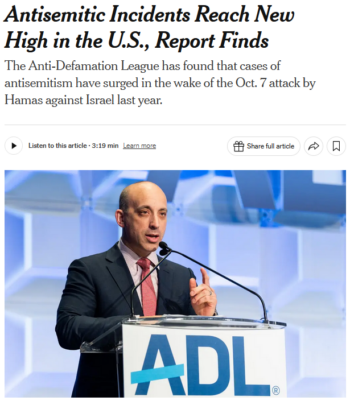
And yet corporate media use the ADL uncritically as a source for reports on antisemitism. For instance, the New York Times (10/6/24) not only headlined the ADL’s assertion that “Antisemitic Incidents Reach New High in the US,” it chose to contextualize the ADL’s findings “in the wake of the Hamas attack,” and called the ADL a “civil rights organization.”
Important media outlets like The Hill (4/16/24), with outsized influence on national policy discussions, ran similar headlines, failing to note the ADL’s highly controversial methodology.
At least the Wall Street Journal (1/14/25) acknowledged that the ADL has been challenged for counting criticism of Israel as antisemitism. But it immediately dismissed the applicability of those challenges to the ADL’s Global 100 survey, which found that 46% of adults worldwide hold antisemitic views. (The ADL’s Global 100 survey was criticized for its flawed methodology as far back as 2014, when researchers found it “odd and potentially misleading.”)
The media’s willingness to accept ADL claims without scrutiny is evident in CNN’s choice (12/16/24) not to investigate the ADL’s accusations of antisemitism against speakers at a recent conference of the National Association of Independent Schools, but rather to simply repeat and amplify the ADL’s dishonest and slanderous narrative.
Methodological faults
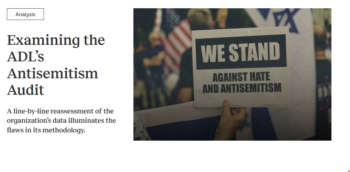
Even setting aside the ADL’s prioritization of Israel’s interests over Jewish well-being, the ADL’s statistics should be thrown out due to methodological faults and lack of transparency.
Even FBI statistics, frequently cited by the ADL, don’t tell a clear story. Their claim that 60% of religious hate crimes (not mere bias incidents) target Jews is misleading, given the systemic undercounting of bias against other religious groups. Because of the history of anti-Muslim policing, Muslims are less likely to report than people of other religions.
In fact, a national survey of Muslims found that over two-thirds of respondents had personally encountered Islamophobia, while only 12.5% had reported an incident. Almost two-thirds of respondents who encountered an Islamophobic incident did not know where or how to report it. When Muslims experience hate, it is less likely to be pursued as a hate crime.
On the other hand, the ADL has an unparalleled infrastructure for collecting incident reports. It actively solicits these reports from its own network, and through close relations with police and a growing network of partners like Hillel International and Jewish Federations.
Perpetrators’ motivations are also relevant and should not be inferred. In 2017, Jews were frightened by over 2,000 threats aimed at Jewish institutions in the United States. It turned out that nearly all came from one Jewish Israeli with mental health problems. Without this level of investigation, policymakers could enact misguided policy based on the ADL’s sensationalism, like CEO Jonathan Greenblatt’s claim that “antisemitism is nothing short of a national emergency, a five-alarm fire that is still raging across the country and in our local communities and campuses.”
Bad-faith accusations
Although critics have long argued that the ADL’s politicized definition of antisemitism and flawed statistics cannot be the basis of effective policy, policymakers continue to rely on media’s deceptive journalism.
Massachusetts State Sen. John Velis cited ADL statistics to claim the state has “earned the ignominious reputation as a hub of antisemitic activity,” and therefore needs a special antisemitism commission. In Michigan, ADL reports of escalating antisemitism led to a resolution that will affect policy in schools across the state. In Connecticut, the ADL referenced its statistics in a government announcement about changes to the state’s hate crimes laws. The ADL’s statistics undergirded the logic of President Joe Biden’s National Strategy to Counter Antisemitism.
But how can politically distorted research be the foundation for effective policy?
Antisemitism is surely increasing. Hate crimes have increased in general—most targeting Black people—especially since the first Trump presidency, and hate incidents generally rise during violent outbreaks like the war on Gaza, and during election periods. But since most antisemitism originates in the white nationalist right wing, why focus primarily on people—including Jews—who are legitimately protesting their own government’s support for Israeli actions against Palestinians? Or on Palestinians themselves, who have every right to promote the humanity and rights of their people?
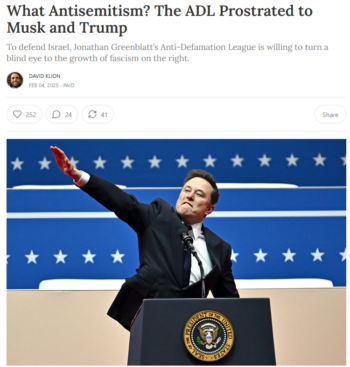
The ADL’s bad-faith accusations weaponize antisemitism to protect Israel at the expense of democratic and anti-racist principles. Anyone who doubted the ADL’s politics should be convinced by its abhorrent defense of Elon Musk’s Nazi salute (FAIR.org, 1/23/25) and its support for Donald Trump.
To pursue effective public policy, policymakers and the public should refuse to cite the ADL’s flawed statistics, and instead develop thoughtful and nuanced ways to understand and address antisemitism and other forms of bigotry and discrimination. Media can play a key role by exposing the politicization of antisemitism by the ADL, including its prioritization of protection for Israel from criticism over the free speech that is fundamental to democratic discourse.
Nora Lester Murad is an award-winning author, educator and activist. From a Jewish family, Nora advocates for bringing Palestine into K-12 schools. Nora is a policy member of Al-Shabaka, the Palestinian Policy Network
RELATED:
- ADL’s J7: Biweekly Jewish Nationalism Think Tank
- Hundreds of Jewish groups urge NEA to reject ADL ban
- Headlines That Hedge: How Western Media Framed the Killing of Palestinian Journalist Anas Al Sharif
- Founders of deadly GHF ‘shaping’ new US-backed administration for Gaza: Report
- BBC: Anti-Islamic US biker gang members run security at deadly Gaza aid sites