Section 622 of the FY2027 Intelligence Authorization Act Locks America into Permanent Unbreakable Intelligence Entanglement with Israel
By GenXGirl1994, reposted from GenXGirl1994’s Substack, June 5, 2026
A Whole-of-Government entrenchment of Israeli influence is advancing through coordinated legislation that subordinates U.S. intelligence, defense, and foreign policy priorities to Tel Aviv’s agenda, at the expense of American sovereignty, interests and taxpayers.
-
H. Res. 1339 endorses Israel Prime Minister Netanyahu’s plan to shift the relationship from U.S. aid to “mutual” defense cooperation and joint investment, praising joint operations against Iran while pushing deeper entanglement.
-
The U.S.-Israel FUTURES Act (H.R. 7540 / S. 3855) formalizes this initiative with $150 million authorized, creating frameworks for joint ventures, co-production, and rapid fielding of Israeli tech into the U.S. military.
-
Section 224 of the FY27 NDAA establishes a U.S.-Israel Defense Technology Cooperation Initiative, tasking the Pentagon with synchronizing bilateral research, development, testing, and industrial integration across critical domains like AI, counter-drones, cyber, directed energy, and missile defense, explicitly prioritizing Israeli-origin technologies for integration into U.S. systems and programs of record.
-
The U.S.-Israel Defense Partnership Act (H.R. 1229 / S. 554) mandates a Defense Innovation Unit office in Israel, cooperative counter-unmanned systems programs, RDT&E on emerging technologies like AI and robotics, and efforts to fold Israel into the U.S. national technology and industrial base (NTIB) alongside allies like the UK and Australia.
-
Section 622 of the Senate’s FY27 Intelligence Authorization “enhances U.S.-Israel intelligence sharing” by further embedding a foreign power into America’s most sensitive national security apparatus and makes it nearly impossible to disentangle U.S. intelligence from Israel.
These measures represent a dangerous erosion of U.S. autonomy by locking-in American taxpayers, innovators, and warfighters into perpetual, one-way technology transfers and industrial dependencies that benefit a foreign nation first, dilute focus on domestic manufacturing, risk entangling the U.S. in endless Middle East conflicts, and treat Israel’s security as inseparable from America’s, despite diverging interests, massive ongoing costs and opposition to the U.S.-Israel relationship by a majority of Americans. This is incremental capture of key levers of U.S. government power by a foreign country, Israel.
This article will focus on Section 622 of the Senate FY27 Intelligence Authorization Act which has received little attention from the public (see the end of this article for links to articles related to the other bills).
Section 662 of the Senate’s FY27 Intelligence Authorization Act (S. 4615), U.S.-Israel Intelligence Sharing Enhancement
Senate Republicans led by Sen. Tom Cotton (R-AR) are quietly advancing legislation that treats U.S. intelligence capabilities as a blank check for a foreign power. Section 622 of S. 4615, the Intelligence Authorization Act for Fiscal Year 2027, codifies and dramatically expands U.S. Israel intelligence sharing into near permanent statutory law. Far from a routine authorization, this provision:
-
subordinates U.S. decision making,
-
restricts future presidential and congressional flexibility, and
-
institutionalizes priorities that place Israeli security interests on par with or above America’s own.
This is a legal straitjacket designed to make disentangling U.S. intelligence from Israel extraordinarily difficult, regardless of future U.S. strategic needs, budget realities, or changes in Israeli behavior.
Core Provisions That Undermine America’s Sovereignty
1. Mandatory Expansion of Intelligence Sharing Shall Expand, No Opt-Out
The bill states the President shall expand and enhance intelligence sharing with Israel on an ever-widening array of topics: cybersecurity threats, terrorism, sanctions evasion, adversarial technology proliferation, missile and drone threats, air and space domain awareness, and more.
This sharing must extend to analytic partnerships and cover threats relevant not just to the U.S. but explicitly to Israel and its regional partners. Nowhere does the bill require Israel to align with U.S. positions, cease settlement activity that complicates U.S. diplomacy, or address documented intelligence risks (for example past espionage cases). It is effectively unconditional.
This is dangerous overreach. U.S. intelligence resources, paid for by American taxpayers and developed through American ingenuity, are not an unlimited public good to be automatically funneled to Israel. Intelligence sharing should be transactional, conditional, and strictly limited to direct U.S. national security benefits. Codifying a blanket shall-expand-mandate removes leverage and turns sharing into an entitlement.
2. The Qualitative Military Edge (QME) Mandate in Intelligence Law
Section 622 explicitly declares U.S. policy to structure security assistance and defense cooperation to help Israel maintain its qualitative military edge consistent with U.S. law. Placing this longstanding policy slogan into an intelligence authorization bill is not boilerplate. It is strategic. It links intelligence flows directly to the broader aid pipeline and signals that America’s intel community must operate with Israel’s military superiority as a guiding objective.
Sovereignty rejects the idea that U.S. policy must guarantee any foreign country’s perpetual military dominance in its region. This commitment distorts arms sales decisions, technology transfers, and now intelligence priorities to favor Israel even when it may conflict with broader U.S. interests (for example, maintaining relationships with Gulf states or avoiding unnecessary escalation with Iran). Taxpayers fund Israel’s edge through billions in annual Foreign Military Financing and Cooperative Programs (research and development).
Embedding it here makes it harder to ever revisit these subsidies, particularly, since both chambers of Congress have introduced multiple bills which pivot the U.S.-Israel relationship from straightforward military handouts to fully integrated so-called “cooperative” research, development, testing, and evaluation (RDT&E) in U.S. bleeding-edge fields like artificial intelligence, cybersecurity, quantum computing, robotics, and automation.
If these bills become law, this brazen heist of U.S. technological supremacy in domains where America outpaces rivals like China, will be gifted to a nation with a documented history of espionage against U.S. industry and government and repackaging of U.S. technology as Israel innovation under the auspices of programs funded by the U.S. taxpayer.
3. Severe Restrictions on Reducing or Limiting Sharing
Perhaps the most anti-sovereign provision states that intelligence sharing with Israel cannot be suspended, reduced, or materially limited except on the basis of a specific and identifiable national security concern (for example, sources methods protection or counterintelligence risk). Any such decision must be personally documented by the President with a detailed rationale.
This is a direct assault on America’s sovereignty. Future administrations, whether concerned about Israeli spying on the U.S. (a documented historical issue), Israeli actions that harm U.S. interests, or simply the need to reallocate resources toward China, will face statutory hurdles and presumptive pressure to maintain maximum sharing. Sovereignty means the U.S. retains unilateral control over its own intelligence product. This language flips that: cooperation is the default. Restraint requires extraordinary justification. It binds future Congresses and Presidents to put the interests of Israel before the U.S.
4. Forced Expansion to Abraham Accords Countries
The bill requires the U.S. to expand intelligence sharing and analytic cooperation with any nations that normalize relations with Israel under the Abraham Accords framework. Priority areas include counterterrorism, cyber, air missile defense, and maritime security.
This effectively uses U.S. intelligence as diplomatic glue to advance a specific regional architecture whether Americans support it or not. American foreign policy becomes the enforcer or quartermaster for Israel’s normalization deals. If Israel wants closer ties with Gulf states, they should manage the intelligence dimensions themselves and perhaps, start by not being a genocidal pariah-state. Dragging America deeper into integrated Middle East security architectures increases entanglement risks and tripwires for U.S. involvement in future conflicts.
5. Heavy Congressional Notification Requirements That Favor Continuity
Any material change in sharing triggers a 15-day notification to intelligence committees including detailed justifications, impact assessments on Israel and regional partners, and effects on integrated defense systems. Annual reports for five years must track categories of intelligence shared, progress on regional integration, and any barriers to deeper cooperation.
While oversight sounds good, the structure is one-sided. It creates bureaucratic and political friction, primarily around reductions while encouraging ever greater integration. This tilts the scales toward permanent entanglement rather than prudent interest-based adjustments.
Congress Should Strip Section 622 Entirely
Section 622 passed the Senate Intelligence Committee with little public scrutiny. It mirrors parallel efforts in the House NDAA to deepen technological and military ties. Together these provisions represent a concerted push to make the U.S.-Israel relationship more ironclad and less subject to democratic accountability.
Americans deserve a foreign policy that puts their security, prosperity, and sovereignty first, not one that treats intelligence cooperation as a perpetual hard to exit subsidy. Congress should strip Section 622 entirely. Anything less is a surrender of America’s sovereignty.
*Additionally*
Backdoor Alliance With Israel
By GenXGirl1994, reposted from GenXGirl1994’s Substack, June 15, 2026
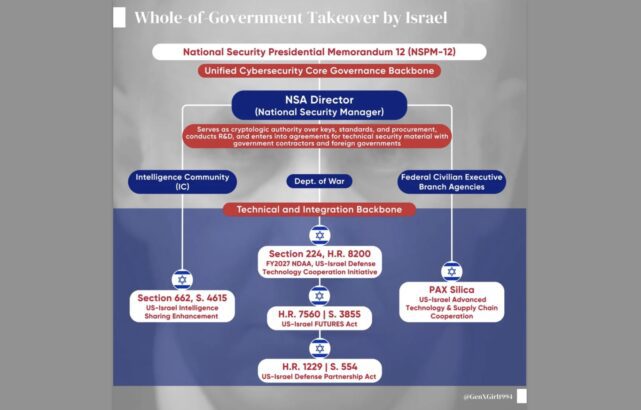
NSPM-12 establishes the core governance and administrative backbone for cybersecurity across America’s most sensitive National Security Systems. The five Israel bills advancing rapidly through Congress supply the technical and integration backbone deliberately designed to embed Israel into these same critical ecosystems while bilateral agreements like Pax Silica embed Israel into the supply chain.
Together, they create a whole-of-government entrenchment that subordinates U.S. intelligence, defense, technology and foreign policy priorities to Tel Aviv’s agenda, at the expense of American sovereignty, national security interests and taxpayers. This dangerous fusion threatens to erode sustained U.S. control over vital national security infrastructure, expose sensitive intellectual property, and severely restrict American operational autonomy.
While NSPM-12 itself is country-agnostic and confers no direct access grants, when paired with these bills and bilateral agreements, it forges powerful enabling pathways that could deliver expanded Israeli participation in the U.S. ecosystem without requiring any new explicit authorities in the memorandum.
NSPM-12: Unified Cybersecurity Framework for National Security Systems
NSPM-12, formally titled the National Security Presidential Memorandum on cybersecurity for National Security Systems, was issued on June 12, 2026. It establishes a unified policy framework across National Security Systems which encompass those owned or operated by the Department of War, the Intelligence Community, and Federal Civilian Executive Branch agencies in support of military, intelligence, and related national security missions.
The memorandum rescinds earlier directives NSD-42 and NSM-8. It prioritizes governance through the re-established Committee on National Security Systems. Core members include the Secretary of War through the Department of War Chief Information Officer, the Director of National Intelligence through the Intelligence Community Chief Information Officer, the Office of Management and Budget through the Federal Chief Information Officer, and the Director of the National Security Agency as National Manager. Advisors encompass the Attorney General, the Department of Commerce, the Central Intelligence Agency, and others.
The Committee on National Security Systems sets baseline cybersecurity requirements for National Security Systems, issues directives and standards that meet or exceed adapted NIST baselines, holds owners and operators accountable, and coordinates shared services. NSPM-12 assigns the National Manager role to the NSA Director who will provide technical advice, issues emergency directives addressing threats and vulnerabilities, serves as cryptologic authority over keys, standards, and procurement, assesses security postures, certifies security, conducts research and development, and enters into agreements for technical security material with government contractors and foreign governments.
The scope covers all National Security Systems defending against sophisticated adversaries in contested cyber environments. Emphasis falls on coordination across the Department of War, Intelligence Community, and Federal Civilian Executive Branch. NSPM-12 creates structured authorities for minimum standards, emergency actions, crypto and technology procurement including with foreign entities, information sharing platforms spanning unclassified through top secret and sensitive compartmented information levels, and international liaison. These authorities operate without naming specific countries yet explicitly enable agreements with foreign governments for security material and services.
The Five Israel Bills & Pax Silica: Deeper Defense, Technology, and Intelligence Integration
A whole-of-Government entrenchment of Israeli influence is advancing through coordinated legislation and bilateral agreements that subordinates U.S. intelligence, defense, and foreign policy priorities to Tel Aviv’s agenda, at the expense of American sovereignty, interests and taxpayers.
-
H. Res. 1339 endorses Israel Prime Minister Netanyahu’s plan to shift the relationship from U.S. aid to “mutual” defense cooperation and joint investment, praising joint operations against Iran while pushing deeper entanglement. This is a non-binding resolution that greases the way for the other bills.
-
The U.S.-Israel FUTURES Act (H.R. 7540 / S. 3855) formalizes this initiative with $150 million authorized, creating frameworks for joint ventures, co-production, and rapid fielding of Israeli tech into the U.S. military.
-
Section 224 of the FY27 NDAA establishes a U.S.-Israel Defense Technology Cooperation Initiative, tasking the Pentagon with synchronizing bilateral research, development, testing, and industrial integration across critical domains like AI, counter-drones, cyber, directed energy, and missile defense, explicitly prioritizing Israeli-origin technologies for integration into U.S. systems and programs of record.
-
The U.S.-Israel Defense Partnership Act (H.R. 1229 / S. 554) mandates a Defense Innovation Unit office in Israel, cooperative counter-unmanned systems programs, RDT&E on emerging technologies like AI and robotics, and efforts to fold Israel into the U.S. national technology and industrial base (NTIB) alongside allies like the UK and Australia.
-
Section 622 of the Senate’s FY27 Intelligence Authorization “enhances U.S.-Israel intelligence sharing” by further embedding a foreign power into America’s most sensitive national security apparatus and makes it nearly impossible to disentangle U.S. intelligence from Israel.
-
Pax Silica through its early and privileged U.S.-Israel Joint Statement, effectively locks Israel into America’s semiconductor, AI, cyber, and critical minerals ecosystems via a Joint Economic Development Group and positioning Israel as a “secure Pax Silica node.”
Overlaps and Enabling Pathways Between NSPM-12 and the Bills
NSPM-12’s governance structure intersects with these 5 Israel bills and Pax Silica across several operational areas.
Cybersecurity threat and intelligence sharing shows high overlap. Section 622 requires expanded sharing on cybersecurity threats and adversarial technology along with analytic partnerships. NSPM-12 directs the Committee on National Security Systems and National Security Agency to disseminate threat and vulnerability information across National Security Systems owners and operators, operate shared platforms including at top secret and sensitive compartmentalized information levels, and issue emergency directives. Israeli-shared cyber intelligence could therefore flow directly into National Security Systems defense posture assessments and metrics, allowing Israeli inputs to shape U.S. threat models and responses.
Crypto, standards, and technical security material procurement represent another intersection. NSPM-12 positions the National Security Agency as cryptologic authority for National Security Systems standards, keys, procurement agreements including those with foreign governments, research and development, and certification. The FUTURES Act, Section 224 of the National Defense Authorization Act, and the Defense Partnership Act advance joint research and development and co-production in cyber, artificial intelligence, quantum, and related domains.
Israeli companies and technology could enter National Security Agency-reviewed or approved National Security Systems crypto solutions or equipment through foreign agreements or National Technology and Industrial Base integration that eases export controls. The Committee on National Security Systems could adapt NIST baselines to accommodate joint standards.
Research and development, testing, certification, and integration into U.S. systems and the industrial base form additional pathways. The bills stress integrating Israeli-origin technology into U.S. military programs of record, Defense Innovation Unit acceleration, and National Technology and Industrial Base access. NSPM-12 empowers the National Manager to evaluate and certify National Security Systems security, conduct and coordinate research and development, and support technical centers.
Israeli technology in cyber, autonomous systems, and artificial intelligence domains central to National Security Systems defense could enter evaluation pipelines or shared services with Committee on National Security Systems coordination. Public-private and international liaison authorities under NSPM-12 align with the partnership models driven by the bills.
Emergency directives, accountability, and cross-agency coordination also intersect. NSPM-12 permits emergency directives to National Security Systems operators for threats routed through chief information officers and chief information security officers while holding agencies accountable through the Committee. Enhanced intelligence sharing under Section 622 or joint operations under National Defense Authorization Act and Defense Partnership Act provisions could generate threats that trigger National Security Systems actions drawing on Israeli-derived insights or technology. Linkage to ensuring Israel’s Qualitative Military Edge in Section 622 ties broader cooperation to National Security Systems resilience.
Broader access risks arise through contractors and foreign governments. NSPM-12 explicitly permits National Security Agency agreements with foreign governments and contractors for security material. National Technology and Industrial Base inclusion and co-production arrangements under the bills could qualify Israeli entities for such roles, granting indirect access to National Security Systems-related standards, classified information portals, or procurement processes. Classified collaboration environments established under NSPM-12 could expand through the mandated partnerships.
Pax Silica and the U.S.-Israel Joint Bilateral Agreement further erode American control over critical technology supply chains in ways that dangerously compound the integration already advanced by the five Israel bills and NSPM-12. While framed as a noble effort to reduce dependence on China, Pax Silica opens wide new channels for Israeli firms to access, co-develop, and embed themselves in foundational technologies that feed directly into National Security Systems, mirroring and amplifying the co-production, NTIB integration, and tech transfer mandates in the FUTURES Act, NDAA Section 224, and Defense Partnership Act.
In the context of NSPM-12’s NSA-led certification, foreign agreements, and crypto/tech procurement authorities, Pax Silica creates yet another non-transparent pathway for Israeli-origin tools and intellectual property to enter U.S. supply chains and classified environments.
Risks from Documented Israeli Espionage Activities
U.S. counterintelligence officials have long ranked Israeli espionage among the most active against the United States, even from a close ally. The Jonathan Pollard case in 1985 stands out but a myriad of other incidents include cellphone surveillance devices near the White House attributed to Israel during the Trump administration, listening devices at Defense Intelligence Agency headquarters in 2021, and attempts on Secret Service vehicles.
In June 2026 the Defense Intelligence Agency elevated Israel’s counterintelligence threat level to critical, citing aggressive human espionage and technical collection targeting U.S. officials on Middle East policy, Iran negotiations, and internal deliberations, along with spyware concerns.
These patterns, combined with NSPM-12 and the five bills, create significant risks. Expanded intelligence sharing under Section 622, joint research and co-production under the NDAA and FUTURES Act, National Technology and Industrial Base integration, and NSA foreign agreements could open pathways for sensitive National Security Systems data, standards, and classified platforms to reach Israeli entities.
Historical espionage and technology diversion precedents suggest potential compromise of U.S. sources, methods, and intellectual property, especially in cyber domains, amplifying vulnerabilities to insider threats and leakage despite existing safeguards.
Accreditation of Israeli-Origin Cybersecurity Tools Under NSPM-12
NSPM-12 empowers the NSA Director as National Manager to review, approve, evaluate, and certify tools and systems for National Security Systems cybersecurity, including government-wide standards and a technical evaluation center. Paired with the bills’ push for Israeli technology in cyberwarfare, AI, and co-production, this opens pathways for Israeli-developed tools to gain accreditation and deployment across National Security Systems.
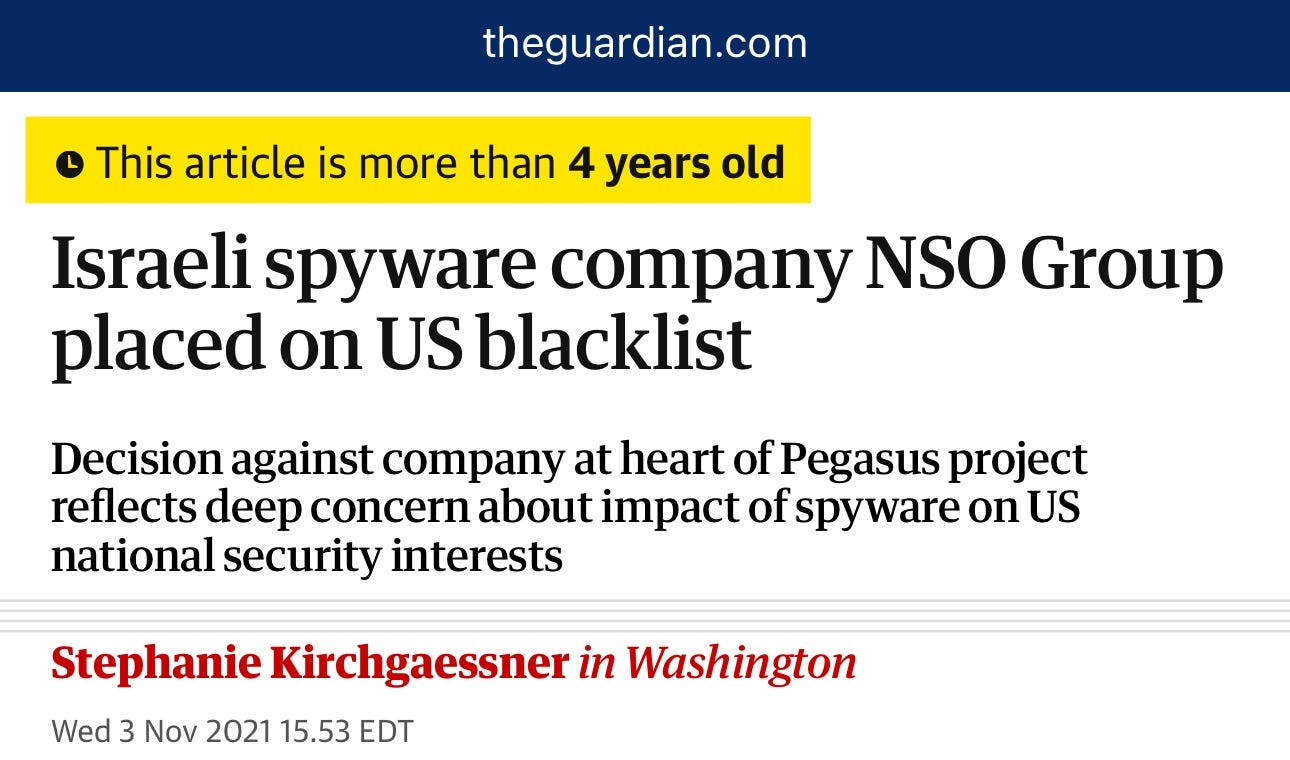
Israeli firms such as NSO Group have a documented history with Pegasus spyware, which enables covert full-device access via zero-click exploits. Pegasus has been misused against journalists, activists, and U.S.-linked targets, leading to U.S. blacklisting. Accreditation of such tools risks introducing persistent backdoors or exfiltration channels into critical systems, undermining the very cybersecurity framework NSPM-12 seeks to strengthen.
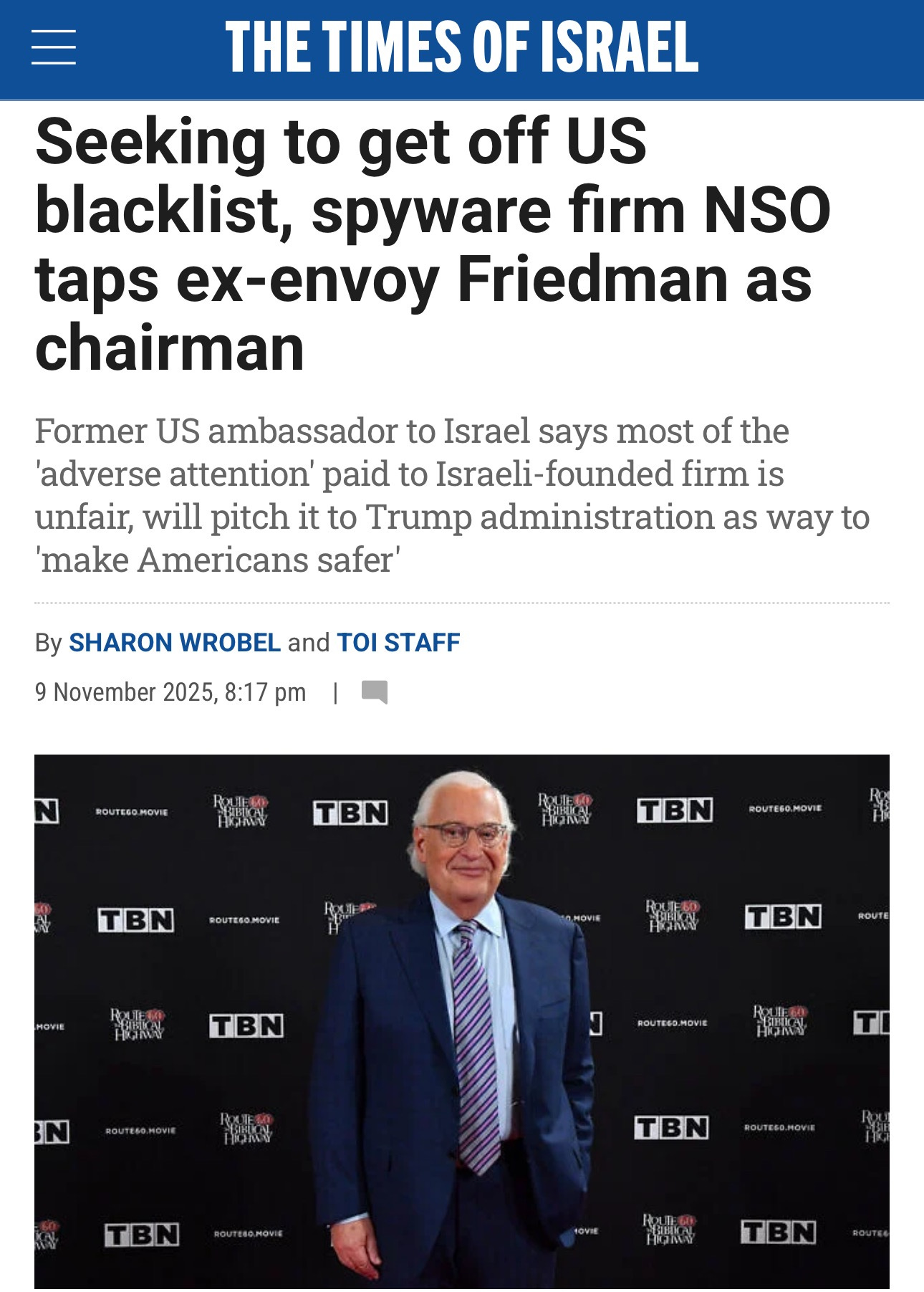
Currently, Pegasus is blacklisted by the U.S. government given the spying cases in U.S. court rulings but that will be short lived. The Israel lobby is actively pressuring the Trump Administration to remove NSO and Pegasus from the blacklist. In fact, NSO recently hired the former US Ambassador to Israel as their Chairman in an effort to further pressure the Trump Administration through an Administration insider.
Analysis of Potential Data Scrubbing and Fourth Amendment Risks
Tools like Pegasus feature stealth capabilities for data exfiltration, self-destruction, and system manipulation. No public cases confirm direct scrubbing of bulk NSA-collected U.S. person data, yet the combined NSPM-12 and bill frameworks create plausible risks in high-access settings.
Accredited Israeli tools could gain privileged access to signals intelligence platforms and supply chains. Section 622 analytic partnerships could embed them in systems handling minimized U.S. persons data under Executive Order 12333 and FISA. This raises possibilities of selective record cleaning, audit trail purging, or exfiltration.
The former Chief of the CIA’s Bin Laden Unit (Alec Station) has stated Israel bypassed Fourth Amendment protections by securing White House approval for NSA data on Americans. Institutionalized pathways under the bills and NSPM-12 would automate such access, lowering barriers for backdoor-equipped tools.
While vetting and standards exist, the integration push creates asymmetric risks given Israel’s espionage record. In short, our very own government is forcing America and Americans to stab themselves in the chest for the benefit of Israel.
GenXGirl1994 Writes on Government Corruption, Free Speech, and is Anti-War.
RELATED:
- Senate is quietly working on new legislation that includes MANDATORY, expansive intelligence sharing with Israel
- Senate wants to force US to share sensitive intel with Israel
- The Disappearing Aid Check: The Future of US–Israel Defense Support
- US-Israel integration in NDAA is far from ‘America First’ – Joe Kent
- Congress Is Quietly Making Israel a Permanent Pillar of U.S. Military Modernization