The head of the IDF Central Command has effectively ordered troops to shoot stone-throwers on sight – so long as they are Palestinian. Soldiers are following through. Youssef Shtayyeh, 15, was shot dead from 100 meters away as he fled
Avi Bluth, the top officer in the Israel Defense Forces Central Command, this week reformulated the army’s long-standing Code of Ethics – and the chief of staff was silent.
According to Maj. Gen. Bluth, it’s permissible and even perhaps necessary to open fire at stone throwers – who in almost every case are children or teenagers – as long as they are Palestinians. If they’re Jews, they mustn’t be shot because of the “sociological consequences” of such an act, as he put it in his twisted apartheid language.
Sociological consequences of killing children arise, then, only if those shot are Jews, members of the Chosen People, but not if they are inferior, sociologically inconsequential Palestinians. Bluth, who also introduced a new satanic term into the discourse here – “limping monuments,” referring to wretched job seekers who are mercilessly shot in the legs by his soldiers, leaving them disabled for life – also boasted that under him, the IDF killed has more Palestinians than ever before.
That is of course false, since more were killed in the intifada years, but the very fact that such a high-ranking commander takes pride in the number of local inhabitants his troops have killed is absolutely disgusting.
And all of this drew a yawn from Israel.
Fully 96 percent of those killed in the last three years were involved in terrorism, the general in charge of the military in the West Bank and Jordan Valley declared. Obviously. After all, to him, every Palestinian who’s born is somehow umbilically tied to terrorism.
Bluth would thus certainly consider Youssef Shtayyeh, a 15-year-old from Nablus, to be marked for death. According to the officer’s bizarre sense of morality, his troops did the right thing when they killed him in cold blood a few weeks ago, from a considerable distance, as he fled without posing any visible danger to them. The general’s citation is already in the mail.
Nablus’ Rafidia neighborhood is a tranquil residential quarter on the slopes of Mount Gerizim – the site of both Rafidia Hospital, a government institution, and An-Najah University. The Shtayyeh family lives in a modern apartment building there; the office of the father of the household, Sameh, 49, an affluent building contractor, is on the ground floor. His wife, Nidah, 42, is a pharmacist. Until two weeks ago the couple had three sons – Abdullah, 17, 15-year-old Youssef and 10-year-old Mohammed – but now only two remain. The grief here is great, but pent-up.
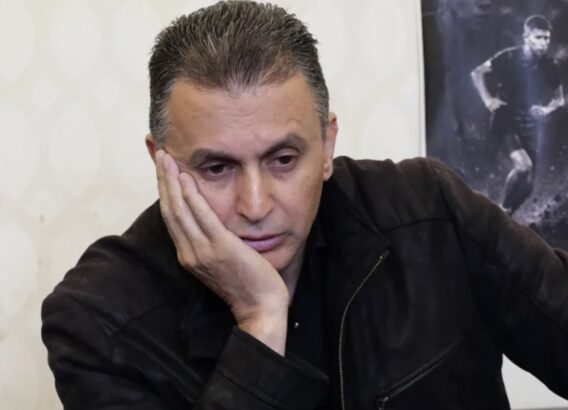
Sameh, wearing a black leather jacket, doesn’t weep. At the end of this month the family was supposed to go on a two-month trip to Spain, Dubai and Saudi Arabia, a kind of coming-of-age journey for Youssef, a competitive swimmer and soccer player who dreamed of seeing Real Madrid play.
He was very excited about the trip, Sameh says, adding that they go abroad every summer, usually to Dubai. Last year Youssef hooked up with some Israeli teenagers at the pool of the hotel they were staying at there. But there will be no trip this year.
“That is our fate. We are losing our children without any reason. The army took Youssef from me, took him and fled the scene,” Sameh says.

He calls Youssef “my baby” when speaking in Hebrew and Arabic. The boy’s cellphone, stained with his blood, is in his father’s pocket. Hanging on his office wall is a processed photo of the soccer player-in-the-making: Youssef dribbling a ball in the dark, enveloped by what looks like a storm. He was in 10th grade at Muscat Secondary School, which was built thanks to funds donated by the Sultanate of Oman to the Nablus school system.
On April 23, a Thursday, the three brothers went off to school: Abdullah and Youssef were taken as usual in a taxi to theirs, in the nearby village of Beit Iba; Mohammed took a bus to his elementary school in Nablus.
Sameh promised to pick them all up at the end of the day, but he was delayed and ended up going home first. Abdullah waited for him, but Youssef went home in a taxi. When Sameh got home, he saw Youssef’s schoolbag, but the youth wasn’t there. Nidah told him that she had paid for the taxi and that Youssef had left immediately afterward. There were rumors then that the IDF had entered the city and that soldiers were heading for Rafidia.
A few minutes after Sameh left to pick up Abdullah about 1 P.M., some shots were heard in the neighborhood. First one shot and then four or five more. On the way, Sameh noticed two cars on the road. He could not have known then that his son was in one of them, dying.
Meanwhile, he placed several desperate calls to Youssef, all of them unanswered, as his cellphone shows. His fears grew. His wife, distraught, also kept calling their son. Their concern grew when relatives started calling and asking how Youssef was – they had already grasped what Sameh only surmised. At first someone told him the teenager had been wounded in the leg and was in Rafidia Hospital, but when he and Nidah got there, they were informed that no wounded person had been admitted.
The hospital’s security guard offered to help Sameh and called the other hospitals in the city. One private hospital told him that a person who had a shoulder wound had arrived. Sameh, increasingly apprehensive, rushed there.
According to Salma a-Deb’i, a field researcher for B’Tselem – The Israeli Information Center for Human Rights in the Occupied Territories, three army jeeps hurtled into the city in the early afternoon. The word in Nablus is that the troops had come to arrest a suspect from an Israeli Arab crime family, but the IDF Spokesperson’s Unit did not specify the reason for the incursion in the statement it put out later.
There were no clashes while the force was in the city, a-Deb’i notes, and no stone throwing. The troops were about to leave – it’s not clear whether they had taken anyone into custody – just as the schools got out. As the vehicles were leaving the main street and heading up to the Rafidia neighborhood, five or six young people, among them Youssef, gathered and threw a few stones at them. The jeeps were about 100 meters away, a-Deb’i says, and the stones didn’t endanger anyone in the armored jeeps, and it’s unlikely that they even came close to the vehicles.
The youths tried to flee, but the soldiers apparently decided to deal with them by lethal means. The jeeps stopped and three soldiers emerged from one of them. Eyewitnesses told a-Deb’i that one walked over to the first jeep, spoke to an officer, and then assumed a firing position, on one knee. The boys began to flee.
The soldier aimed and fired a single shot, hitting Youssef on the right side of his upper back as he ran away. Shooting, and killing, a person running for his life has seemingly become a matter of routine in the West Bank.

A-Deb’i reported that eyewitnesses told him that after Youssef was hit, the soldier fired another four or five bullets at him.
The IDF Spokesperson’s Unit stated that proper suspect arrest procedures had been followed, but according to the testimonies it happened in reverse: First the teenager was killed, and then warning shots were fired. Blurry video footage taken from afar by an eyewitness documents Youssef’s final moments. He is seen stumbling toward a private car that was passing by.
The car’s occupants, an elderly couple, told the B’Tselem field researcher that at first they didn’t realize that the boy wanted them to stop, but then they bundled the frightened and bewildered youth into their car. The soldiers, they said, fired a few more rounds at Youssef as he approached the car and the couple became fearful for their own lives. It was only after the teenager suddenly collapsed in the back seat that they saw blood streaming from his chest, at the bullet’s exit point.
The car sped to the private hospital in the city; the couple later said they were afraid to go to Rafidia, because the army was still on the main street.
The troops left the scene immediately after the shooting. In the past, a-Deb’i points out, soldiers fired tear gas or stun grenades at stone throwers, but in the last two years they have shot to kill.
The IDF Spokesperson’s Unit made do this week with a standard, dry, generic response: “On April 23, during operational activity of the security forces in Nablus, in [the area assigned to] the Shomron Brigade, a terrorist threw stones at the forces. The forces executed the suspect arrest procedure [and] at its conclusion opened fire at the terrorist. The claim that a Palestinian was killed at the site is known.”
So it goes: The boy is a “terrorist,” his death is “known,” to whoever killed him in cold blood.
At the hospital, Sameh and Nidah were informed that Youssef had died on the operating table. The staff had tried to delay the announcement of the death a little – their son was in fact dead upon arrival.
The skies of Nablus were overcast this week, and a cold wind howled through the city.
“The soldier targeted my child,” the bereaved father tells us. “I would like to ask you: Does the killing of my son help great Israel? How does a country like Israel shoot children? And another question: In Tel Aviv, people demonstrate and throw things at the police – are they killed? My son didn’t manufacture missiles. He didn’t endanger any soldier. Shooting children hurts your image internationally.
“I carry my son’s death in my heart,” he continued. “But you [in Israel] have to understand that without morality, a country is not strong. It’s not normal for a country like Israel to behave like a criminal gang. Killing children is no solution to anything. The soldiers didn’t think of my child for a second. It’s gang behavior. Soldiers like that must be kept out of the army.”
Youssef went to swim practice in a local hotel pool, in the city’s Sport Village and also in the Olympic pool on Mount Ibal. He also trained in Nablus’ international soccer academy. His coach told Sameh that Youssef was built like Ronaldo. The rather ominous picture of the youth charging ahead with the ball was taken at the municipal stadium a few months ago. “The soldiers will be happy to know that they killed a soccer player,” the father says.
Gideon Levy & Alex Levac are Israeli reporters for Haaretz.
RELATED:
- More than half of Palestinian child detainees have no charges
- ‘Catastrophic,’ Says UNICEF: 1,100+ Children Killed or Wounded in Mideast Since US-Israel Launched Iran War
- Tucker Carlson visits Gaza refugees, accuses Israel of murdering children
- The most precarious place in the world to be a child: Israel’s year of war on children
- 1 in 5 amputees in Gaza is a child, UN warns amid prosthetic care crisis