By Gideon Levy and Alex Levac, Reposted from Haaretz, April 24, 2026
Al-Mughayyir is under attack. It’s probably the most relentlessly assaulted Palestinian village in the West Bank these days. No one is coming to its defense, the army is not lifting a finger – sometimes it even collaborates with the settler-pogromists – and the villagers are distraught and helpless. Violent invaders swoop down upon them almost daily from the unauthorized outposts that have sprung up nearby, killing, maiming, stealing, looting, torching and uprooting. Five times this month alone, settlers have stolen what local shepherds estimate to be hundreds of head of sheep.
But what happened this past Sunday, in advance of an even more terrible incident, was unprecedented. This time the theft took place in broad daylight, as eyewitnesses filmed the scene, and it was on a particularly large scale: It involved 170 sheep, worth about 3,000 shekels ($1,000) each, and after making off with the flock, the settlers had the audacity to claim that it was the villagers who had stolen their sheep.
On top of this, the Israel Defense Forces quickly escorted the rustlers back to their outpost, Or Nachman, over the hill, with their booty, protecting them from the Palestinians who tried to get their livestock back. In response, the troops fired live ammunition and tear gas at them and then proceeded to enter Al-Mughayyir, where they launched aggressive searches of homes, ostensibly looking for the sheep that had supposedly been stolen from the settlers.

As if the wholesale theft of the animals wasn’t enough, on Tuesday, the day after we visited, a settler in uniform apparently fired live ammunition into a group of people near the local school, killing two. Naturally, the villagers are deeply fearful of what will happen next.
In 2000 the shepherds of Al-Mughayyir owned 30,000 sheep. Today they say they have fewer than 5,000 and they can’t be taken to pasture: Settlers intimidate them nonstop and have also taken over some of the village’s land.
Indeed, according to local council head Amin Abu Aaliya, of the 42,050 dunams (10,512 acres) residents owned before October 7, 2023, only 950 dunams remain, and not all of it is agricultural land. All the rest has been seized by the unruly inhabitants of the illegal outposts dotting the area, particularly Or Nachman, Adei Ad, Mevo Shiloh and Shlisha Farm. The villagers no longer dare to approach their own property.

Everything that has been happening in the West Bank during the past two and a half years seems to be occurring on a more intense level in this beautiful village of 4,000, in the Ramallah district. Settlers are now stealing the remaining sheep and killing local residents.
Last week, in the dead of night, they stole 70 sheep from a farm abutting Al-Mughayyir that had already been set ablaze in the past, according to a report by Muhammad Rumana, a field researcher for B’Tselem – The Israeli Information Center for Human Rights in the Occupied Territories.
Despair and terror are etched on the faces of the many farmers and shepherds who are flooding the office of the council head (who himself gets to work on a tractor) in order to seek consolation and advice. After the possibility of working in Israel was revoked for West Bank Palestinians, large numbers of olive trees were axed, burned and rendered inaccessible, herders have fallen victim to sheep rustling. When the settlers discovered that IDF troops were not coming to the defense of the villagers, as it is obligated to do under international law, but were actively participating in the theft of livestock – as has been amply documented – they stepped up their efforts.

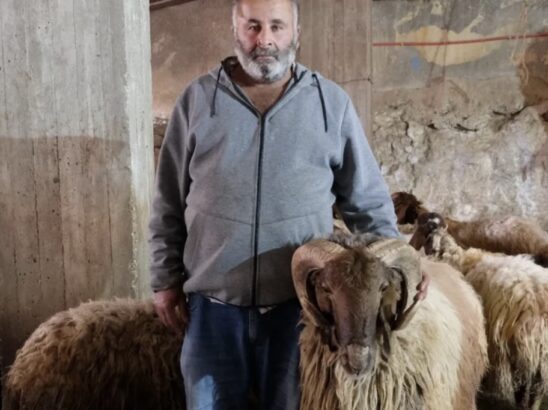
“Is there any way to protect my sheep?” Anis Abu Aaliya, the last shepherd to fall victim to such plundering, to date, asked naively this week as we stood on the roof of his house, overlooking the empty pen. Anis knows exactly where his sheep were taken that night, thanks to a neighbor who witnessed the event: to Or Nachman to Shlisha Farm. Of course there’s no way Anis can get there or do anything to retrieve the flock. The local authorities haven’t done anything, either, other than to receive the complaint he filed and announce that they have launched an investigation.
Up on the roof, Anis, 49, looks down sadly. The father of four, and former owner of 200 sheep, says that now only 30 remain; they were not in the pen at the time of the theft. At about 9 A.M. on Sunday, he had taken the flock to graze near his house – afraid to go any farther – when suddenly six masked settlers, armed with clubs, appeared. He realized immediately what they were up to and tried to herd the animals toward his house, but the odds were against him. The settlers, descending the hill on foot, rushed in and began to hustle the flock upward, toward Or Nachman.
Anis shouted for help as the plundered sheep were herded up the rocky slopes. Dozens of villagers arrived and tried to make their way up to the outpost but about 100 meters away from it, a military force accompanied by Or Nachman’s security chief showed up – they had obviously been summoned by the settlers – and chased the villagers off with tear gas and live ammunition.
Anis says he tried to explain to the soldiers that it was the settlers who had stolen the flock, but they ignored him and forced him and his neighbors to turn back toward home. “You can’t prove these are your sheep,” an officer told him. Of course anyone familiar with the situation in the territories in recent years knows there is absolutely no way Palestinians would dare to invade a violent outpost and steal sheep from it.

About a half an hour later, the villagers who had tried to help Anis returned home, defeated and despondent, seven army jeeps, two police vans and two Border Police vehicles roared into Al-Mughayyir, searching for the sheep that had ostensibly been stolen from the settlers. The forces stormed a number of homes, firing tear gas along the way – also outside the local school where teachers were forced to disperse the students, a scene that was repeated with fatal consequences two days later.
During their search, the soldiers and police officers entered the home of Rakad Abu Aaliya, 46, a distant relative of Anis who has six children. They pushed his 12-year-old son Zeidan against a wall, wounding him lightly. Rakad refused to allow the invaders to reach his sheep pen and managed to stave them off while a few neighbors quickly moved the animals out, scattering them around the village. Rakad’s flock was not in the pen next to his house on Monday either, in order to keep them from becoming the target of yet another raid.
A few troops, apparently accompanied by two settlers, also showed up at the home of Anis’ brother, 56-year-old brother Shawki. A brawl ensued but the soldiers retreated.
Upon leaving, the soldiers and police officers locked the iron gate at the village’s western entrance – the only one that had been left open since the start of the war in the Gaza Strip. Al-Mughayyir remained under a total siege for about four hours, the council head tells us; ambulances were denied entry.

For his part, Anis tried to file a complaint at the Sha’ar Binyamin police station later in the day, on Sunday, but was prevented from entering and was told by duty officers that the settlers had already filed a complaint against him for stealing their sheep. Returning the next morning, he managed to submit his complaint, document No. 169507/2026. The police are investigating.
Meanwhile, this week, Anis’ nephews, Zahar, 34, and Awad, 26 – two of his brother Shawki’s four children – were laboring to build a gate at the entrance to the compound including their uncle’s house and sheep pen in a desperate effort to protect family and property.
As family and friends were recalling the harrowing events during our visit the following day, an army jeep – whose passengers included settlers in uniform, we were told – again hurtled into the village.
In response to Haaretz’s query, the IDF Spokesperson’s Unit stated this week: “On Monday, IDF troops and Israel Police officers rushed to the village of Al-Mughayyir, which is in [the territory assigned to] the Binyamin Brigade, in the wake of a report that was received about Palestinians who stole a flock of sheep from Israeli citizens. The forces entered the village with the aim of recovering the flock. During their entry, a Palestinian suspect who resisted detention and also attacked the force was detained. The IDF and the Israel Police acted to remove all the Israeli citizens from the village. During the incident no sheep were taken from the village.”

The theft of sheep on Sunday that had so agitated local residents was, however, dwarfed by what happened on Tuesday: Again settlers stormed into Al-Mughayyir, again locals tried to block their way – and then a settler wearing an IDF uniform apparently knelt down and fired multiple rounds, from a distance, at a group of residents who had gathered next to the school. Marzouq Abu Naim, 32, and a 12-year-old boy, Aws Hamdi al-Naasan, were killed. Four residents were wounded.
Villagers say they know the settler’s name. They disseminated his photo this week on social media, where there were reports saying he is the principal of a school in a nearby settlement. For its part the IDF, which is investigating the incident, related that stones were thrown at an Israeli vehicle and a reserve-soldier passenger had fired shots at the Palestinians.
Seven years ago, we reported that settlers who had entered Al-Mughayyir killed Hamdi Naasan, 38, the father of Aws who was shot to death this week. In the earlier incident, the invaders claimed they had been under attack; then, too, the army had joined the settlers’ assault on the village, using live ammunition and tear gas.
A photograph taken back then of little Aws, hunched over his father’s body, is permanently etched in the mind.
Gideon Levy is an Israeli journalist and author. Levy writes opinion pieces and a weekly column for the newspaper Haaretz that often focus on the Israeli occupation of the Palestinian territories.
RELATED:
- ‘Day of Ordinary Terror’: Israeli Attack on West Bank School Kills Man, Child
- Israeli soldiers using sexual assault to force Palestinians out of West Bank, report says
- Israeli soldiers echo settler ideology, talk of revenge after targeting Palestinians and detaining CNN crew in the West Bank
- In the West Bank, life is a constant battle – 3 articles
- Israeli media reports grotesque settler attack in West Bank