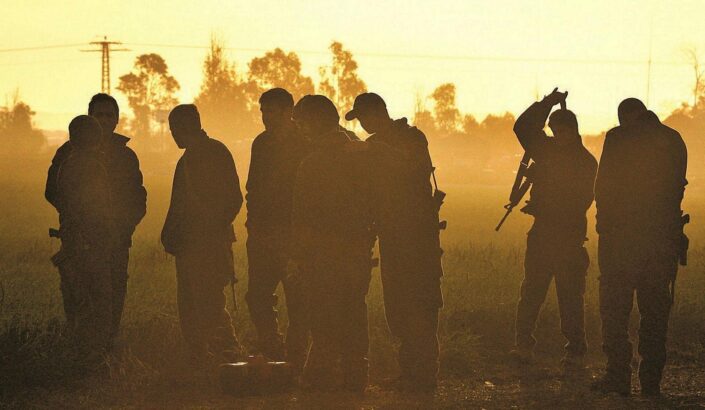
This week, Israel was revealed as an apartheid state even for the dead: a segregation regime for skeletons.
By Gideon Levy, Reposted from Ha’aretz, January 28, 2026
Israel has heroes the likes of which we’ve never seen – body scavengers: hundreds of soldiers, rabbis, pathologists, and dentists who were recruited to find the remains of Ran Gvili in the Gaza Strip. “There was crazy excitement,” the dentist who identified the teeth of the former hostage relayed. Alongside the understandable joy at finding his body, it’s impossible to ignore the necrophilic frenzy that has gripped Israel.
While one might understand those who are “crazy excited” that the body had been found, it is impossible to ignore the heavy price and the double standard surrounding the exhumation and brutal desecration of the remains of hundreds of Palestinians in what was defined as a mission of national heroism, Operation Brave Heart.
Moreover, if before this Israel was considered an apartheid state for its living subjects, at Gaza City’s al-Batsh Cemetery, it was revealed as an apartheid state even for the dead: a segregation regime for skeletons.

A state that abducted and continues to hold hundreds of bodies – some buried, some frozen for months and even years – is willing to charge any price for the return of a single body. To recover Gvili’s remains, the state is permitted to do anything. Only Jewish Israelis dream of bringing their loved ones to Israel for burial. It is as if the hundreds of Palestinians who dream of bringing their loved ones to Palestine for burial don’t exist. Even the dead have no rights. The body brokers continue to hold corpses as bargaining chips in a barter that will never end.
Israel’s dead have all returned, and it continues to seize bodies and save them for a rainy day. The refrigerators and the cemeteries are full to the brim with the dead, each one of whom has parents and children who long to give them a proper burial. But Israel is adamant: Only we have feelings. Only we are human beings.
On January 27, while Israel celebrated the finding of the body of the last hostage and al-Batsh Cemetery became a sandy plain, four young men, residents of Gaza City, went to what used to be a cemetery to search for the bodies of their loved ones. Each of them carried a different pain. One was looking for his father’s grave, another for his mother, the third for his brother, and the fourth for his sister.

The IDF killed all four of them: Mahmoud Lulu, Abdul Qader Abu Khader, Abdul Karim Ghabayen, and Yusuf al-Rifi, a minor. As of January 28, the IDF spokesperson had not responded to Haaretz’s question about why they were shot dead. Taking the lives of innocent people is also worth it to find the body of the last Israeli hostage.
Nothing remains of the cemetery where hundreds of people were buried. The IDF spokesperson told Haaretz on Wednesday: “All of the bodies were reinterred in the same area using soil brought by the IDF. No bodies were left on the surface.
Al Jazeera broadcast on Wednesday two videos filmed by brave residents who went to the IDF-controlled cemetery in search of the remnants of their relatives’ graves. “Here’s a body, and here’s another body,” the man recording the scene says softly, panting, agitated.
The scene is distressing: The videographer points to torn plastic bags, presumably containing human remains, that roll on the ground. The vast area is entirely covered in sand; not a single grave remains. If in the first Nakba, that of 1948, Israel was careful to preserve cemeteries, in the Gaza Nakba, not a stone in al-Batsh remained standing. How will people find the graves of their loved ones? How will they find their bodies in the sand?
And in Tira, in northern Israel, the family of Walid Daqqa, who died in an Israeli prison after 38 years of incarceration, waits for his body. They’ve been waiting for almost two years: his wife, Sana, their daughter Milad, and his brother, Assad; waiting and waiting – in vain.
Gideon Levy is an Israeli reporter for Haaretz.
RELATED:
- Gaza’s ‘Board of Peace’ – A New Phase of Palestinian Dispossession and Genocide
- Iran, Gaza and the politics of counting the dead
- War on Gaza – Two Years of Extermination and Counting
- Gaza: US Forces Can Be Liable for Assisting Israeli War Crimes
- ‘Every Atrocity Imaginable’: Litany of Israeli War Crimes Continues