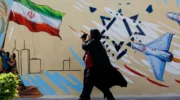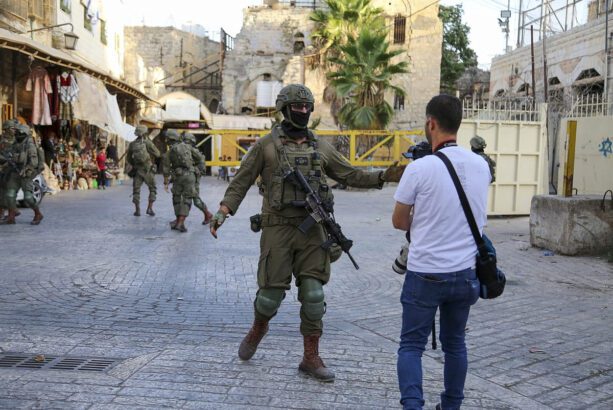
In 2025, the military censor banned or redacted over 5,000 news reports, with suppression peaking during Israel’s war with Iran.
By Haggai Matar, reposted from +972 Magazine, June 17, 2026
Last year, the Israeli military censor halted the publication of an average of two articles per day by media outlets in Israel, while interfering in the content of another 13. This makes 2025 the second-highest year on record for media censorship in Israel since +972 Magazine began tracking it 15 years ago — second only to 2024.
According to limited data provided in response to a freedom of information request by +972 and the Movement for Freedom of Information, the censor — a unit inside Israel’s Military Intelligence Directorate — demanded redactions in 4,974 news items last year. That’s down from 6,265 in the previous year, but significantly higher than the average of around 2,300 annually between 2011 and 2023.
Additionally, the censor completely barred 753 news items from publication — down from 2024’s record-breaking 1,635, but still above the prior annual average of around 320. In all, the Israeli military prevented information from being made public over 15 times a day, on average, throughout 2025.
Israeli law requires media outlets to submit articles dealing with issues of “security” to the censor for review prior to publication, in line with the “emergency regulations” enacted following Israel’s founding that remain in place today. The total number of news items that media outlets submitted to the censor in 2025 was 17,176, compared to a previous annual average of just under 12,000 and an all-time high of 20,770 in 2024.
The censor is only permitted to intervene when there is a “near certainty that real damage will be caused to the security of the state” by an article’s publication. But the list of topics falling under the censor’s definition of security is vast and includes information relating to undisclosed arms deals, administrative detention, intelligence activities, troop locations, and the targets of missile strikes.

The law gives the censor the authority to indict journalists and fine, suspend, shut down, or even file criminal charges against media organizations that do not comply. It is the responsibility of each outlet’s editors to decide what to submit before publication, although the censor can also intervene retroactively and request the removal of articles published without its approval (as it did last year with a column in Haaretz that described the locations of Iranian missile strikes in Tel Aviv, for example).
Media outlets are also barred from revealing to their audiences whether and to what extent the censor interfered with an article. In the case of television news, a representative of the censorship authority is often present inside studios to monitor live content. (For more background on the censor and +972’s stance toward it, you can read the letter we published to our readers a decade ago here.)
The censor’s black box
As part of Israel’s military intelligence apparatus, the censor is exempt from the Freedom of Information Law. It is therefore not obliged to disclose data upon request, and invariably refuses to respond to most of our inquiries for specific information.
Even relatively general questions, whose potential risk to national security is highly questionable, went unanswered this year — including requests for a breakdown of interventions by media outlet, a general categorization of the grounds for full and partial redactions, and information on enforcement measures taken against violations of the censorship regulations.
For the first time since we began collecting data a decade ago, however, the censor’s response this year noted two new categories for its interference in the media: It disclosed that the publication of one article had been “delayed,” while 92 articles were “returned without treatment.” It did not provide any further information about the meaning of these new categories.
We also received limited information regarding Israel’s national archive (known as the Israel State Archive, or ISA). Since the ISA began a digitization process in 2016 and shifted to mostly online record viewings, the military censor has intervened to determine which scanned documents are uploaded. As a result, documents that the ISA had long ago decided to release to the public have disappeared.
In response to our inquiries about the scale of this operation, the censor revealed that the ISA submitted 3,422 files for review in 2025 and that “the vast majority of them were approved without amendment or redaction.” Our requests for more precise information were not answered.

While the data indicates a general increase in censorship since October 7, interference was most intensive during periods of war with Iran. Police, municipal inspectors, and sometimes civilians enforced severe restrictions on reporting the locations of Iranian missile strikes, sometimes impeding reporters and photographers in the field — particularly Arab and foreign journalists.
The two men responsible for the spike in censorship over the past two years — Kobi Mandelblit who served as chief censor until April 2025, and Netanel Kula who replaced him — are both relatives of senior legal appointees from the religious-Zionist movement: Mandelblit is a cousin of former Attorney General Avichai Mandelblit, while Kula is the son of the Ombudsman of the Israeli Judiciary, Asher Kula. Three months after Kula replaced Mandelblit as chief censor, reports leaked that he had pulled reports about Prime Minister Benjamin Netanyahu’s son purchasing an undisclosed home abroad. (The story came out anyway.)
There were, however, several known cases of media outlets flouting censorship regulations last year — particularly on the far-right. The ultra-nationalist Channel 14 published sensitive combat plans and military intelligence tools time and again despite security officials determining it caused “actual harm” to national security, and yet not once was it penalized. Ironically, it was Israeli liberals who advocated for censoring the channel’s freedom of expression, rather than amplifying the growing voices against the practice as a whole.
In the current era of digital journalism that transcends borders, when Israeli journalists themselves often publish stories in foreign media outlets to circumvent the censor, the age-old institution is both anti-liberal and outdated.
The stories left untold
“It is particularly important during times of emergency to receive reliable information about changes regarding the censor’s activities,” said Or Sadan, an attorney from the Movement for Freedom of Information and director of the Freedom of Information Clinic at the College of Management Academic Studies. “Although there has been a slight decrease from last year, it is hard not to notice the alarming rise in the number of news reports being hidden from the public.”
He added: “Democracy is based on the transfer of information from the government to the public, and any infringement upon this is a direct infringement upon democracy.”
While military censorship constitutes an extreme and exceptional attack on press freedom in Israel, however, it is not the most acute violation of such freedom by the Israeli military. First and foremost is the killing of over 250 journalists in Gaza, Lebanon, Yemen, and Iran since October 7 — some of whom were directly targeted, including in “double-tap” airstrikes.
Simultaneously, the army continues to shoot, beat, and arrest West Bank journalists, and torture those imprisoned, often without charge. Within Israel’s borders, new waves of proposed legislation aim to undermine Israeli media independence, and the government continues to attempt to seize control of media outlets, empower sympathetic journalists, and harm their rivals. It is thus no coincidence that Israel continues to plummet in the international press freedom index, where it recently ranked a dismal 116th out of 180 countries.
Yet journalists in Israel are still largely free to tell the stories they deem most important and most do not, making the most severe censorship taking place in Israel self-censorship.
As my colleague Sebastian Ben Daniel (John Brown) recently demonstrated, Israel’s largest, most respected investigative programs on commercial channels — produced by so-called liberal reporters — have not once addressed the military’s policies in Gaza or the West Bank over the past two and a half years. Nor have they reported the killing of tens of thousands of children and other innocent Palestinians in Gaza, the deliberate starvation and destruction of entire Gazan cities, or the numerous other war crimes Israel is committing.
None of that is because of the military censor. It is done by choice.
Haggai Matar is an award-winning Israeli journalist and political activist, and is the executive director of +972 Magazine.
RELATED:
- Western Media Normalize Ethnic Cleansing of Lebanon by Viewing It Through Israel’s Eyes
- Censorship and Thuggery Won’t Save Israel’s Reputation
- The Issue of Israel Is Ending Democracy In Michigan
- The Faustian Bargain of Journalists Embedding with the Israeli Military in Gaza
- Defining Dissent: How the Federal Crackdown on Anti-Semitism Redefines the Boundaries of Speech