Reposted from Al Jazeera, August 11, 2025
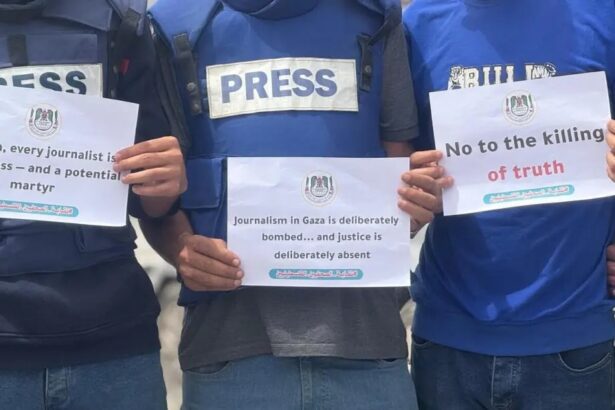
Despite mounting evidence, dating back to the early days of the Israeli war on Gaza, of the deliberate targeting of Palestinian journalists—and their status as both declared and undeclared targets, most recently including journalists Anas Al-Sharif and Mohammed Qreiqea—many mainstream Western media outlets persist in adopting and perpetuating the Israeli narrative. This framing continues to shape and influence discussions around the systemic killing of Palestinian journalists in Gaza.
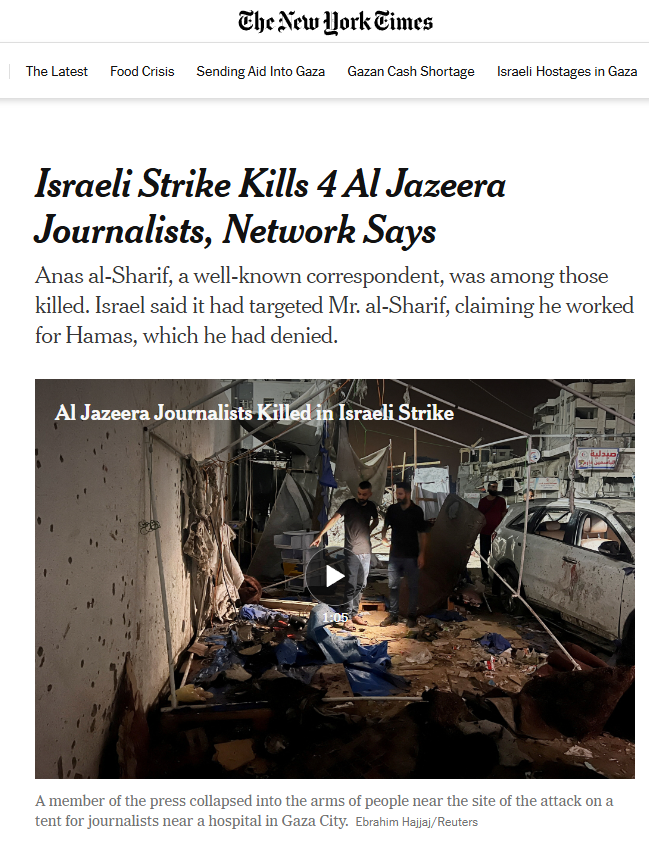
In The New York Times, the headline reads: ‘Israeli airstrike kills four Al Jazeera journalists, network says’. The Times continues to use cautious phrasing—attributing claims of killing or targeting, when perpetrated by Israel, to an unconfirmed account or a source it presents as questionable—rather than stating them as fact, even amid abundant evidence. When Israel bombs a hospital, casualties are sometimes noted only as ‘according to the Hamas-run Health Ministry’. When Israel directly killed Al Jazeera journalists, the chosen framing in the headline is “…[Al Jazeera] network says”.
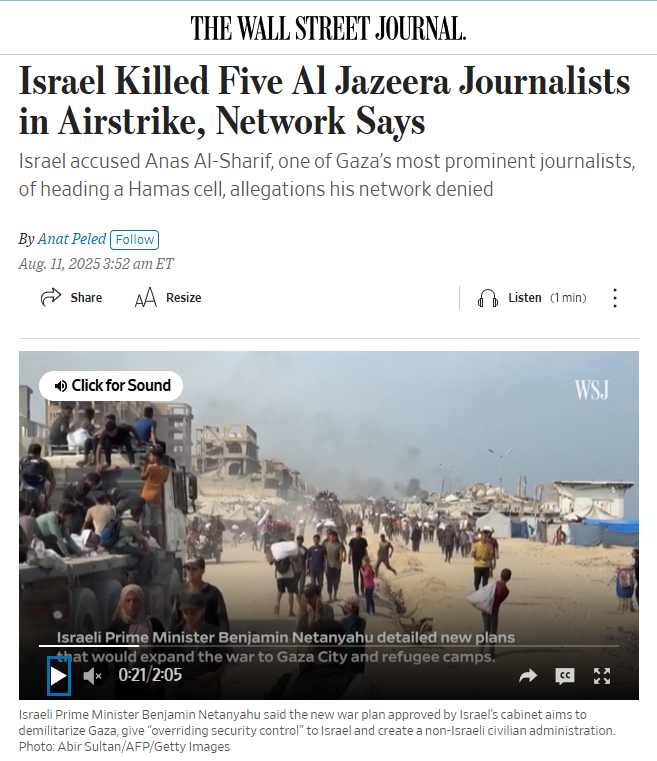
To ‘balance’ the story, mainstream outlets amplify Israel’s unverified accusation that Anas Al-Sharif was the head of a Hamas cell—an allegation he has repeatedly denied. The result is a narrative reduced to claim versus counterclaim, as if the killing of journalists were merely a matter of opinion. Other outlets follow the same safe formula, The Wall Street Journal among them. In their reports, both papers give generous space to Israel’s charges against Al-Sharif—that he ‘led a terrorist cell’, was ‘responsible for rocket attacks on Israeli civilians and soldiers’, and that Israel had earlier produced what it claims is evidence of his affiliation with Hamas.
Other media outlets, including the BBC, gave significant weight to the Israeli narrative, branding Al-Sharif a ‘terrorist’. The BBC, The Guardian, and others framed their coverage of the killing of Al-Sharif and his colleagues—Mohammed Qreiqea, Ibrahim Thaher, and Mohammed Noufal—around this allegation. The effect was a pattern in which the Israeli claim became the central thread, overshadowing the basic fact: that journalists in their tent were directly and openly targeted, despite being civilians by definition—a reality that, editorially, should not be undermined by any Israeli claim of alleged affiliations or activities.
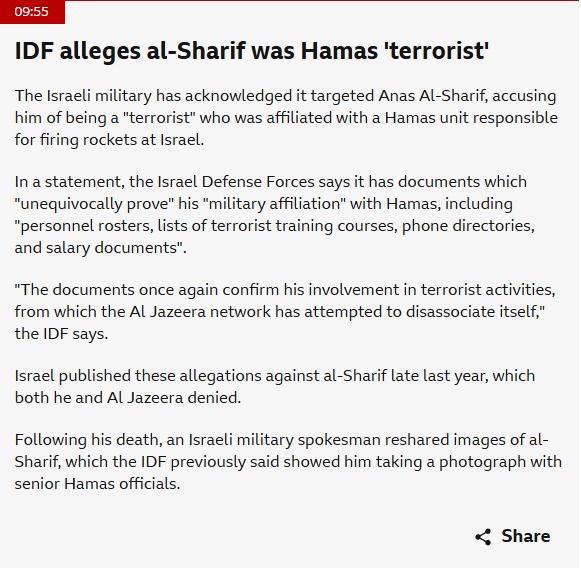
The New York–based Committee to Protect Journalists (CPJ) underscored this point, noting in a statement that Israel’s allegations fit a pattern of charges repeatedly levelled against Palestinian journalists without credible evidence. CPJ and other human rights organisations had already stated, in earlier releases over recent months, that there is no evidence to support Israel’s accusations against Al-Sharif. ‘Israel’s pattern of labelling journalists as militants without providing credible evidence raises serious questions about its intent and respect for press freedom,’ said CPJ’s regional director, Sara Qudah. ‘Journalists are civilians and must never be targeted. Those responsible for these killings must be held accountable,’ Qudah added.
By contrast, the BBC—along with major outlets such as The New York Times and The Washington Post—omitted from their coverage numerous warnings issued by international organisations, including CPJ itself, Reporters Without Borders, Al Jazeera, and UN Special Rapporteur Irene Khan, about Israel’s threats to target Al Jazeera correspondent Anas Al-Sharif and the campaign against him by the Israeli army and its propaganda apparatus. Many leading Western media outlets also ignored Al-Sharif’s final message, posted on his social media accounts, when he sensed he had reached the threshold of Israel’s death zone in Gaza.
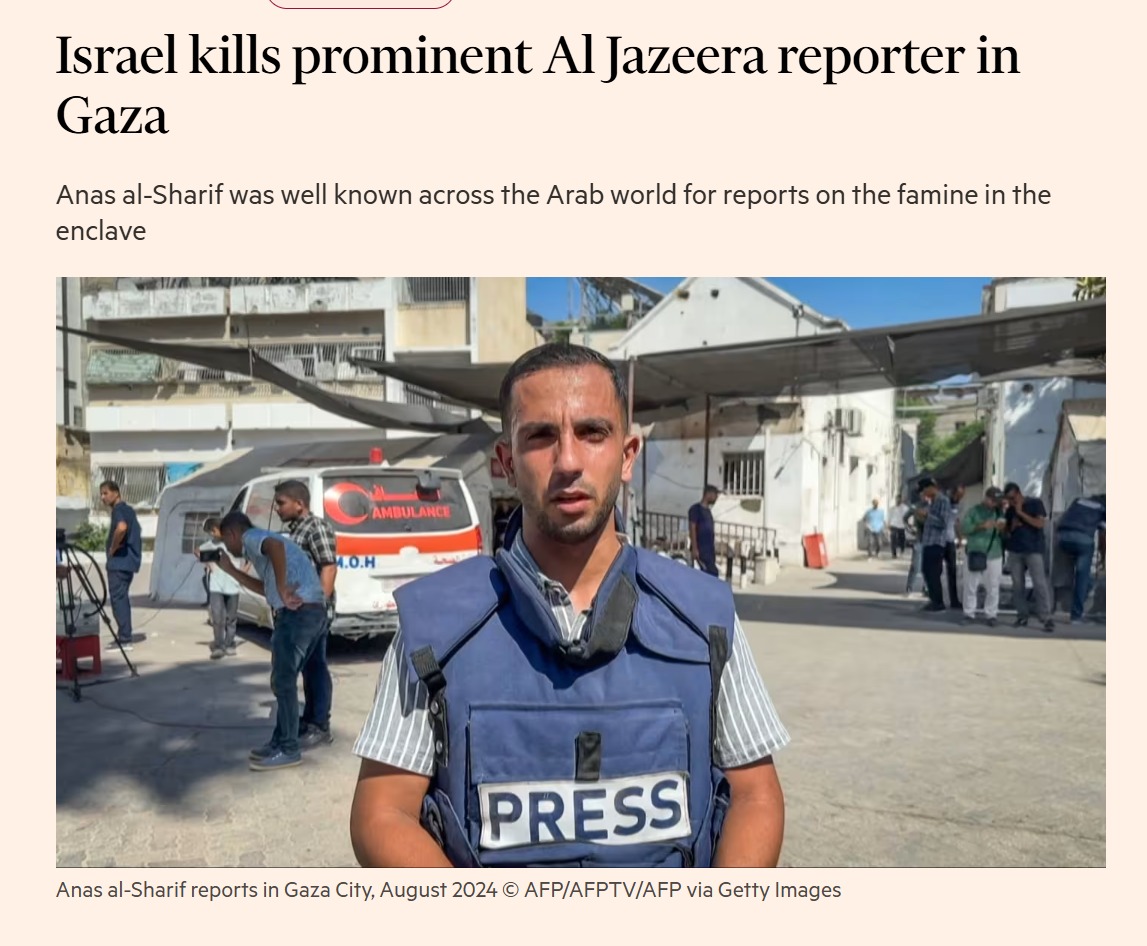
In a departure from the usual equivocation, some prominent Western newspapers adopted a markedly different and more forthright tone in covering the killing of Al-Sharif and his colleagues. Chief among them was The Financial Times, whose headline—while maintaining objective balance—stood in stark contrast to the cautious framing typical of Western media. It stated plainly: ‘Israel kills prominent Al Jazeera correspondent in Gaza,’ unambiguously naming the perpetrator.
In the body of the report, the paper noted that ‘The Israeli military acknowledged killing Anas Al-Sharif, 28, repeating unproven allegations that he was the head of a Hamas cell.’ The article gave greater space to CPJ’s statement and earlier warnings about Israeli threats against Al-Sharif, and it situated the killing within its clear context: Israel’s ongoing pattern during this war of targeting Palestinian journalists and its ban on foreign reporters entering the Gaza Strip since 7 October 2023.
By seeking to control and shape the narrative adopted by Western media, Israel manufactures a sense of ‘consent’ around its ongoing crimes against Palestinian journalists. It does so by repeatedly levelling misleading accusations and pushing objective truth into ambiguous grey areas, while banking on the hesitation of many major outlets to name the killer outright. Even when journalists are directly targeted, these media often refrain from condemning or challenging Israel’s version of events, effectively granting it greater leeway to evade accountability.
RELATED:
- Israel assassinates ‘voice of Gaza,’ Al Jazeera journalist Anas al-Sharif
- Israel’s Biggest US Donor Now Owns CBS
- Anas al-Sharif among five Al Jazeera journalists killed by Israel in Gaza
- 22 Months of Complicity: Why The Media Suddenly Changed Its Mind On Gaza
- Democrats seek to blame only the ‘Netanyahu government’ for the Gaza genocide, but the true responsibility rests with Zionism