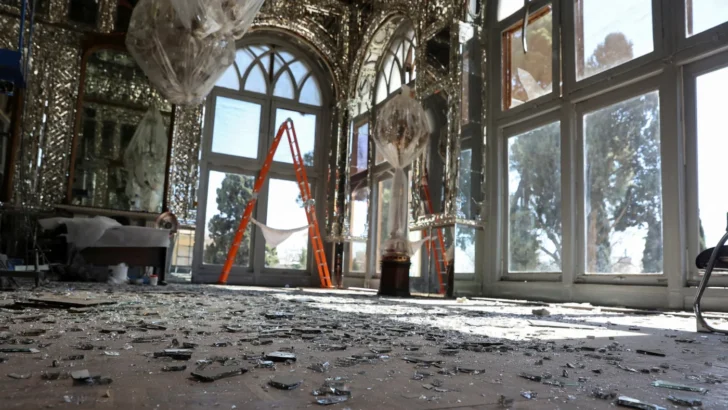
From Isfahan to Tehran to Khorramabad, Israeli and American strikes have damaged landmarks, including some inscribed by Unesco
By Rayhan Uddin, Reposted from Middle East Eye , March 16, 2026
Iran’s history is layered with conquest, cultural renewal and craftsmanship – all of which can be seen in its remarkable heritage sites.
The iconic turquoise domes of Isfahan and the intricate interiors of mosques and palaces across the country are internationally renowned.
Iran’s architectural heritage can be divided roughly into two eras. The first is the pre-Islamic period, which included Iranian empires such as the Achaemenids and Sassanids, and the second involves a succession of Islamic empires and states, starting with the Rashidun caliphate and ending with the Qajar state until the early 20th century.
Iran has 29 sites recognized as World Heritage Sites by Unesco – the tenth most sites in the world. But these sites have come under attack over the past two and a half weeks by Israel and the US.
From Isfahan to Tehran to Khorramabad, Israeli and US strikes have devastated Iranian landmarks, including several inscribed by Unesco.
As the war drags on and the precedent is set, more heritage sites are at risk, with one Iranian official describing the attacks as a “declaration of war on a civilization”.
Middle East Eye takes a look at the sites that have been damaged so far.
Golestan Palace
On 1 March, a day into the conflict, a strike damaged Golestan Palace – the only Unesco World Heritage Site in Tehran.
The blast from a missile strike nearby blew out the palace’s windows and damaged the iconic mirrors and glasswork in the complex, according to images published by Iranian media.
Seyyed Ahmad Alavi, head of Tehran’s tourism and heritage committee, said the blast had also damaged historic Orsi doors and lifted sections of tarmac within the grounds.
Israel is bombing Iranian historical monuments dating as far back as the 14th century. Multiple UNESCO World Heritage Sites have been struck.
It’s natural that a regime that won’t last a century hates nations with ancient pasts. But where’s UNESCO? Its silence is unacceptable. pic.twitter.com/7eu09Cjiyf
— Seyed Abbas Araghchi (@araghchi) March 12, 2026
Golestan Palace was originally built during the Safavid period in the 14th century.
Most of its current features and ornaments date from the 19th century during the Qajar era, when it became the seat of the dynasty’s government. The Qajars made Tehran the country’s capital in 1786.
It consists of eight palace structures, most of which now serve as museums, as well as a garden complex surrounded by a gated wall.
Chehel Sotoun Palace
A string of key heritage sites in Isfahan were damaged by US-Israeli attacks, including the Chehel Sotoun Palace (Forty Columns).
Pictures published by Iranian media showed broken doors, smashed windows and debris scattered throughout the palace.
The site, commissioned by Abbas I, the Safavid shah often known as Abbas the Great, is famed for its frescoes depicting battle scenes and royal receptions.
Iran – US and Israel war
Damage to the interior of the 17th-century historic landmark in central Isfahan, Chehel Sotoun Palace.
The province’s Deputy for Cultural Heritage said that several landmarks were damaged.
Location of the palace: https://t.co/dsM1sksxSg@GeoConfirmed pic.twitter.com/ONHmSiARrQ
— Ghoncheh Habibiazad | غنچه (@GhonchehAzad) March 9, 2026
Footage online showed a large crack down the middle of a 17th-century fresco depicting Safavid Shah Tahmasp welcoming Mughal ruler Humayun to Iran.
The gardens of the palace are part of nine historic gardens in Iran that have together been inscribed as a Unesco World Heritage Site.
Ali Qapu Palace
Near Chehel Sotoun, the Ali Qapu palace was also damaged.
Local media reported that the doors and windows of the complex had been shattered.
Ali Qapu is inscribed as a Unesco World Heritage site as part of a collection of sites in the Naqsh-e Jahan Square in Isfahan.
The palace was first opened in 1597.
The six-story building has elaborate ceilings with intricate inlay work, as well as a number of paintings and frescoes.
Jameh Mosque
A historic mosque in Isfahan was damaged too. A blast on 9 March sent turquoise tiles in the Jameh Mosque crashing to the ground, The New York Times reported.
It cited photographs from Iran’s ministry of culture and heritage, which showed plumes of smoke rising behind the mosque.

A mosque was first built on the site in the late eighth century during the Abbasid era. It was rebuilt a century later, with new additions and renovations over more than a millennium.
It is considered to be one of the most important examples of Persian and Islamic architecture.
Royal Precinct (Dawlat Khaneh)
As well as the two palaces and the historic mosque, several other sites in the Royal Precinct, known as Dawlat Khaneh, were reportedly damaged too.
According to an art newspaper, citing local media, the 17th-century Rakeb-Khaneh pavilion (House of the Jockey) was also damaged.
Ashraf Hall, a residential structure from the Safavid court, was also impacted.
As was Teymouri Hall, a building from the Timurid-era which later became Iran’s Natural History Museum.
Falak-ol-Aflak castle
The Falak ol-Aflak citadel in the Khorramabad area of Lorestan province was also damaged. The site dates back to the Sassanian period (between the third and seventh centuries).
Iranian authorities said that Israeli air strikes struck the vicinity of the hilltop castle on 8 March.
The strikes targeted Lorestan’s cultural heritage department, destroying the building.

The blast also damaged the site’s archaeology and anthropology museums, a local official said, as well as the citadel’s barracks, regimental buildings and other structures.
“Fortunately, the main structure of Falak-ol-Aflak Castle was not damaged,” said Ata Hassanpour, the head of Lorestan’s cultural heritage department.
Rayhan is a Middle East Eye journalist based in London, with an interest in geopolitics, conflict and human rights.
RELATED:
- These are the casualties and cost of the war in Iran 2 weeks into the conflict
- Don’t Fall for the Regime Change Talk. Israel Is ‘Mowing the Lawn’ in Iran
- US so far burned through ‘years’ of munitions in Iran war: Report
- ‘Catastrophic,’ Says UNICEF: 1,100+ Children Killed or Wounded in Mideast Since US-Israel Launched Iran War
- The Unbelievable Madness of Our War With Iran