The Israeli government has practically paralyzed the agency dedicated to Palestinian refugees, and sanctions have caused extensive budget cuts. But UNRWA is still the most important humanitarian organization operating in Gaza. In an interview with Haaretz, its heads tell their side of the story
AMMAN – The past week has been especially turbulent for the United Nations Relief and Works Agency, or UNRWA, even relative to the chaos it has suffered since October 7, 2023. Last Tuesday, Israeli police arrived at an UNRWA clinic in Jerusalem’s Old City and ordered it closed. The facility had been running continuously almost from the time the agency was founded in the 1950s, providing services to thousands of patients every year. It is unlikely to reopen.
The same day, Jerusalem’s municipal infrastructure company announced that from the following week, it will be cutting off water and electricity from UNRWA facilities that are still operating in the city. The most important one is a vocational training center in north Jerusalem, which will probably be forced to close, leaving 350 young people from impoverished families living in refugee camps who are being trained in auto repair, welding, carpentry, construction and other trades with nowhere to go.
At the same time, a public outcry erupted in Lebanon after parents of children attending UNRWA schools in the refugee camps learned that the word Palestine had been removed from the textbook maps. It was replaced with Gaza Strip and West Bank. And if that weren’t enough, this week tens of thousands of UNRWA employees were notified that their salaries are being cut by 18 percent due to the agency’s dire financial situation.
In a wide-ranging interview in Amman with Haaretz, the two heads of the agency – Roland Friedrich and Sam Rose, who are responsible for the West Bank and Gaza, respectively – sought to explain the reality as they see it. “There’s always this argument that UNRWA perpetuates the [Palestinians’] refugee status. It’s the other way around – it’s because there is no political solution to the refugee issue,” says Friedrich.

Terrorists in disguise
Since the start of the Gaza war, UNRWA has become radioactive. Israeli lawmakers compete with one another for who can tar the agency the most – “an arm of Hamas,” “terrorists in disguise,” and “terror organization” are just a few of the epithets that have been thrown at it. Meanwhile, the Knesset has approved by large majorities two laws that strike hard at the organization. The first bans it from operating in Israel and the second prohibits Israeli governmental authorities from having any contact with it. Another amendment approved last week bars infrastructure companies from providing water and power to UNRWA facilities.

Most of the accusations Israel has made against the agency concern its staff and its alleged cooperation with Hamas, including on October 7. Israel also asserts that UNRWA facilities in Gaza, mainly schools, have been used by Hamas. Friedrich and Rose reject these allegations and provide data from a UN report that points to a more complex situation than what’s been portrayed in the Israeli media and in the Knesset.
Regarding staff, they claim that Israel has provided proof of a Hamas connection for just 12 of the organization’s 12,000 Gaza employees. The evidence against nine of them was solid enough, and all were fired or killed in the fighting. One of them is the terrorist who took the body of Yonatan Samerano to Gaza. “This is absolutely unacceptable and disgusting. It’s a serious crime. Nobody wants those people in the agency,” says Friedrich. “From that, to say that 12,000 people are Hamas – that is a different thing.”
Rose says the behavior of the individual must be separated from that of the organization. Referring to the ties between Britain’s Prince Andrew and convicted sex offender Jeffrey Epstein, he adds: “You don’t destroy, you don’t blame the institution for the faults of a couple of [people]. I’m not going to call for the dissolution of the monarchy … just because of one bad apple.”

UNRWA doesn’t have its own intelligence service or security force, he says, “So we do what we can do, which is making sure our staff adheres to our rules and regulations, and do trainings and raise awareness and take action when actionable information comes to our attention. We can only root this stuff out if we have the cooperation of the states that do have security services. When it comes to Gaza, that’s Israel. And it’s for this reason that we share our staff lists every six months.”
Rose notes that Israel recently rescinded the operating permits for 37 humanitarian organizations working in Gaza, in most cases because the organizations refused to provide lists of their Palestinian employees. “I don’t think anybody from UNRWA wants to work with people who might have participated in a terrorist attack on the 7th of October,” adds Friedrich. “[Israel] gave names, but no real sort of evidence. It was not done in a way that you could authentically say: This is correct; this is not correct. And we also suggested bringing in a third party to look at it.” The suggestion was declined.
“These are simplified, populist arguments,” says Rose, “and one we’re seeing now that’s coming up again and again is that all the attackers on October 7 went to UNRWA schools. Therefore UNRWA itself is a terrorist factory. I work for UNWRA, does that make me a terrorist? And if I’m a terrorist, I’m therefore a product of the school I went to. So does that mean my school, which happens to be the largest Jewish school in Manchester [Rose’s father is Jewish], is also a terrorist factory?”
Rose says that before the war, UNRWA used to report to Israel what the UN calls “neutral violations,” meaning when Hamas used its facilities. He admits that there were tunnels under schools in Gaza as well, but claims that UNRWA had no control over this.
During the war between Israel and Gaza in the summer of 2021, “a bomb was dropped by the [Israel Air Force] on the playground of an UNRWA school, and it didn’t explode,” says Rose. “We had to then extract the bomb that had gone all the way [into the ground], and you could see there was a tunnel running under the UNRWA playground. Gaza is replete with tunnels,” he says, adding that there were no entrances or exists from the tunnel into the school itself. “There’s a Tube line running under every house in London, but it doesn’t mean they own [the tunnel], that they can get on the train.”
“I think UNRWA is a reminder that all is not well, that you’ve got occupied land,” continues Rose. “And UNRWA becomes the lightning rod for all this criticism, when essentially UNRWA is the instrument that the international community created to manage the humanitarian situation and the delivery of services – consequences of this political issue – until there’s a solution.”
Rose paints a picture of the agency trying to stand up to Hamas during the Israeli blockade of the Strip: “We used to organize marathons in Gaza, and then Hamas came in. … At first we were allowed to do them, but they had to be gender-segregated.” The men ran in one direction and the women in the other direction, but at some point during the run, the two groups would meet. Citing this, Hamas canceled the marathons.

He also describes how, to Hamas’ displeasure, UNRWA “was trying to integrate certain things into the curriculum, to give kids more of a progressive education. So teaching human rights and tolerance and conflict resolution, and certain kinds of constructs that have been introduced more recently, LGBT-type things that don’t sit very easily with them.
“UNRWA gets blamed by Israel for radicalizing Palestinians when it’s their lived existence that radicalizes them,” he adds.
42,000 desperate people
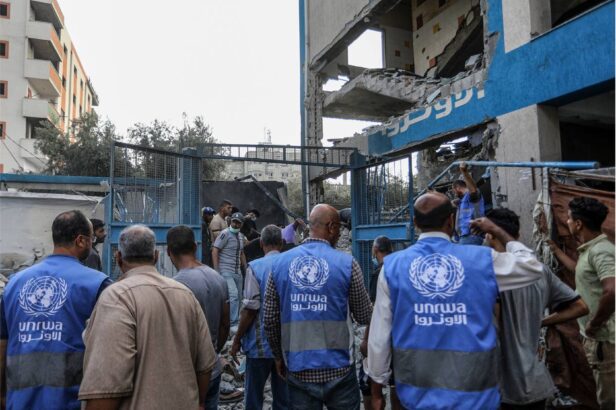
UNRWA today employs more people than all the other UN and humanitarian agencies in Gaza put together. This includes 1,347 doctors and medical personnel and more than 10,000 teachers, drivers, social workers and other staffers. Rose estimates that 80 percent of vaccinations in Gaza are administered by UNRWA staff.
In addition, over 100,000 displaced people live in schools run by UNRWA, and many more live near the schools and receive services from the agency. Since the cease-fire, UNRWA has resumed some of its educational activities; today, about 70,000 children study in temporary schools that it operates. In addition, the agency is also responsible for collecting garbage in large parts of Gaza.
For a year now, the Israeli assault on UNRWA has prevented it from bringing food and aid into the Strip. “We spent hundreds of thousands of dollars on stickers and relabeling things, repackaging them and then having to give them to other organizations [to distribute the items in Gaza], when we should be throwing everything we’ve got at getting food to the people,” says Rose. The relabeling had to happen because UNRWA itself was banned from providing the items.
More recently, mainly because the United States has halted funding to UNRWA, the agency has run into budgetary difficulties and has been forced to impose steep salary cuts and layoffs. While most of the countries that contribute to the organization (except for the U.S. and Sweden) have restored and even expanded funding, that doesn’t cover the void left by the U.S.

In November, to Israel’s chagrin, the UN General Assembly overwhelmingly voted to renewed UNRWA’s mandate, and in December the assembly passed another resolution, again with a very large majority, calling on Israel to end its boycott of the agency.
As the head of the agency’s activity in Jerusalem and the West Bank, Friedrich has had a challenging road. He joined the agency 10 days after October 7, and within one year was forced to leave Jerusalem along with his entire international team. Throughout that time, he was fighting against incessant harassments by Israeli authorities and citizens.
The list is long and includes the shuttering of UNRWA-operated schools in Jerusalem in June; seven arson attempts against the UNRWA facility, which houses a gas station, over the last two years (no arrests have been made); press conferences held by politicians at the entrance of its building in Jerusalem; and ultimately, a police raid on the facility late last month, where the agency’s equipment was confiscated by the tax collection authority, which cited outstanding debts to the Jerusalem municipality – even though the UN is supposed to be exempt from city tax.
During the raid, the UN flag was removed from the building and was replaced with the Israeli flag. Last Friday, police officers showed up again in the compound, equipped with a drone. They explained to security guards that they came back to ensure the flag was still in place. According to Friedrich, despite politicians’ rants, throughout most of the war, the Israeli military maintained good contacts with the agency, asking it on 25 occasions to evacuate schools during military operations in Gaza refugee camps. However, when Israel’s anti-UNRWA laws went into effect in January 2025, this coordination was halted.

UNRWA continues to operate 96 schools, attended by 48,000 children, just in the West Bank. The agency also runs a medical network, a social-psychological support network and a social aid system, and also collects 55,000 tons of garbage every year. Over last year, the agency had also had to face the eviction and destruction of three West Bank refugee camps: Jenin, Nur al-Shams and Tulkarm.
“Clearly what we’re seeing there [the destruction of the camps] is a severe violation of international law,” says Friedrich, “and it makes no sense from a security perspective: There are 42,000 people there – desperate, frustrated, radicalized. … But you also hear statements in the Hebrew media with military commanders saying that ‘once we’re finished here, the geopolitical expression of the refugee issue will be gone.’ So what is this, a security need or a political one?”

Early on in the war, Friedrich went with some of his team members to the site of the massacre at the Nova music festival and Kibbutz Be’eri. “We’re also fully aware of the traumatic impact of the 7th of October,” he says. “I know Israel and Palestine very well, so of course there’s ultimately an obligation to go there and see it. It was shocking. … You go to Be’eri and you look at all the pine trees and what comes up as the first thought is the forests of Latvia and the Holocaust.”
“The impact on the Israeli side is very, very clear. And that also explains some of the political views of UNWRA,” says Friedrich, “but I think we have to be careful to differentiate between the solution to the issue as part of a broader political solution. Eighty percent of what we do also makes a direct contribution to stability.”
“If UNRA didn’t exist, you’d have to build it. But UNRWA does exist,” adds Rose. “Deal with the problem rather than blaming UNRWA. You know, that’s quite a good headline.”
Nir Hasson is a journalist at Haaretz, reporting from Jerusalem and the environmental desk. He covers a wide range of topics including regional interest and world news, juvenile justice, and cultural issues, with a particular focus on the Middle East and the legal rights of minors.
RELATED:
- ‘People in Gaza are neither dead nor alive, they are walking corpses,’ says UNRWA
- The real reason Israel is banning UNRWA, and what it means for millions of Palestinian refugees
- Action Alert: send your member of Congress to learn about impact of cuts to UNRWA
- WAFA: UNRWA report: Gaza suffers humanitarian crisis
- New polls show growing support for Palestine, and for calling Israel’s actions “genocide”