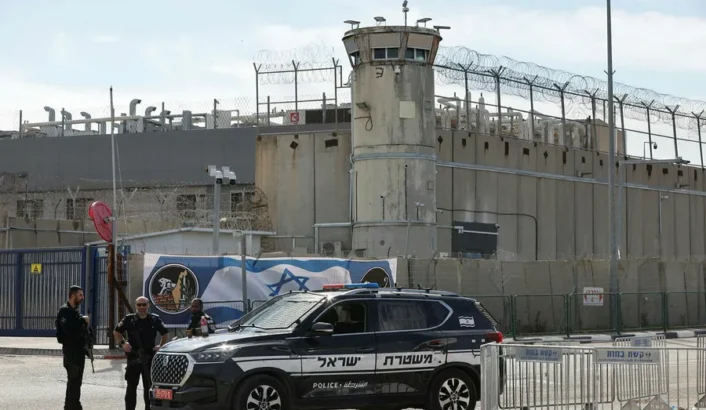
The Ofer prison. Credit: Olivier Fitoussi (Credit: Olivier Fitoussi)
The UN Committee against Torture expressed ‘particular concern’ that the number of deaths in custody to date ‘appears to be abnormally high and appears to have exclusively affected the Palestinian detainee population’
by Nir Hasson, reposted from Haaretz, November 29, 2025
This article includes descriptions of torture and sexual violence.
The UN Committee against Torture expressed concern in a report published Friday that Israel subjects Palestinian prisoners and detainees to torture.
The report issues sharp criticism of Israel regarding its violation of its obligations under the Convention against Torture, to which it is a signatory, based on information from numerous sources, including Palestinians, the Israeli government and international and Israeli organizations.
The conditions listed in the report include cruel and degrading punishment, sexual abuse and sexualized forms of torture, poor sanitary conditions and systematic denial of medical care. The committee also determined that the Israeli justice system violates its obligations to prosecute suspects of torture.
In its report, the committee criticized the term “unlawful combatants,” a status that is not recognized in international law and denies Palestinian prisoners the rights of criminal detainees or prisoners of war.
According to the report, Israel refuses to provide information to the detainees’ families “regarding their fate or whereabouts, placing them effectively outside of the protection of the law – a practice amounting to enforced disappearance.”
The committee also criticized the practice of administrative detention, as well as the decision by Defense Minister Israel Katz not to use administrative detention against Jews.
Administrative detainees are held under a procedure defined as “preventive detention,” which is based on intelligence that is not disclosed to the detainees or their lawyers. There are no evidentiary court hearings for their cases and the detainees’ lawyers are not privy to evidence against them, other than a short summary presenting the suspicions against their clients.
Gazans detained in the Shuja’iyya neighborhood of Gaza City, in 2023. Credit: Moti Milrod
The committee expressed concern over a severe deterioration in the incarceration conditions of Palestinian detainees and prisoners as a result of National Security Minister Itamar Ben-Gvir’s policies, calling it “a deliberate state policy of collective punishment.”
The committee stated that it is particularly concerned about the holding of security prisoners in a cell for 23 hours a day, sometimes for consecutive days, without access to showers, ventilation, electricity or water, without personal belongings, and at times while shackled.
According to the report, prisoners are denied access to basic medical treatment and detainees are treated while blindfolded and shackled. Prisoners suffer from scabies, and no adequate efforts are made to treat the disease.
It added that prisoners don’t receive proper nutrition, and many have lost a significant amount of weight, “which, in some cases, has contributed to their deaths in custody.” According to the report, they “are forced to share meals or are provided with inedible food.”
Detained women don’t receive appropriate gynecological care or hygiene products, the report said. The committee further determined that Israel violates international humanitarian law by not permitting Red Cross representatives to visit security prisoners and detainees.
Bodies of unidentified Palestinians returned from Israel as part of the cease-fire deal are brought to Nasser Hospital in Khan Yunis, Gaza Strip, Wednesday. Credit: Abdel Kareem Hana/AP
The committee expressed “its particular concern” that the number of deaths in custody to date “appears to be abnormally high and appears to have exclusively affected the Palestinian detainee population.”
Since October 7, 98 Palestinian deaths have been documented in Israeli prisons. The report also notes claims that autopsies of some of the detainees’ bodies “indicated signs of torture and ill treatment, including denial of medical care and extreme malnutrition,” adding that, “to date, no state officials have been held responsible or accountable for such deaths.”
While taking into account Israeli comments “regarding its views on the veracity of information” that was presented, the Committee “is nonetheless deeply troubled at reports indicating a de facto state policy of organized and widespread torture and ill-treatment during the reporting period that has gravely intensified since 7 October 2023.”
The torture, it says, “amounts to war crimes and crimes against humanity, and forms part of the actus reus of genocide.”
According to the report, the Committee received allegations of “repeated severe beatings, dog attacks, electrocution, waterboarding, use of prolonged stress positions, sexual violence, threats against detainees and their family members, insults to personal dignity and humiliation such as being made to act like animals or being urinated on, systematic denial of medical care [and] excessive use of restraints, in some cases resulting in amputation.”
The report also listed “the performance of surgeries without anesthetic, exposure to extreme cold or heat, including boiling water, denial of adequate nutrition and water, deprivation of clothing, sleep and access to hygiene facilities and products, including feminine hygiene products, deprivation of light or darkness, use of loud music and noises, denial of the right to freely practice one’s religion, and the forcible use of hallucinogenic medication.”
Sde Teiman Detention Center, near Be’er Sheva Credit: Breaking the Silence
The report says the use of hallucinogens was done, per the allegations, “in a discriminatory manner, against Palestinians, and for purposes including the extraction of information or confessions and as a means of exacting punishment, including collective punishment.”
According to the report, allegations of sexual violence included “rape, attempted rape, molestation, sexualized forms of torture, beatings administered while detainees were naked specifically targeting their genitals, electrocution of the genitals and anus, the use of repeated, unnecessary, degrading strip searches, prolonged forced nudity, including in front of members of the opposite sex, with the aim of degrading and humiliating victims in front of both soldiers and other detainees, the forcible removal of women’s veils, sexual harassment, the use of sexual slurs, threats of rape, production of sexually humiliating videos and various other forms of physical and sexual violence.”
About three weeks ago, dozens of Israeli representatives, including ones from the Foreign Ministry, Justice Ministry and Israel Prison Service, appeared before the committee. The Israeli representatives sought to convince the committee that there are adequate incarceration conditions in civilian and military prisons and that the justice system supervises the prison system and adjudicates violations.
However, “The State Party provided information concerning only a single conviction related to torture or ill-treatment since October 2023, where the sentence of seven months by the court martial appears not to reflect the severity of the offense. The Committee is further concerned by allegations that many detainees refrain from lodging complaints due to the threat of reprisal,” the document states.
The committee added that Israel must respond to the claims within a year.