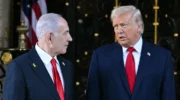
The U.S. media is predictably spreading government propaganda and ignoring Israel’s role as it cheers on the war against Iran and pushes for regime change.
Since the U.S.-Israeli strikes on Iran began, the mainstream media has featured an barrage of voices openly cheering on the war.
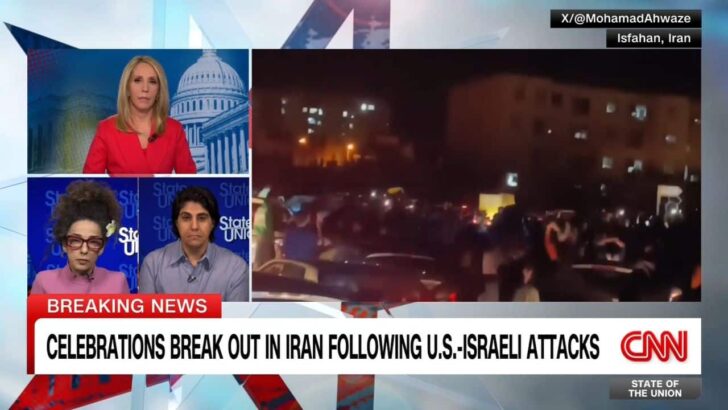
Chief among them is Masih Alinejad, an Iranian-American pundit who has spent years calling for the Iranian government to be toppled. She’s been all over cable news, celebrating the attacks.
On CBS, she called on Trump to “finish the job” in Iran and attacked New York City Mayor Zohran Mamdani for opposing the strikes
“This is a Berlin Wall moment. Let’s tear this wall down,” Alinejad told CNN’s Dana Bash. “Then America will be safe without Islamic Republic. I love America. I love Iran.”
“This is a Berlin Wall moment. Let’s tear this wall down. Then America will be safe without islamic republic. I love America. I love Iran” –@AlinejadMasih on @CNNSOTU pic.twitter.com/B9jCbweqCg
— Brian Stelter (@brianstelter) March 1, 2026
In another one of her CNN appearances, she told Jake Tapper that she was frustrated by world leaders who had condemned the military effort. “Stop being allergic to regime change, be allergic to dictatorship,” she said. “This is the 21st century.”
“This is the end, we hope, of [the Iranian] regime,” said Tapper, while introducing her.
On Twitter, Alinejad thanked Tapper for “giving the Iranian people a platform from the very beginning, when they said clearly and courageously: we want this regime gone.”
Live on CNN: I know there are journalists on CNN who don’t like president @realDonaldTrump. But whether you like him or not, this was the right decision by the President of the United States to remove Ali @khamenei_ir and the terrorists monsters in Iran.
This is not about your… pic.twitter.com/dId4BrIKbu
— Masih Alinejad 🏳️ (@AlinejadMasih) March 2, 2026
Beyond regime-change advocates, networks like CNN have dutifully relied on individuals connected to the U.S. government for military analysis.
Former CIA Director David Petraeus told Tapper that the killing of Iran’s Supreme Leader Ali Khamenei was a “reflection of stunning arrogance on the part of the Iranian leadership. Former Biden official Brett McGurk said Iran’s retaliatory attacks were a miscalculation and might prove that Trump had succeeded.
Even CNN’s co-called liberal commentators are fomenting regime change.
CNN host and contributor Van Jones posted a video championing Reza Pahlavi, the exiled son of Iran’s former Shah, who is pushing to become leader.
“He does NOT want to return as a king,” insisted Jones. “He does NOT want a throne. He wants to return as a healer for Iran. A transitional figure to usher in Democracy for the Iranian people. I believe Reza Pahlavi has an honest shot at leading Iran and changing the Middle East — and possibly the world.”
Yesterday the U.S. and Israel attacked Iran and killed their Supreme Leader. Now the news cycle is moving onto “NOW WHAT??”
For those of you who are unfamiliar – meet Reza Pahlavi. When millions took to the streets protesting the regime, they chanted his name.
Important… pic.twitter.com/gPGT7ZxLAO
— Van Jones (@VanJones68) March 2, 2026
Jones’s video seems part a concerted campaign to build support for Pahlavi to ride into Tehran as the savior of the West. This charm offensive also included an exclusive sit down with Pahlavi on 60 Minutes on Sunday night to discuss possible regime change.
In fact, when it comes to this war the media won’t take “no” for an answer.
The Wall Street Journal editorial board has warned Trump to avoid repeating the same mistakes as Bush in the Middle East. Not George W. Bush during the Iraq War, but George H.W. Bush, who they feel ended the Gulf War too early.
“The biggest mistake President Trump could make now would be to end the war too soon, before Iran’s military and its domestic terror forces have been more thoroughly destroyed,” declared the editors.
Similarly, in the Washington Post, columnist George Will celebrates the strikes and says they’re a necessary step toward restoring “the credibility of U.S. deterrence.”
Even the liberal ‘opposition’ promotes war
Critiques of the war from the more so-called liberal sectors of the media come with a barrage of caveats and embrace the same justifications used to promote intervention.
The New York Times‘ editorial board published an Op-Ed criticizing the strikes as “reckless,” decrying Trump for not seeking congressional approval for his attacks. However, the paper concedes that the “elimination of Iran’s nuclear program” is a “worthy goal” and accepts the image of the country as an international menace.
“Iran’s government presents a distinct threat because it combines this murderous ideology with nuclear ambitions,” write the editors.
“A responsible American president could make a plausible argument for further action,” they conclude.
Israel’s role has always largely been scrubbed from liberal narratives.
MS NOW’s Rachel Maddow ran a 20-minute segment breakdown of the U.S.-Israeli strikes on Iran.
“So, why is this happening?” she asked her viewers. “Who benefits?”
One might assume that Maddow’s inquiry was rhetorical. After all, Israel has been waging a proxy war against Iran for decades, sabotaging their nuclear facilities, carrying out cyberattacks, and assassinating nuclear scientists.
However, Maddow barely mentioned Israel on her list of beneficiaries. The real culprit pushing Trump to war? The Gulf Arab states. Maddow insists that they are dragging the U.S. to war over their many financial connections to the Trump administration and family.
“There’s lots of attention on Israel, and indeed Israel and the U.S. worked together in the bombing campaign against Iran in June, and again in this new war that started Saturday,” declared Maddow. “But it is the Gulf Arab states who are all against Iran, who want Iran removed as their regional rival.”
Maddow has to know that Netanyahu was pushing for an attack long before he even took power. After the strikes began, he publicly stated that the Trump administration had made his dreams come true. “This coalition of forces allows us to do what I have yearned to do for 40 years,” he explained.
The Iranian Threat
As they did with Iraq, pundits have also predictably framed Iran as a powerful force that posed an imminent threat to the United States.
During a CNN panel, former George W. Bush official and on-air contributor Scott Jennings claimed that Iran was on the verge of launching ballistic missiles at Israel and U.S. targets before the country was attacked.
Jennings repeated the claim in a tweet. “Senior Trump Administration officials telling me that credible intelligence indicated Iran planned preemptive missile strikes against US military targets in the region, and against civilian targets as well. Failure to act would’ve resulted in mass US casualties,” he wrote.
Shortly after he made the statement, the Pentagon admitted that Iran was not planning to strike unless Israel attacked them first.
I’ve heard that CNN leadership was not pleased with Scott Jennings over this tweet, which the network’s own reporting contradicted, and expressed that to him.
But it clearly didn’t matter much: Jennings was back on the air today promoting the admin’s actions on Iran… https://t.co/KZA9LozAZ6
— Max Tani (@maxwelltani) March 2, 2026
According to Semafor media editor Max Tani, CNN was upset with Jennings over the tweet, as it contradicted the network’s own reporting. “It clearly didn’t matter much: Jennings was back on the air today promoting the administration’s actions on Iran,” Tani noted.
Despite all this, there’s a major difference between the lead-up to the Iraq War and the current attacks. Polling shows that a majority of the U.S. population opposes Trump’s actions in the region. A recent survey has opposition to the war at 59%, while just 12% would support sending in U.S. ground troops.
“I think that the polling is very good, but I don’t care about polling,” Trump told the New York Post. “I have to do the right thing.”
Michael Arria is Mondoweiss’ U.S. correspondents. His work has appeared in In These Times, The Appeal, and Truthout. He is the author of Medium Blue: The Politics of MSNBC. Follow him on x at @michaelarria.
RELATED:
- Tucker Carlson: A New Middle East War for Israel Started by the U.S.
- Israel’s lonely push for war with Iran
- Trump Starts a Major Regime-Change War with Iran, Serving Neoconservatism and Israel
- Oman’s Foreign Minister Said US-Iran Deal Was ‘Within Our Reach.’ Then Trump Started Bombing
- Are MAGA restrainers pulling their punches this time on Iran?