With at least 8,000 people still missing in Gaza – presumed either buried under rubble, in mass graves dug by the Israeli military, or detained by Israel and held outside Gaza – determining the fate of the missing is a top priority.
On 19 October 2025, Gaza’s Ministry of Health announced it had received 150 bodies from Israel.
The corpses were handed over by the International Committee of the Red Cross, and their return followed the ceasefire agreement that came into effect on 10 October.
With at least 8,000 people still missing in Gaza – presumed either buried under rubble, in mass graves dug by the Israeli military or detained by Israel and held outside Gaza – determining the fate of the missing is a top priority.
But as Israel still keeps crossings into Gaza shut to all but the bare minimum of aid, Gaza’s authorities are without heavy machinery to shift millions of tonnes of rubble or relevant scientific materials to properly identify sometimes deeply decomposed corpses. This undermines efforts to provide information to families of the disappeared.
It was left to the forensic teams at Nasser Medical Complex in Khan Younis to examine and document the corpses that were returned in October.
“The bodies were bound from the hands and ankles and had abrasions and bruises all over,” Ahmad Dhiar, director of the Forensic Medicine Department in Gaza, said in a 20 October interview with Palestine TV.
“Some bodies were naked except for their underwear. Others were fully naked.”
Dhiar said that the bodies had all been frozen, preventing the forensic teams from performing autopsies until the tissues thawed after two days.
Two bodies, he added, had been blindfolded and had constraints around their necks. Others bore signs of physical abuse.
“Several bodies had gunshot wounds to the head and chest,” he said, suggesting that they may have been executed.
Some were just skeletons while others were in an advanced state of decomposition.
Identifying the dead
The Israeli side provided 90 DNA profiles along with the 150 bodies, but no names.
Yet the Gaza Strip, as Israel is well aware, lacks equipment and tools for DNA or tissue analysis.
“We only have a rudimentary procedure relying on the body’s length, trying to specify the age, the nutritional status, the presence of personal belongings, from the teeth, the bones, previous surgeries or amputations, distinguishing marks on the body like scars or moles in distinctive locations only the family can recognize,” Dhair said.
Providing DNA profiles is futile as a result, he said.
Based on the October “ceasefire” agreement, Israel was to hand over bodies according to a 15 to 1 ratio – 15 Palestinians for every Israeli.
As of January 2026, the Ministry of Health in Gaza had received 345 bodies, from which, so far, only 99 have been identified.
Dhair explained the process of identifying these bodies in a video published by Gaza’s Ministry of Health on 14 October.
Forensic teams examine the bodies to determine the cause of death, how long since death and the types of injuries suffered.
A criminal evidence team then documents and photographs these injuries along with the body’s general features and clothing.
These photos are uploaded – please be warned, the pictures are harrowing – to a website created by the Ministry of Health in Gaza, where people can view the photos to try to identify the corpses.
If someone recognizes a body, they head to Nasser Medical Complex to view the photos again. After confirming that it is the right body, and that they have a close relationship or are relatives, they are allowed to take the body for burial.
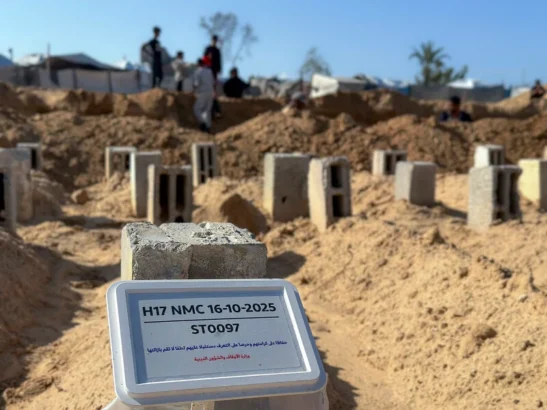
If a corpse is not identified, it will be buried in a designated location where every grave is numbered – a mass grave for unidentified martyrs.
In case someone later identifies a body from photos, they will know where their loved one was buried.
Lost in detention
On 16 November, Israel handed Hamas through mediators a list that contained 1,468 names of those Israel said it had captured over the two years prior to October’s ceasefire.
Hamas accused Israel of hiding the true number of detainees, however, and the Palestinian Center for Missing and Forcibly Disappeared, a missing persons center in Gaza, reported that the list is incomplete and “does not reflect the true number of those detained.”
Based on reports from families and its own field monitoring in the Gaza Strip, the center suspects hundreds of individuals have been detained by the Israeli military whose names did not appear on the Israeli list.
Israel doesn’t disclose information about the numbers, whereabouts and fate of Gaza’s prisoners held in military detention camps such as Sde Teiman.
As of 1 January 2026, according to prisoner rights group Addameer, Israel is holding 9,300 Palestinian detainees. The group noted that “this number does not include detainees held in military camps affiliated with the occupation army.”
In all, the fate of at least 8,000 missing and disappeared persons from the Gaza Strip remains unknown as of 5 January 2026.
In addition to the Israeli military withholding information, there are at least three other reasons why some people remain missing.
First, the Israeli army has reportedly dug a mass grave near the Zikim crossing containing an unspecified number of bodies.
Second, some bodies may have been completely vaporized or damaged beyond any possible identification. This is also known as total body disruption. Israel has been accused of using thermal weapons by human rights groups like the Euro-Med Monitor. Such weapons can melt bodies from the heat and intensity of the blast.
But even without such weapons, bodies have been completely obliterated. Nooh al-Shaghnobi, 24, a member of Gaza’s Civil Defense, told The Electronic Intifada how, in the first months of Israel’s genocide, he witnessed how two of his colleagues “instantly evaporated” when an Israeli missile struck them directly while they were responding to an emergency in Gaza City’s al-Tuffah neighborhood.
Beneath rubble
A third reason for the missing numbers is that Israeli military ground forces are still occupying more than half of Gaza behind its so-called yellow line. How many bodies are buried under rubble in these areas is impossible to say until Palestinian authorities gain access.
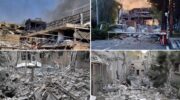
As of 11 October 2025, approximately 81 percent of all structures in the Gaza Strip are damaged, with 123,464 structures completely destroyed out of a total of 198,273 damaged structures, according to a preliminary analysis by the United Nations.
Israel has wreaked havoc across the Gaza Strip. The UN estimates Israel’s bombing campaign has generated more than 61 million tonnes of debris, or about as much as “if you build a 12-meter wall around Central Park and fill that with rubble,” according to Jaco Cilliers, the United Nations Development Program Representative in Palestine.
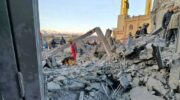
With so much rubble, retrieving the bodies of those buried beneath is a complicated and time-consuming task.
Israel, which is still committing genocide in Gaza, has only recently allowed heavy search equipment to enter Gaza in order to search for the remains of Israeli captives.
Most of the heavy equipment in Gaza was destroyed over the past two years. Al-Shaghnobi, who has been working with Gaza’s Civil Defense for seven years, told The Electronic Intifada that in the first few months of the genocide, Civil Defense teams deployed diggers and bulldozers.
But the Israeli military targeted municipality warehouses and destroyed almost all remaining equipment used by the Civil Defense and municipality workers.
“We started using rudimentary tools, like a shovel, sledgehammer, hoe, pickaxe and axe,” he said. “But you can’t dig through concrete with a shovel.”
There were so many distress calls in the early days of the genocide that it became overwhelming, al-Shaghnobi said.
“Most days, there were so many distress calls, we wouldn’t get any rest or sleep,” he said. “Sometimes we would go three days straight with consecutive missions.”
Al-Shaghnobi described how he and his colleagues tried to respond to emergencies. When they arrive at a location, he said, they first examine the scene to determine whether the damage is to a single-family house or a multi-story building and how to section off search areas to look for survivors.
“Ninety percent of the people [trapped] under the rubble are unconscious, or they can’t make a sound, or their voice is very faint,” al-Shaghnobi said. “We have to try as much as possible to follow the sound or see where there is blood.”
They try to keep the area around the location quiet in order to hear better. Sometimes they were called back because people heard someone start shouting from under the rubble after they regained consciousness.
The time spent rescuing one person, al-Shaghnobi said, depends on the specific circumstances.
“Sometimes we find people just as they were, on the ground with only two or three stones on top of them,” he said.
At others, when a person is buried under a block of concrete or a concrete slab or if they are injured, requiring them to be handled with extreme caution, it takes longer to get them out.
The lack of heavy machinery and equipment is a major obstacle, forcing al-Shaghnobi and his team to prioritize emergencies.
“We will always start with younger people,” he said, adding that with better equipment, it would have been possible on “thousands” of occasions to save more people.
“I feel a profound sense of helplessness as a civil defense worker when there are people alive under the rubble, but I can’t reach them because of the bombing or the lack of equipment.”
Khaled El-Hissy is a journalist from Jabaliya in the Gaza Strip and an assistant editor at The Electronic Intifada.
RELATED:
- ‘I searched for my father in the ruins’: The fate of thousands buried under Gaza’s rubble
- Rescue Teams Dig Up Over 50 Bodies Buried in Shallow Graves in Courtyard of Gaza City Clinic
- Israel now targets anyone trying to rescue children buried under rubble
- ‘Disappeared, buried, detained’: The horrors of Gaza’s missing children
- The Gaza family torn apart by IDF snipers from Chicago and Munich