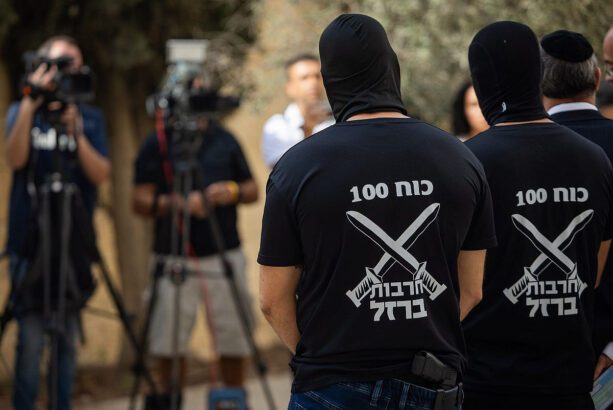
By dropping all charges against the soldiers filmed abusing a Palestinian detainee, Israel has abandoned the whole masquerade of accountability.
By Michael Sfard, Reposted from +972 Mag , March 21, 2026
The renowned astrophysicist Stephen Hawking discovered that a black hole, the celestial object that swallows everything around it and from which, seemingly, nothing that enters ever escapes, nevertheless emits a certain level of electromagnetic radiation. As is customary in the exact sciences, the phenomenon was named after the scientist who discovered it; in this case, “Hawking radiation.”
Sde Teiman, the Israeli military base-turned-detention facility for Palestinians, which includes a hospital compound for prisoners, has functioned since early on in Israel’s devastating war on Gaza as a moral black hole. All traces of humanity — be it the most basic moral principles, medical ethics, or any remnants of Israeli shame — were swallowed up into it and completely disappeared.
According to testimonies from former detainees and investigations by journalists and human rights organizations, we Israelis starved, tortured, and humiliated Palestinian prisoners there, while providing the wounded and sick with disgraceful medical treatment which, on several occasions, led to amputations that would have been avoidable had the care been reasonable. All values were whirled into the heart of the moral black hole that is the Sde Teiman camp. Was no value at all really saved from it?
Well, it turns out that Sde Teiman, too, has its own Hawking radiation spewing out of it. But just like what disappeared into Sde Teiman, so too the radiation emitted from it is not electromagnetic but ethical: Sde Teiman has radiated the truth about the nature, functioning, and mission of the law enforcement bodies responsible for handling allegations of Israel’s human rights abuses against Palestinians.
Last week, Israel’s top military lawyer dropped all charges against five soldiers from Force 100 who were accused of beating a Palestinian detainee and tearing his rectum by stabbing it with a sharp object — an act that was partially caught on CCTV camera in footage that was later leaked. In doing so, he exposed once and for all the great Israeli lie about the existence of a professional, independent investigative and prosecutorial system seeking substantively to hold rogue soldiers to account.

The closing of the case and the cancellation of the indictment accusing the defendants of horrific physical abuse of a helpless detainee freed the truth from the chains of lies in which it has been held by Israel’s hasbara apparatus. (Incidentally, this is the proper use of the Hebrew root ḥ-l-tz, “to extract” — not the Israeli who got stuck in London and found a flight back to the land of wars, apartheid, and a Kahanist government, but a terrible truth imprisoned in hell and brought into the light.)
The truth is that a law enforcement system that genuinely strives to hold soldiers accountable when they kill, humiliate, or abuse Palestinians has never existed in Israel, or at least not for several decades. The truth is that what exists is a system that effectively provides immunity for soldiers when their victims are Palestinians, and even strives for that outcome. And the truth is that the rare instances of accountability that the system does produce are intended to conceal this reality and fend off the claim that there is no punishment in Israel for harming Palestinians.
In other words, the military enforcement systems have long wanted to proceed without enforcement, while still appearing as though they were fulfilling their purpose, by sacrificing a few cases, usually minor ones, in which indictments were filed. These indictments were never meant to enforce the law but rather to serve as a symbolic performance of enforcement — an exception designed to obscure the rule.
According to data obtained through freedom of information requests to the army by the Israeli human rights organization Yesh Din (for which I serve as a legal advisor), between 2016 and 2024 the military enforcement authorities were informed of 2,427 complaints regarding harm to Palestinians by soldiers in the occupied West Bank. The army opened investigations into only 552 of these cases (22.7 percent of the complaints), and only 23 led to indictments (0.9 percent).
In the Gaza Strip, the situation is not much better: More than 1,500 complaints related to soldiers’ conduct since October 2023 have so far yielded only two indictments.
This is the context in which Military Advocate General Itay Offir’s decision to close the Sde Teiman abuse case should be understood: not as a final nail in the coffin of the pretense of law enforcement, but rather as the abandonment of the whole masquerade.

An enemy at home
The same is true of the justifications for closing the case, which legally should not hold water. Offir explained that because the detainee who was abused had been released back to Gaza, the central witness had been lost. Yet his decision contains no reference to whether or not the former detainee was approached and asked if he would be willing to enter Israel to testify against those suspected of abusing him.
Offir also claimed that because his predecessor, Yifat Tomer-Yerushalmi, and her staff had violated the law by leaking the video to the media and obstructing the investigation of that leak, the fairness of the process and the sense of justice were compromised.
As a former criminal defense attorney, I struggle to understand how such improper conduct changes the evidentiary picture against the defendants or the ability of a military court to judge the case without prejudice. For better or for worse, the leak and its attempted cover up did not alter the credibility or probative value of the evidence in the case: the video, the medical reports on the detainee’s condition, or the testimonies of the detainee and the suspects.
Finally, the Military Advocate General noted that the investigation into the leak and the subsequent obstruction of its investigation could cause significant delays in conducting the case against the defendants. This may be true and indeed might create a problematic delay in provision of justice, but it is not the first legal case in Israel to last a long time, and I have never heard of indictments in grave criminal cases being canceled simply because proceedings drag on.
The truth is that the reason for abandoning the facade of law enforcement is not evidentiary difficulties or harm to procedural fairness, but rather a change in the constellation of pressures applied to the Israeli legal system as a whole.

A decade ago, the main concern of the Military Advocate General and the Attorney General was damage to Israel’s image in the eyes of the international community — something that could lead to international pressure and even legal proceedings in international courts. This was the engine that dictated the need for sacrificial indictments.
Today, however, the hostility of the Israeli right toward the domestic judicial system, and the use of rare cases of enforcement — such as that of Elor Azaria, an Israeli soldier filmed in Hebron executing a Palestinian who lay wounded on the ground after he had stabbed another soldier — to incite against it, have convinced the Attorney General and the Military Advocate General to abandon even the appearance of enforcement.
Once, they feared the world; today, they fear Israel’s leadership and the wrath of thuggish politicians — such as those who broke into Sde Teiman to prevent the arrest of the suspects — and fall in line with them.
With the closing of the Sde Teiman case, only two cases remain, to the best of my knowledge, in which indictments have been filed against soldiers over events connected to the war in Gaza. One involves a shlimazel soldier who stole money from a Palestinian house (a routine event in this war) and, when he tried to deposit it in Israel, it turned out that some of it was counterfeit. The second involves a reservist who also attacked detainees at Sde Teiman but foolishly signed a plea deal; in retrospect, he deserves the Israel Prize for being a freier.
The truth, plain and simple, has burst forth from Sde Teiman. For years it was kept bound and silenced by its wardens: the IDF Spokesperson, the government’s hasbara apparatus, and the Israeli judicial system. But they released it from its shackles once it became clear that keeping it imprisoned was creating an enemy at home that exploited their own lie for political ends.
Michael Sfard is an attorney who specializes in human rights law and international humanitarian law, and the author of ‘The Wall and The Gate: Israel, Palestine and the Legal Battle for Human Rights.’
RELATED:
- What Every IDF Soldier Serving at Notorious Sde Teiman Knows Is Happening to Its Palestinian Detainees
- ‘Raped by female soldiers’: Palestinian in leaked Sde Teiman photo speaks out
- In Israel, raping Palestinian prisoners is justified. Leaking the footage is betrayal
- Israeli society’s dehumanization of Palestinians is now absolute
- Blaming the Israeli ‘far right’ lets a genocidal society off the hook