Eroding the status quo at Al-Aqsa, backing settler pogroms, ignoring violent crime: If there is an eruption, it will have been engineered by Israel alone.
By Baker Zoubi, Reposted from +972 Mag, February 24, 2026
“Security preparations are being made for Ramadan…” “Security officials are warning…” “The question is not whether there will be an escalation, but when…”
Statements like these flooded the airwaves in Israel last week ahead of the start of the Muslim holy month of Ramadan, emphasizing what has become almost conventional wisdom here in recent years: that Ramadan is a threat, portending violence by Palestinians against Israeli Jews.
Eyal Zamir, the Israeli army’s chief of staff, wrote a letter to the political echelon to this effect, detailing the army’s readiness for a potential escalation on various fronts. As the Israeli outlet Mako put it: “Zamir warned … about the potential for destabilization in Judea and Samaria [the West Bank] in the explosive month that will begin this week.”
Israel’s police chiefs and representatives of the Interior Ministry even held a special meeting with imams and other public figures in Israel’s Arab communities last week, urging calm. While the meeting was wrapped in conciliatory language, it clearly reflected a security perception that Palestinian citizens are a risk factor to be managed, and not a community whose rights and freedom of worship must be protected.
On the contrary, the man in charge of the police, National Security Minister Itamar Ben Gvir, is working on legislation that would make it easier to ban the Islamic call to prayer. Under Ben Gvir, the police have already begun imposing fines for “noise disturbances” from mosques — a policy that is expected to increase during Ramadan’s nightly Taraweeh prayers.

In truth, the warnings by Israel’s security establishment could not be further from reality. Ramadan is not a threat, nor an “explosive month,” and never has been. The question we should be asking is: Who really wants an escalation during Ramadan, and who should we be warning about?
A one-sided escalation
Recent weeks have seen a markedly low incidence of nationalist attacks by Palestinians against Israeli Jews, both in the West Bank and inside the Green Line. In stark contrast, Israeli settlers have been carrying out pogroms in Palestinian villages on a near-daily basis, forcing some 700 Palestinians to flee their homes so far this year alone.
Just last Friday, settlers attacked the village of Mukhmas and shot dead a 19-year-old Palestinian man as Israeli soldiers looked on. Meanwhile, the army detained more than 100 Palestinians in the West Bank in the first week of Ramadan.
While settlers take over more Palestinian land on the ground, the Israeli government is simultaneously making annexation a legal reality. Israel’s security-political cabinet recently approved major policy changes in the West Bank, including easing the sale of land to Jews and transferring authority over the Cave of the Patriarchs/Ibrahimi Mosque and Rachel’s Tomb — two of the most contested holy sites in the West Bank — to Israel’s Civil Administration.
Meanwhile, Finance Minister Bezalel Smotrich declared that one of his goals for the next Knesset term is to “encourage emigration” from both Gaza and the West Bank, his favorite euphemism for ethnic cleansing. Ben Gvir, for his part, invited right-wing journalists to tour Ofer Prison last week — where at least five Palestinian prisoners have died in custody since October 7 — to showcase the dire conditions in which security prisoners are being held.
In Gaza, Israeli attacks have killed dozens more Palestinians in recent weeks despite the so-called ceasefire, while the ongoing siege is further exacerbating the humanitarian crisis. And amid the partial reopening of the Rafah Crossing, the Israeli army and its proxy gangs are harassing and intimidating the trickle of residents who have been allowed to return to the Strip.

Even in Jerusalem, which has been relatively “quiet” over the last two years, the escalation continues on the Israeli side with mass evictions from Palestinian neighborhoods in favor of settler organizations. The Israeli police have also shut down humanitarian organizations operating in the city.
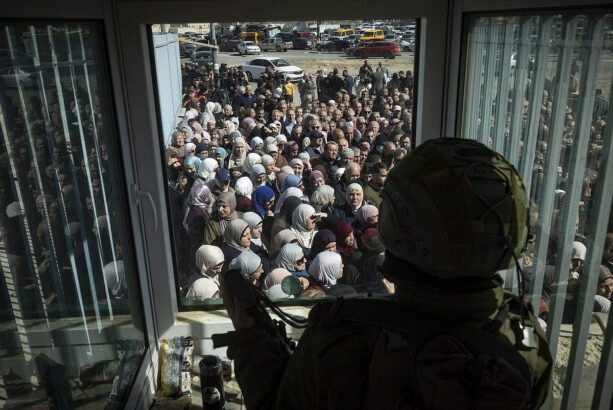
But it is Al-Aqsa Mosque where Israel’s policies bear the greatest risk of provoking a violent reaction. Despite denials from Prime Minister Benjamin Netanyahu, Ben Gvir has unilaterally upended the decades-old status quo on the mosque compound, also known as Temple Mount, by allowing Jewish prayer on the site and recently even permitting printed prayer sheets.
Israel has restricted the entry to Jerusalem of Palestinians from the West Bank to 10,000 people, while extending the visiting hours of Jews to the compound, and still, the first Friday of Ramadan passed quietly. If there is to be an escalation, it will have been engineered by one side only: the Israeli government.
Racist incitement
The most heated front these days, however, is not in the West Bank or Jerusalem but in Palestinian towns and cities inside Israel, where organized crime and gun violence are surging without state intervention. The number of gang-related murders this year — more than 57 already — is higher than last year’s daily average and continues to climb.
Many of these murders are carried out by direct gun shots to the head — killings requiring the skills of professionals. Some instances have involved double and even triple murders. And on February 21, a drone dropped a grenade on a home in the northern town of Kafr Kana.

While the Israeli police have proven unwilling or unable to combat these crimes, they are busy killing Palestinians with no connection to them. Last Wednesday (February 18), police shot dead 18-year-old Ahmed Ashkar in the northern town of Kabul for allegedly failing to stop his motorbike, leading to clashes with the police and the declaration of a strike — a scenario likely to develop in other Arab towns due to the incitement from Ben Gvir and his backing for the murdering police officer.
In recent weeks, police have also blockaded Arab neighborhoods in the binational city of Lod, and killed a Bedouin man during a weeks-long raid on the southern village of Tarabin Al-Sana.
None of this, it is worth emphasizing, has anything to do with Ramadan. Despite the Israeli narrative, the holy month usually sees a decrease in protests due to the social and festive nature of the month, alongside its religious significance and fasting itself. In fact, Muslims tend to lead calmer lives during Ramadan — not just here, but across the Arab and Islamic world.
Israel’s insistence on portraying Ramadan as a month of tension and escalation because of Palestinians’ actions is entirely unfounded, forming yet another aspect of this government’s campaign of incitement that is being amplified uncritically by much of the Israeli media.
The reality could not be clearer: The push toward a violent eruption this month is coming from Israel alone. The government’s continued support of violent settlers in the West Bank, the restrictions on Palestinians entering Jerusalem, Ben Gvir’s efforts to change the status quo at Al-Aqsa, and the policy of abandoning Palestinian citizens in the face of organized crime all risk provoking public anger and escalation, even if not to the extent of the events of May 2021.
The real threat is not Ramadan, but the murderous incitement of this government and its attempt to tarnish a holy month with discourse of terror and hatred — all to serve political interests and fuel racist impulses.
Baker Zoubi is a journalist and Palestinian citizen of Israel, based in the village of Kufr Maser in the Lower Galilee.
RELATED:
- Israeli settlers join ‘safari’ tour of Palestinian prisoners
- Israeli Soldiers Killed Gaza Aid Workers at Point Blank Range in 2025 Massacre: Report
- No Protection, No Justice: US Citizens Killed with Impunity by Israel
- Israel’s Genocide Has Killed More Journalists Than WWI and WWII Combined: Report
- Israel’s Best-Kept Secret: Palestinian Resistance Never Agreed to Disarm