More than 230 Christian school teachers were barred from Jerusalem through restrictive permit policies, exposing a broader Israeli strategy to undermine Palestinian education and religious presence in the city. Fayha’ Shalash reports from the West Bank.
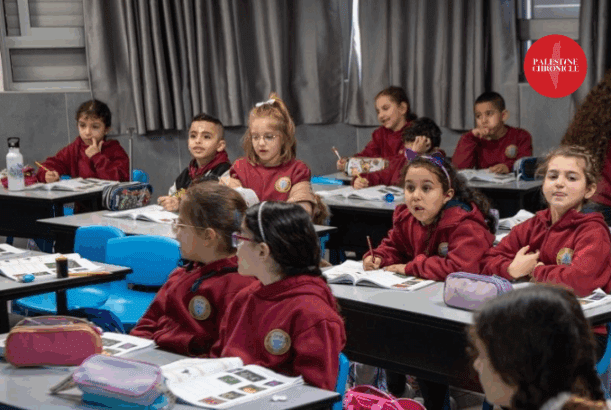
Christian schools in Jerusalem staged a week-long strike to protest what they described as systematic and deliberate restrictions imposed by Israel.
Israel has prevented more than 230 teachers from the West Bank from obtaining permits to enter Jerusalem and carry out their work as usual in these schools.
These restrictions are not limited to permits or to Christian schools alone. Israeli authorities have long obstructed education in the city through multiple mechanisms, most notably preventing the provision of new classrooms, conducting frequent raids on schools, arresting and searching students and teachers, closing some schools under various pretexts, and preventing the renovation of their buildings.
There are 15 Christian schools in Jerusalem, educating more than 12,000 students from the city. They are considered among the oldest and most prestigious schools.
Since 2002, when Israel erected the apartheid wall around Jerusalem, it has prevented Palestinians from the West Bank from entering the city except with a special permit. This permit is granted only to specific categories, such as certain patients, workers, or employees, and for a very limited period.
Deliberate Obstruction
More than 230 teachers from Bethlehem, who have been working in Christian schools in Jerusalem since before the construction of the apartheid wall, are now forced to obtain special permits to continue their work.
Richard Zananiri, principal of the Bishop’s School in Jerusalem, told us that they were surprised by Israel’s refusal to grant the necessary permits to a large number of teachers. This has disrupted the school year and forced Christian schools to close their doors in protest against this new and punitive Israeli measure.
The second semester was supposed to begin on January 10 at these schools, but the permit issue has disrupted classes due to the absence of many teachers who were denied entry permits to the city.
“I call them permits of humiliation. They are not a favor from Israel. Their purpose is humiliation. When they prevent dozens of teachers from reaching Jerusalem from the West Bank, they are disrupting the entire school year,” he added.
Some teachers were denied permits, while others received incomplete permits, meaning they are not valid for all days of the week. This significantly disrupts the school day.
“Some teachers received permits that prevent them from entering Jerusalem on Saturdays, when we are open, and others were barred from entering on Sundays and Fridays. Although these are holidays for our schools, we have many extracurricular activities that take place on those days and require the teachers’ presence,” he said.
The shortage of teaching staff in Jerusalem is another facet of the suffering, as these schools cannot do without teachers from the West Bank due to their extensive experience and the lack of alternatives from within Jerusalem.
After a week of classes being suspended in protest, Israel agreed to renew the permits for most of the teachers, but stated that 57 of them “didn’t pass the security check and their cases will be dealt with later,” leaving the door open to renewed pressure and future restrictions.
While Israeli Prime Minister Benjamin Netanyahu claims to be protecting the rights of minorities, on-the-ground policies continue to expose a pattern of restrictions and violations affecting the religious freedom of Christians and their historical presence in the city.
These practices include imposing restrictions on access to holy sites, especially during religious holidays, and repeated attacks by extremists on clergy and church property, in addition to real estate and tax policies targeting Christian endowments and institutions.
Israelization of Education
For decades, Israel has pursued policies aimed at undermining education in Jerusalem by imposing strict administrative and security restrictions on Palestinian schools, obstructing the work of educational institutions, and restricting the national curriculum while attempting to impose the Israeli curriculum as a replacement.
These policies include reducing licenses, imposing exorbitant fines, and burdening schools with taxes, creating an unsafe learning environment, and negatively impacting the fundamental right to education.
These measures are part of a broader, systematic policy targeting the Palestinian presence in Jerusalem and seeking to weaken national identity by striking at one of its most important pillars: education.
Fayha’ Shalash is a Ramallah-based Palestinian journalist. She graduated from Birzeit University in 2008 and she has been working as a reporter and broadcaster ever since. Her articles appeared in several online publications. She contributed this article to The Palestine Chronicle.
RELATED:
- Palestinian church committee urges churches worldwide to protect aid work in Gaza
- World Council of Churches calls for sanctions on Israel
- From Churches to ChatGPT: Israeli Contracts Worth Millions Aim to Influence U.S. Public Opinion
- U.S. Pastors Become Willing Ambassadors for Israel’s War
- New Israeli settlement in West Bank town near Bethlehem threatens the Christian presence in Palestine