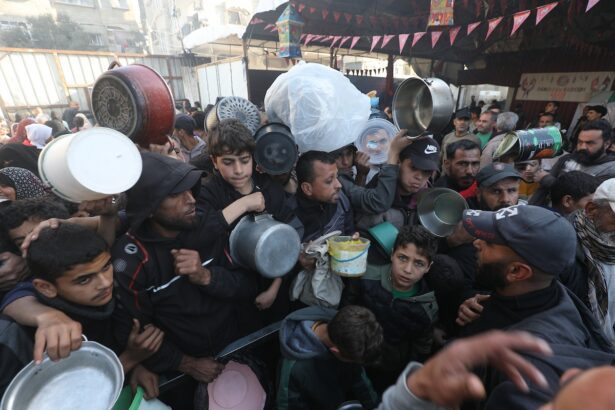
Once Israel and the U.S. launched their war on Iran, Israel closed the crossings into Gaza and cut off all aid. Palestinians in the Strip now fear a return to famine amid food shortages and soaring prices.
The U.S.-Israeli war on Iran has been felt in the Gaza Strip from day one. As soon as the war broke out on Saturday, February 28, Palestinians in the Strip immediately expressed fears of potential border closures and the restriction of the entry of supplies, expecting that hostilities would likely continue for weeks. It did not take long for their fears to be realized.
Israel almost immediately closed all the crossings into Gaza, including those designated for humanitarian aid. Palestinians had already rushed to the markets that morning, anticipating the closure and hoping to stock up on food and other essential supplies. Those who used to buy one kilogram of flour every two or three days began purchasing entire sacks, rapidly causing shortages.
Amid the world’s preoccupation with Israel’s continued escalation in Iran — and now in Lebanon, as Hezbollah enters the fray — Gazans fear that another of Israel’s wars will go unnoticed: the resumption of its starvation policy in Gaza.
Mahmoud al-Qarra, 55, a resident of Khan Younis, says that even the simplest global developments have local consequences for Gazans. He explains that since the war began and news began to spread that the crossings might close, prices preemptively skyrocketed. Israel had not yet announced that the crossings would be closed.
“No one in Gaza has forgotten the taste of hunger,” Qarra told Mondoweiss. “Nor have they yet recovered from the famine.”
Over two years of genocidal war in Gaza, Israel pursued a systematic policy of starvation as early as the first few months of the war. But in March 2025, Israel completely cut off all food going into Gaza for three months. Later, it resumed allowing a negligible trickle of aid into the Strip under overwhelming international pressure, while pursuing a policy of “engineering chaos” meant to prevent Palestinians from reaching aid sites or to hamper the safe delivery of aid to those who needed it. By August of that year, the world’s largest famine-monitoring body in the world officially declared a famine in Gaza.
“We lived through a bitter experience,” says al-Qarra. “Everything we do now is based on that experience.”
‘If Israel annihilates us the world would be too preoccupied to notice’
On Saturday morning, the prices of sugar, meat, cheese, and other basic food commodities doubled. Later in the day, Israel’s COGAT agency, which is responsible for administering the occupied Palestinian territories, announced that all crossings would be closed, while humanitarian aid going into Gaza would be suspended until further notice. The move was described by COGAT as the result of “necessary security adjustments.”
Yet the statement claimed that the closure would “have no impact on the humanitarian situation” in Gaza, since the “substantial quantities of food” that have supposedly entered since the ceasefire began in October 2025 “amount to four times the nutritional needs of the population.”
The COGAT statement is consistently contradicted by reports from international aid bodies, which assert that Israel has systematically fallen short of the number of aid trucks agreed upon in the ceasefire deal (about 600 trucks per day, of which only about 200 appear in border crossing manifests). According to the UN Office for the Coordination of Humanitarian Affairs (OCHA), throughout January, “rations covered 100 per cent of minimum daily caloric need,” a rate that decreased the next month to 75 percent. Moreover, the trucks actually allowed to offload aid have consistently fallen short of the numbers registered at the border crossings, according to OCHA’s weekly situation reports over the past several months.
Muhammad Abu Hamad, 34, a local merchant in Gaza, says that by late Saturday night and early Sunday morning, all of his food items were sold out. He even put up the amounts he had kept in reserve to store for long months due to the overwhelming demand. Those quickly ran out as well.
“When people were dying en masse on live TV, nothing changed for them,” Abu Hamad says. “The siege was not lifted. We weren’t supplied with food, even as global attention focused entirely on the war in Gaza.”
Now, with the world preoccupied with the assault on Iran, Abu Hamad says, Palestinians are afraid that the world won’t notice what happens to Palestinians “even if Israel were to annihilate the Palestinian people in a single night.”
“People are afraid Israel will exploit this war,” he explains, “to carry out wide acts of destruction.”
But on the ground, Israeli military operations never stopped since Israel and Hamas agreed to a ceasefire in October 2025. In areas of Gaza still under Israeli control, demarcated by the so-called “Yellow Line” that cuts Gaza roughly in half, systematic home demolitions continue unabated. Many residents who have attempted to return to their homes near the Yellow Line have been shot on sight by Israeli forces, while residents living in nearby displacement centers continue to hear constant explosions on a daily basis. On Friday, February 27, Israel killed three police officers at a checkpoint in Khan Younis. According to the Ministry of Health’s daily report, casualties continue to mount, while dozens of injuries arrive at Gaza’s hospitals each day.
Last Ramadan, Palestinians in Gaza were fasting amid the famine. After the ceasefire, they didn’t expect to have to endure similar conditions for a second year in a row. Muin Alawan, 28, says that in a month marked by fasting, religious rituals, and family visits, the least he expected was to be able to celebrate the holy month without fear of food running out. Nothing else about Ramadan in Gaza remains the same — no homes for gatherings nor mosques for hosting prayers, Alawan says.
But Israel found another occasion to impose deprivation on the people of Gaza. “This is Israel,” Alawan observes. “It is only accustomed to war, and that will never change.”
Tareq S. Hajjaj is the Gaza Correspondent for Mondoweiss and a member of the Palestinian Writers Union. Follow him on Twitter/X at @Tareqshajjaj.
RELATED:
- Israeli Lawmakers Demanded Better PR to Conceal Gaza Famine. Google Obliged.
- Largest Gaza aid flotilla sets sail as famine deepens
- The New “Free Press” Editorial Defending its Famine Denial Includes Fundamental Errors
- Netanyahu’s plan to “end” US aid to Israel is to give even more money under a different name
- By suspending 37 aid organizations is Israel pushing toward a final expulsion?
- Israel gives war profiteers sole control of life-saving Gaza aid: Report