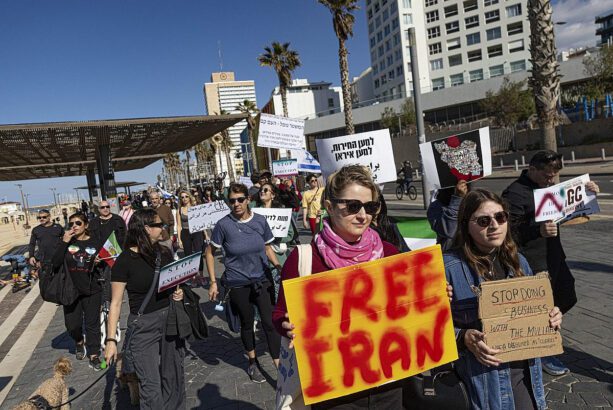
Only moments ago, Israelis were cheering on a holocaust in Gaza — and now they dare to celebrate the valiant uprising of the Iranian people.
Forty-seven years ago today, Mohammad Reza Pahlavi, the former Shah of Iran, left the country for good. Forty-seven years ago today, my family and I left Iran too, not knowing that it would also be for good. In the chaos of the revolution, nothing was clear except the chaos itself.
We only learned about the royal family’s departure on the way to the airport, from the headlines of the special editions of the newspapers that shouted: شاه رفت, “The Shah is gone.” The Shah was gone, and so were we.
For 47 years, I have been following from afar the homeland we left behind: its joys, which are too few, and its disasters and pains, which are far too many. And like the rest of the world, in recent days I have been following the heroic uprising of the Iranian people in their struggle to free themselves from the oppression of this evil and cruel regime. Witnessing the terrible price they have been forced to pay, my heart feels as if it is flying out of my chest to them.
The footage of Basij forces mowing down protesters is chilling. I still have a fair few relatives in Iran; since the protests began, I have not dared contact them to ask about their wellbeing because any such contact from someone in Israel could put them in danger. So I follow from afar and pray for the best.
In Israel, like everywhere else around the world, the Iranian uprising has taken over the headlines and much of the public discourse — not only because of the implications that these developments, or a possible U.S. attack, would have for Israel, but also because the demonstrations give the Israeli public an opportunity to “stand on the right side” and restore their image, both to themselves and to the world.

When I see Jewish Israelis who only a moment ago were supporting the barbaric genocide of the Palestinians of Gaza — with all their might, with measured enthusiasm, or with a shrug of the shoulders and a “That’s how it is in war” — now celebrating the valiant uprising of the Iranian people, the nausea shakes me to my core.
Is there a more insolent collective on earth than the Zionist one? After yawning in the face of babies starving to death and the bombing of entire neighborhoods, and still exhibiting total indifference to the ongoing suffering in the Strip, they now dare to talk about a cruel regime? About a struggle for liberation? About democracy? About freedom?
I see Israelis shaking their heads self-righteously about the fact that no one knows the real number of victims among the protesters in Iran. Do they know the real number of victims of the Gaza holocaust? Do they even care?
Recently, I was overcome by a flu the likes of which I have never experienced. They say it is the worst flu to attack our region in decades, and I believe it. I know that it is currently wreaking havoc on the residents of Gaza — with no warm bed, no roof over their heads, no medicine, and no dry space to recover. The insatiable Israeli cruelty still does not let go of these survivors, insisting on continuing to torture them.
While I was bed-ridden, I was unable to do much except scroll through more and more videos from Iran, and especially from my hometown, Tehran. Every time, after I put down my phone, I would sail away in my imagination to the visit I might one day be able to make.
If I have a wish, it is this: to see Iran one more time. The street where our house used to be, which is no longer there. The Jewish school where I studied, which still exists. The city’s grand bazaar. The alley that leads to my grandparents’ home in Isfahan. I can easily recreate the smell of each of these places.

I recently read Raja Shehadeh’s memoir, “We Could Have Been Friends, My Father and I.” Shehadeh describes how difficult it was for his father, one of the most prominent Palestinian lawyers of his time, to come to terms with the loss of his home in Jaffa after the Nakba: the constant longing and readiness to return, and the heartbreak of being unable to do so.
My parents never imagined their lives would end anywhere other than in their homeland. But unlike many others forced to uproot themselves, including the Shehadeh family, another country was waiting with open arms to offer us a new homeland — provided we were willing to commit to the task of erasing the history of the people whose land it had so generously offered us.
It took me many years to understand the significance of this: that even before I set foot on this land, at the age of 9, I already had rights that went far beyond those of the people who had lived there for centuries. My rejection of this injustice stems not only from my position as an Israeli Jew, with all the privileges this entails, but also from the moral imperative imposed on me by my Iranian identity, and my identity as an immigrant.
My family and I did not experience a Nakba — far from it. We chose to emigrate from our homeland; no one expelled us. Unlike Palestinian refugees, we could return at any moment. Our fate would have been no worse than that of the tens of millions of other Iranians under this nightmare regime. We were not thrown into exile; the homeland of another people was spread out at our feet, after subjugating and crushing its inhabitants.
For all these reasons, I will not stake a claim to any kind of diasporic solidarity with the Palestinian refugees (after all, I do not have the insolence of Zionists). But the pain of watching from afar as your homeland is torn apart, corrupted by a despicable and cruel regime, is something I know well.
Freedom for the Iranian people. Freedom for the Palestinian people. And freedom also for Jewish Israelis from the shameful role of masters in a regime of supremacy. May we see the day when all refugees can return to their homelands with their heads held high, and all the evil regimes of this broken world will be eradicated forever.
Orly Noy is an editor at Local Call, a political activist, and a translator of Farsi poetry and prose. She is the chair of B’Tselem’s executive board and an activist with the Balad political party. Her writing deals with the lines that intersect and define her identity as Mizrahi, a female leftist, a woman, a temporary migrant living inside a perpetual immigrant, and the constant dialogue between them.
RELATED:
- Iran Does Not Hate Americans… But It Has Legitimate Reasons to Do So
- Iran, Gaza and the politics of counting the dead
- How Israel and the US are exploiting Iranian protests
- The Israeli Influence Operation Aiming to Install Reza Pahlavi as Shah of Iran
- Did Netanyahu just ask Trump for another war — and get it?