Israeli settler groups have begun bulldozing Palestinian lands in the town of Beit Sahour to make way for a new settler outpost. The settlement threatens the existence of the largest remaining Christian community in the West Bank, residents say.
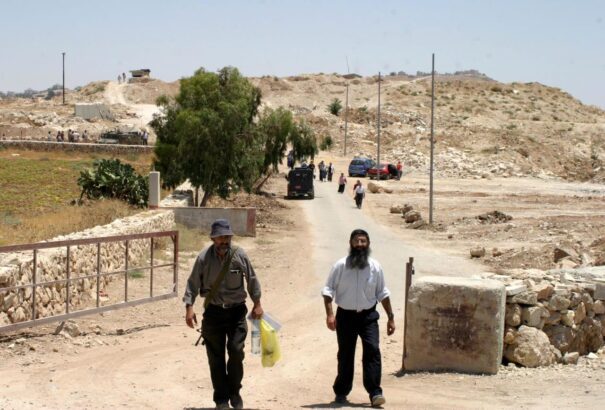
Last month, Israeli settler groups began razing lands in the Palestinian town of Beit Sahour just east of Bethlehem. Before long, settlers placed caravans on a hilltop known by locals as Ush al-Ghurab and announced the establishment of a new settler outpost called Shdema.
A predominantly Christian town, residents of Beit Sahour tell Mondoweiss that the encroaching settler presence threatens the existence of the largest remaining Palestinian Christian community in the West Bank. [Editor’s note: The Shepherds’ Fields, located in Beit Sahour, are remembered as the spot where the shepherds first saw the nativity star.]
According to a report by the Balasan Initiative for Human Rights, the new Shdema outpost “marks a substantial escalation in Israel’s settlement expansion and territorial consolidation in the Bethlehem district.”
“The emergence of the Shdema settlement must be understood as part of a broader territorial strategy designed to reshape the demographic and geographic reality between Jerusalem and the Bethlehem hinterland,” the report states. “The consequences for Beit Sahour’s residents are significant and multifaceted.”
In a letter to supporters shared with Mondoweiss, Dr. Elias Iseed, mayor of Beit Sahour, wrote that this settlement “is not simply a construction project,” but “an act of dispossession.”
“It is being built directly upon Palestinians’ lands, homes, and backyards, stealing the soil from beneath peaceful families who have lived here for generations,” the mayor wrote.
According to the Balasan report, the 100 dunams (approximately 25 acres), “had been earmarked for public facilities.” These included “a children’s hospital to be built, recreational areas, cultural center, green space, and community hall, plans that had already begun implementation with donor support before settler pressure forced their suspension.”
According to Israeli settlement watchdog, Peace Now, the outpost “is intended to choke the Palestinian town of Beit Sahour and block its development,” adding that the site on which Shdema is being built has been reserved for Palestinian development projects for about 15 years, but that “there is no limit to the settlers’ audacity in establishing outposts and creating facts on the ground.”
According to the Balasan report, “only about 7% of Beit Sahour’s administrative land remains accessible for building due to settlement encirclement and the Annexation Wall.” This has caused an intensification of “demographic pressure” on the town, limiting its urban development and encouraging “the displacement of its population, mainly composed of Palestinian Christians.”
“Beyond its material impacts, the settlement plays a symbolic and cultural role in the ongoing effort to entrench an exclusive Zionist narrative in the area,” the report states. “Israeli settler groups have repeatedly invoked biblical justifications for taking over the site, despite archaeological evidence refuting such claims. These ideological assertions accompany attempts to rebrand the area as part of a ‘return of Jews to Bethlehem,’ a rhetoric deployed to normalize settler presence and obscure the illegality of the project under international law.”
As mayor Iseed writes, the West Bank has already witnessed a historic rise in settler violence:
“According to the United Nations Office for the Coordination of Humanitarian Affairs (OCHA), there were 757 settler attacks on Palestinians in the West Bank since January 2025, a 13% increase compared to 2024. These attacks include assaults, destruction of property, and intimidation, often carried out with impunity.”
Yusef Daher, Coordinator of the Jerusalem Liaison Office of the World Council of Churches, tells Mondoweiss that settler encroachment has devastated local communities, “because we have neither the time nor the strength to stop this land grab.”
“We are an unarmed people enduring extremely violent Israeli settler gangs under the protection of their army and ministers,” Daher said.
The Balasan report asserts that the establishment of Shdema constitutes a violation of international humanitarian law and the Fourth Geneva Convention, which prohibits the transfer of the civilian population of the occupying power to the territory it occupies and proscribes the expropriation of land.
“The outpost further contributes to the creation of irreversible facts on the ground, undermining the right of the Palestinian population to self-determination and violating obligations of the occupying power to protect property and ensure public order and civil life,” the report states. “In this context, the establishment and expansion of the Shdema outpost are not isolated violations but form part of an unlawful territorial regime that the International Court of Justice [in its July 2024 Advisory Opinion] found incompatible with international law.”
“By entrenching and expanding civilian settlements on confiscated Palestinian land Israel both deepens the illegality identified by the Court and exacerbates its obligations of cessation and non-recognition,” the report added.
Consequently, the Shdema outpost, which “reinforces an internationally unlawful situation,” must be brought to an end by third States, the report concludes.
Rifat Kassis, General Coordinator of Kairos Palestine and a resident of Beit Sahour, told Mondoweiss that the settlement “is a direct assault on the heart of the Christian presence in Palestine.”
“By confiscating what remains of our towns’ open spaces and tightening the ring of settlements around Beit Sahour and Bethlehem, this project threatens the very existence of the largest remaining Christian community in the Holy Land,” Kassis said. “If allowed to continue, it will be the last nail in the coffin of the Christians’ presence in Palestine, accelerating displacement, severing social cohesion, and pushing more families to forced migration.”
“We make this plea not because we expect political leaders — whose governments consistently choose their interests with Israel over justice for the oppressed — to change their course,” Kassis explained. “We write it so that our own descendants will know that we were not silent, and so that the future generations of those governments will know that their ancestors stood by in silence while a people, and a Christian heritage rooted in this land for two millennia, were being pushed toward erasure.”
Jeff Wright is an ordained minister of the Christian Church (Disciples of Christ), and reporter for Mondoweiss
RELATED:
- Prominent Israeli Settler Says Spitting on Christians ‘Ancient Jewish Custom’
- ‘Our Future Was Here’: Christians in Gaza
- Christians come under attack as Israeli leaders get more extreme
- ‘They are trying to make it unbearable’: Jerusalem Christians face Easter under Israeli crackdown
- Gaza’s Christians refuse to abandon churches before Israeli attack