Israel’s Defense Ministry announced a massive project to expand the production of IDF tanks and armored personnel carriers. Two lines in U.S. Army documents reveal the possibility that the plant in Israel would be built with American funding.
By Oded Yaron, Reposted from Haaretz, January 12, 2026
The United States may finance the construction of Israel’s new armored-vehicle production plant with up to $2 billion from U.S. military aid funds, according to official American documents obtained by Haaretz. This comes even as Israel has declared its intention to begin reducing its reliance on U.S. assistance.
The U.S. Army, which is responsible for the project, said in response that no formal decision has yet been made. Israel’s Defense Ministry declined to comment on the funding.
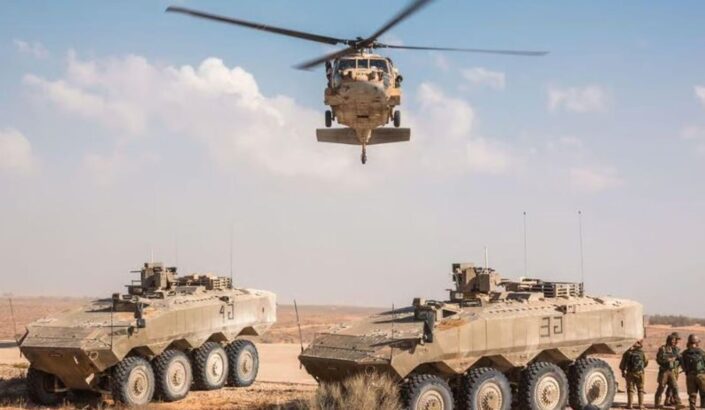
Last August, the Israeli government’s ministerial panel for defense procurement approved the “Armored Vehicle Acceleration Project” – an ambitious plan to increase the production rate of Merkava tanks and the armored personnel carriers used by the IDF, the Namer and the Eitan. According to an Israeli Defense Ministry statement, the project’s cost is estimated at more than 5 billion shekels ($1.5 billion). The announcements did not mention any foreign financing.

The ministry said: “The acceleration program includes the expansion of production infrastructure across numerous industries throughout the country, many of them located in the periphery … and will include expanding production infrastructure at the Merkava and armored vehicle plant at the IDF Maintenance and Rehabilitation Center.” This, it added, is part of the Defense Ministry director general’s strategy to expand Israel’s domestic defense manufacturing base.
The wars in Gaza and Lebanon were a major stress test for the IDF’s armored corps, as well as for the logistics system responsible for maintenance and operations. The Namer and the Eitan provide armored troop transport, logistics support, and battlefield rescue, and over the past two years, they have won Israel Defense Prizes.
Even before the acceleration project was approved, Israel’s Defense Ministry invested hundreds of millions of dollars in expanding the production of spare parts for armored vehicles and Merkava tanks through companies such as Ashot Ashkelon Industries and IMCO Industries, which manufactures electronic systems. Ashot Ashkelon’s annual report pointed to a “sharp increase in the volume of orders received from the Israeli Defense Ministry” and projected growth in “local production capabilities.”
According to two official American documents, the U.S. is expected to play a significant role in the project. A presentation by the U.S. Army Corps of Engineers, shown last October at a Middle East contractors’ conference, detailed future “business opportunities.” Under the “Israel” section, a new project was published for the first time, including the “planning, design and construction” of the “Joint Systems Manufacturing Center” for the armored vehicle acceleration project.

According to the presentation, the project’s cost is $1-2 billion, to be financed from U.S. military aid funds. It also noted that a start date had not yet been set. Another Corps of Engineers presentation from November, outlining “contractor opportunities forecast,” likewise includes the construction of Israel’s armored-vehicle production plant. The presentation also said, “We are exploring the potential for a multibillion-dollar Joint Systems Manufacturing Center (JSMC) project, which could be a pivotal next step for the program.”
The U.S. Army Corps of Engineers is responsible for construction projects for U.S. allies that are funded through American aid. As Haaretz recently revealed, U.S. assistance does not finance only aircraft, missiles, bombs, and other weapons systems – many billions of dollars in aid are also channeled into the construction and maintenance of bases, airfields, naval facilities, and other critical IDF infrastructure.
If and when the project receives final approval, the U.S. will issue a formal tender for contractors to compete over each component of the armored-vehicle plant’s construction. The rules governing the use of U.S. aid funds stipulate that only American companies may bid as prime contractors, but in practice, they often employ Israeli subcontractors, who carry out most of the on-site work.
The current U.S. aid agreement, under which Israel received $38 billion over the past decade, is set to expire in 2028, and it remains unclear what a new agreement will look like. A congressional study found that over the past two years, against the backdrop of the war, the U.S. spent a total of about $32 billion to support Israel.
In addition to direct costs stemming from U.S. military activity in Yemen and Iran, Washington provided Israel with $21.7 billion in assistance – the vast majority beyond the annual $3.8 billion. At the same time, the House of Representatives approved last year a special $26 billion military aid package, including about $4 billion for missile defense interceptors and $1.2 billion for the new laser-based air defense system,

Over the past year, voices on both the American left and right have expressed growing reservations about the scope of aid to Israel in light of the war against Hamas, Hezbollah, and Iran, calling for it to be reduced or even canceled altogether.
Over the weekend, Prime Minister Benjamin Netanyahu said in an interview with The Economist that he supports scaling back U.S. security assistance to Israel, intending to end it within a decade. As Amos Harel wrote in Haaretz on Sunday, these remarks were not made in a vacuum but in response to explicit expectations voiced by Trump – the president has on several occasions expressed dissatisfaction with the massive U.S. investments in the security of other countries.
The U.S. Army Corps of Engineers said that “it does not currently have a formal JSMC program with Israel, so any questions on programs the Israeli Ministry of Defense may be considering should be addressed to them.”
Israel’s Defense Ministry said that the Merkava and Armored Vehicles Directorate and the Procurement Administration are currently in the stage of conducting negotiations and issuing tenders, but declined to comment on the question of U.S. funding.
Oded Yaron is an Israeli reporter for Haaretz.
RELATED:
- Measure To Protect Israel From Global Arms Restrictions Tucked Into US Defense Budget
- Even Former AIPAC Democrats Are Signing On to Block Arms Sales to Israel
- An arms embargo on Israel is not a radical idea — it’s the law
- Gaza breakdown: 20 times Israel used US arms in war crimes
- Israeli Indifference to Palestinian Suffering Is Fertile Ground for the Growth of Sadism