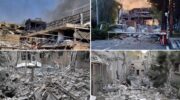
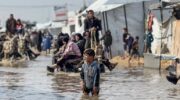
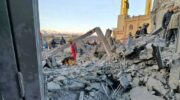
Around 70 people were killed daily in Gaza in August.
An attempt to clarify why 29 Israeli strikes that killed 180 people were carried out was met with vague answers or silence.
Last Monday (August 29), four shells struck Nasser Hospital in Khan Younis, killing 22 people. In the nine minutes between the first and second strikes, medical staff and journalists gathered at the site of the first hit – on the hospital’s emergency stairwell. Television cameras were pointed there, which is why the second, deadly strike was so thoroughly recorded.
Hours later, the world saw how a precise Israeli military strike killed a large group of people – most of them medical personnel and journalists, none of them armed – on a hospital stairwell. The outcry was so intense that, in an unusual move, even Prime Minister Benjamin Netanyahu issued an apology: “Israel deeply regrets the tragic error that occurred today at Nasser Hospital,” Netanyahu wrote on his English-language X account – but not on his Hebrew account.
On the same day, a few kilometers north of the hospital, the Israeli military fired a missile that struck a displaced persons’ tent. Five people were killed in the strike – parents Odah and Aline Kawarea and their three young children: Issa, Aliyan, and Hussam. In a photo shared on social media, the three small bodies lie side by side, their faces mangled by shrapnel. Odah’s brother, Ahmed, told the digital news agency Ma’an that the family was killed in a drone strike while asleep.
He said the family had no affiliation with any faction, and the father had already been injured in a strike a year earlier, losing an eye and suffering paralysis in his hand. “There is no safe place in Gaza; they just force us to gather in one place to kill us,” the brother said. That same day, another missile struck a different tent in the Nuseirat refugee camp, killing Sheikh Imran Qudaih, his children Zakaria, Issa, and Yahya, and his 12-year-old grandson Anas.
There was nothing unusual about that day. In fact, compared with other days in August, it was one of the less deadly days in the Gaza Strip. During August, an average of around 100 people were added each day to the Gaza Health Ministry’s death toll. Several hundred were missing, or their bodies were identified only long after their deaths.
On average, over 70 people have been killed by fire in the Strip daily. Estimates suggest that about 30% were killed by gunfire near food distribution centers or aid convoys. Most were killed by airstrikes or artillery shelling that hit displaced persons’ tents, homes, and people standing in the streets.
In recent months, global media and political attention have focused on mass hunger in Gaza. Earlier coverage largely centered on the deaths of hundreds of people waiting in food distribution lines. Yet throughout this period, the leading cause of death in the Strip – as throughout the war – remained airstrikes.
Haaretz sent the Israel Defense Forces a list of 29 documented strikes between late July and late August, which, according to the Palestinian Health Ministry, killed 180 people, and requested the military’s response. For five of the strikes, the IDF provided a partial reply, leaving key questions unanswered: What were the targets of the strikes? Was the risk to civilians considered? Was an investigation opened into civilian casualties? For the remaining 24 strikes, the response was entirely general.

On July 28, 15 members of the Noufal family were killed. With this strike, the IDF said that the target had been four militants. On August 11, the IDF reported suspected activity in southern Gaza City. A missile fired to neutralize the threat struck a residential building, killing nine people, including six children from the Arhim family. Al Jazeera released footage showing civil defense personnel counting the children’s bodies: “Here is a girl, and another girl, here are two children, four girls and two boys,” one of them said.
Four days later, the IDF’s 36th Division struck a “structure that posed a threat,” according to the military. Seven people were killed in the strike, including two toddlers. That same day, fire was also directed at “suspects in a building.” The building was a school in the Al-Daraj neighborhood, where displaced families were living. Seven people were killed.
#صور | عائلة كاملة مسحت من السجل المدني..
ارتقاء طارق محمد أبو هجرس وزوجته رنا محمد أبو هجرس وأطفالهم الخمسة جراء قصف الاحتلال منزلًا في بلدة بني سهيلا شرقي خان يونس. pic.twitter.com/ZlF6FQfPHt— المركز الفلسطيني للإعلام (@PalinfoAr) August 9, 2025
The IDF also provided an explanation for another strike in which a fisherman was killed at sea. According to the military, he was “active in Hamas’ naval force.” Regarding the strike that killed the Kawarea family on August 25 – the same day Nasser Hospital was hit – the IDF said the strike was “unrecognized.”
For the other 24 strikes, the military offered no specifics beyond the following general statement: “The IDF targets only military objectives, taking measures to minimize harm to civilians and civilian infrastructure in accordance with the laws of armed conflict, including precautions before carrying out strikes. Conversely, terrorist organizations in the Gaza Strip systematically violate international law, cynically using civilian infrastructure for terrorist activities. Preliminary review indicates that the incidents mentioned involved strikes against terrorist targets. The claims in the report will be examined. In cases where no precise coordinates were provided, it was not possible to verify the journalist’s claims.”
منذ ليلة أمس ارتكبت إسرائيل مجزرة بحق المدنيين في حي الزيتون حيث استهدفت عمارة سكنية في شارع النديم ما أسفر عن استشهاد أكثر من 18 شخصًا ولا يزال آخرون عالقين تحت الأنقاض pic.twitter.com/yfqhkMCtW4
— MOHAMED🤍 (@moham_pales) August 13, 2025
The strikes on the list include attacks on tents, residential buildings, and schools housing displaced families. Among other omissions, the IDF did not respond regarding the strike that killed the entire Abu Hajras family – Muhammad, Rana, and their five children – on August 8. The father was a Palestinian police colonel affiliated with Fatah, not Hamas, and also worked as a communications engineer. After the family’s death, Abu Hajras’ father said his son supported the Palestinian Authority and peace.
The IDF also did not comment on the killing of seven members of the Abu Hanidek family on August 13: Ahmad, 15; Mona, 8; Ali, 6; Ahmad, 4; and Muhammad, 2. On that day and the next, Palestinians reported that the IDF killed more than 30 people in three strikes on buildings in Gaza City’s Zeitoun neighborhood.
On August 30, hours before the killing of Hamas spokesperson Abu Obeida, another missile struck Gaza City’s Ansar neighborhood, where a line of people were waiting for pita bread. Twelve people, including five children, were killed. Footage filmed immediately afterward showed residents collecting pita bread stained with blood, bodies piled onto a truck, and a mother saying goodbye to a building. The IDF spokesperson requested the coordinates of the strike from Haaretz and received them, but no explanation was given for the strike’s target.
Nir Hasson is an Israeli journalist.
Rawan Suleiman is a journalist for Haaretz.
RELATED:
- Report: Internal IDF Document Concludes Months-long Gaza Offensive Failed
- Israel blocking outside journalists from Gaza doesn’t help its cause
- Netanyahu’s delusion: If you don’t support me you’re not ‘MAGA’
- Gaza genocide: ‘There is nothing to occupy. The city itself no longer exists’
- Palestinian Liberation From Israeli Colonization Will Liberate the United States, Too
- U.S. Support for Israel Comes at a Staggering, Multifaceted Price