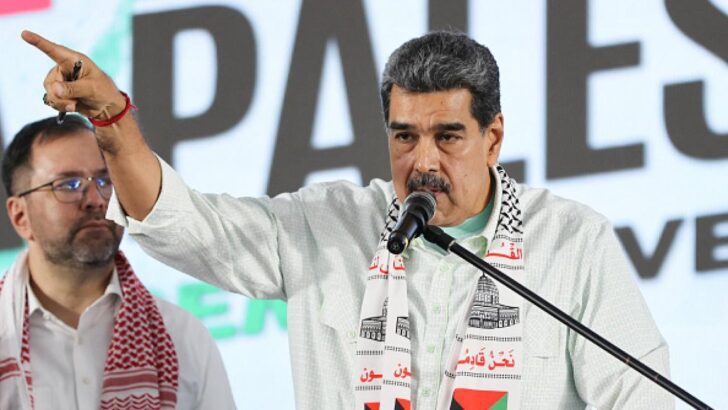
Among the factors in the Trump administration’s decision to attack Venezuela, is Venezuela’s support for Palestinian human rights.
Below are eight articles from diverse sources with information on this aspect:
[Editor’s note: Speaking on CBS’s “Face the Nation,” US Secretary of State Marco Rubio said the mission is also about ending Iranian and Hezbollah activity inside Venezuela.]
Venezuela’s acting leader says ‘Zionist undertones’ marked US capture of Maduro
The accusation drew on years of anti-Israel rhetoric from Caracas.
Venezuela’s acting leader, in an address to the nation on January 04, said there were “Zionist undertones” to the U.S. military’s capture of President Nicolás Maduro.
Delcy Rodriguez, a vice president under Maduro who is now the interim leader, has demanded the “immediate release” of Maduro and his wife, Cilia Flores, since they were captured by U.S. forces on Saturday. Maduro and Flores were flown to New York City, where they are expected to appear in federal court on drug-trafficking and other charges on January 05.
“Governments around the world are simply shocked that the Bolivarian Republic of Venezuela is the victim and target of an attack of this nature, which undoubtedly has Zionist undertones,” Rodriguez said in the televised address. “It is truly shameful.”
President Donald Trump doubled down on his assertion that the United States was “in charge” of Venezuela on Sunday (January 04) night, telling reporters that he demanded “total access” from Rodriguez.
“We need access to the oil and to other things in their country that allow us to rebuild their country,” Trump said.
Rodriguez’s reference to “Zionist” influence echoed past statements by Maduro. The president said that “Zionists” were facilitating Venezuela’s takeover as the United States ramped up its military campaign, including strikes on boats and a naval buildup in the Caribbean Sea, over recent months.
“There are those who want to hand this country over to the devils — you know who, right? The far-right Zionists want to hand this country over to the devils,” Maduro said during a speech in November.
Maduro also blamed “international Zionism” for protests that swept across Venezuela in 2024, after he was accused of stealing the presidential election amid widespread claims of fraud.
Venezuela and Israel have not had formal relations since 2009, when then-President Hugo Chávez cut ties, citing Israel’s conduct during its offensive in Gaza that year. Maduro, like Chavez, is deeply critical of Israel and supportive of Palestinians.
Israeli officials have not publicly responded to Rodriguez’s claim about “Zionist undertones,” but Prime Minister Benjamin Netanyahu celebrated Maduro’s ouster without naming him on January 03.
“Congratulations, President @realDonaldTrump for your bold and historic leadership on behalf of freedom and justice. I salute your decisive resolve and the brilliant action of your brave soldiers,” Netanyahu said on X.
Foreign Minister Gideon Saar also praised the U.S. action and said that “Israel stands alongside the freedom-loving Venezuelan people, who have suffered under Maduro’s illegal tyranny.”
Venezuela’s official Jewish community has not yet commented on the operation to remove Maduro. Some 3,000 to 5,000 Jews live in the country, down from a height of about 25,000 in the 1990s. Maduro’s 12-year reign was marked by a protracted economic collapse, exacerbated by U.S. oil sanctions, that drove an exodus of 7.7 million Venezuelans.
The Jewish Democratic Council of America condemned Trump’s actions and attempts to “create regime change” in a statement on January 03.
“For the overwhelming majority of Jewish American voters, maintaining our democracy is the number one policy priority,” said the group. “The American people do not want — nor did they vote for — unauthorized war with Venezuela, especially not one that circumvents the U.S. Constitution.”
Shira Li Bartov is a JTA contributor covering culture and global news.
Why Israel is Pushing for Regime Change in Venezuela through Washington
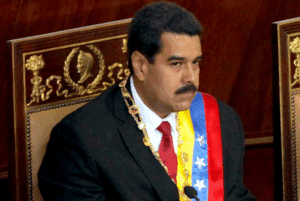
Washington’s pro-Israel think tanks, like the Foundation for Defense of Democracies, are pumping out articles salivating over the prospect of controlling the nation’s oil.
By Robert Inlakesh, Reposted from The Palestine Chronicle, December 13, 2025
Not only is the pro-regime change Venezuelan opposition allied with the Israeli Likud Party, but toppling the government in Caracas directly serves Israel’s regional agenda. This is why pro-Israeli commentators are adamant that the US military intervene and put American lives on the line.
While parallels are beginning to be drawn between the buildup to the Iraq war and the Trump administration’s regime change propaganda against Venezuela, one key similarity is being conveniently left out of the picture.
Israeli Prime Minister Benjamin Netanyahu is infamous for cheerleading the US’s illegal invasion of Iraq in 2003, a war which Israel refused to fight in itself, but nonetheless lobbied for and encouraged through its allied neoconservative think tanks in Washington, DC.
Despite the White House recently releasing a new 33-page National Security Strategy document, in which the US declared it is no longer seeking to engage in “nation-building wars” and that the days of regime change operations to export American values are over, the current administration is threatening just that against Venezuela. It is additionally aiming to achieve this outcome in Gaza through its UNSC-approved Gaza ceasefire plan.
The parallels to the buildup to the Iraq War couldn’t be any starker. Pro-Trump conservative commentators are currently salivating at the prospect of getting their hands on Venezuelan oil. In addition to this, the false charge that Venezuela is somehow responsible for the US’s fentanyl crisis has led to labeling the Venezuelan President Nicolas Maduro’s government as a “narcoterrorist” regime.
However, if you listen to what Trump administration officials are using as a justification for their goal of toppling Maduro, they consistently accuse Caracas of allying with Hezbollah and Hamas. Some pro-Israeli commentators even claim that Hezbollah and Hamas could be preparing attacks on the US homeland, not only an audacious and illogical charge, but one with not a shred of evidence to back it up.
These are also not the enemies of the US, but instead the enemies of Israel, making it more suspicious as to why there is such a hyper focus on this issue. For example, Venezuelan opposition leader Maria Corina Machado recently spoke at a conference in Oslo and was asked to address the issue of US intervention in her country; her response was to declare the country “has already been invaded”.
“We have the Iranian agents. We have terrorist groups such as Hezbollah, Hamas, operating freely in accordance with the regime”, Machado claimed in order to justify the invasion of her nation.
The US also recently released footage of its illegal theft of a Venezuelan oil tanker, justifying this move by claiming it was used to transfer Iranian oil. It is of note that Tehran’s relationship with Caracas is frequently cited as if it represents a threat to the United States. Moves like the recent tanker seizure represent a step that is an aggression toward Iran by proxy.
Donald Trump, whose long-desired Nobel Peace Prize was stolen away by the pro-war Venezuelan opposition leader he backs to overthrow Maduro, attempts to pride himself on the idea that he is a broker of peace and opposed to regime-change wars. Yet, between March and May, he launched a failed war on Yemen, followed by directly striking Iran in June, both acts committed solely for the sake of Israel.
Washington’s pro-Israel think tanks like the Foundation for Defense of Democracies (FDD) are pumping out articles groveling over the prospect of controlling the nation’s oil, but also ensuring that the new Venezuela led by a US-puppet regime will cut ties with Israel’s enemies.
In a new article written by the FDD’s Senior Iran and Financial Economics Advisor, Saeed Ghasseminejad, it spells out in a tone of certainty that “a new regime in Caracas would sever ties with Iran. Tehran uses Venezuela as a base for expanding its jihadi influence in America’s backyard. A U.S.-aligned Caracas would kick the Iranian agents out, making the southern border and the homeland more secure.”
The Atlantic Council think tank has even claimed that Lebanese Hezbollah “has helped to turn Venezuela into a hub for the convergence of transnational organized crime and international terrorism.”
In fact, in the same issue brief that was published back on October 7, 2020, entitled ‘The Maduro-Hezbollah Nexus: How Iran-backed Networks Prop up the Venezuelan Regime’, you see the think tank use the term “narcoterrorism”. The Atlantic Council blames Israel’s enemies for this, allegedly setting up a “narcoterrorism conspiracy that involved dissidents of the Revolutionary Armed Forces of Colombia (FARC), drug cartels in Mexico, the Islamic Republic of Iran, Syria, and the Lebanese terrorist group Hezbollah.”
Such an obsessive focus on this fact-free conspiracy theory, which points the finger at a who’s who of Israel’s enemies, recently roping in Hamas also, is not by accident. Nor is the pledge of allegiance to Israel by the Venezuelan opposition.
While it is clear that Venezuela is allied with Iran and collaborates with it as a means of navigating the world under crushing US sanctions, these conspiracy theories presented by pro-Israel think tanks, Israel Lobby-sponsored politicians, and Israeli-aligned media outlets are about as serious as the claims that led to the Iraq War, in terms of the evidence to back them up.
Another motivating factor in Israel’s desire to see the Venezuelan State toppled is the emergence of what is now being called the “Isaac Accords”. This initiative was announced publicly by Argentine President Javier Milei late last month.
Failing to rope more major Arab and Muslim nations into the Trump administration’s so-called “Abraham Accords”, the Israeli government is now setting its sights on Latin America. The Isaac Accords demonstrate an active push from Israel to expand its influence in the Western Hemisphere.
Left-wing movements and governments in Latin America have historically stood with the Palestinian cause, a legacy of unified resistance to imperialism that lasts until this day. If Venezuela’s government is toppled, it is predicted that there will be a domino-style effect, knocking out other left-wing governments in the region, or at least the US will move onto the next targets. This means both Cuba and Nicaragua will be in the firing line.
In order for Tel Aviv to prove successful in its Isaac Accords mission, it needs US-funded parties to win elections and for Washington to carry out regime change operations across the region. The only country that appears immune to this strategy for now is Brazil under its current President, Lula da Silva.
Everywhere else, the Israelis have the perfect men in office to pursue this strategy to its bitter end. Take US Secretary of State Marco Rubio, who is not only the recipient of at least $1,013,563 in Israel Lobby funds, but has a personal animus toward the Cuban leadership as a member of that nation’s broadly pro-regime change diaspora. Rubio understands full well that regime change in Caracas leads to toppling the government in Havana.
While Israel is not the sole driver of the US Trump administration’s regime change agenda in Venezuela, it is undeniable that it is a factor and will certainly benefit from this outcome.
Robert Inlakesh is a journalist, writer, and documentary filmmaker. He focuses on the Middle East, specializing in Palestine.
‘Pure Evil’: Mark Levin Rages at Critics Calling Maduro Removal Illegal
By Willa Pope Robbins, Reposted from Mediaite , January 04, 2026
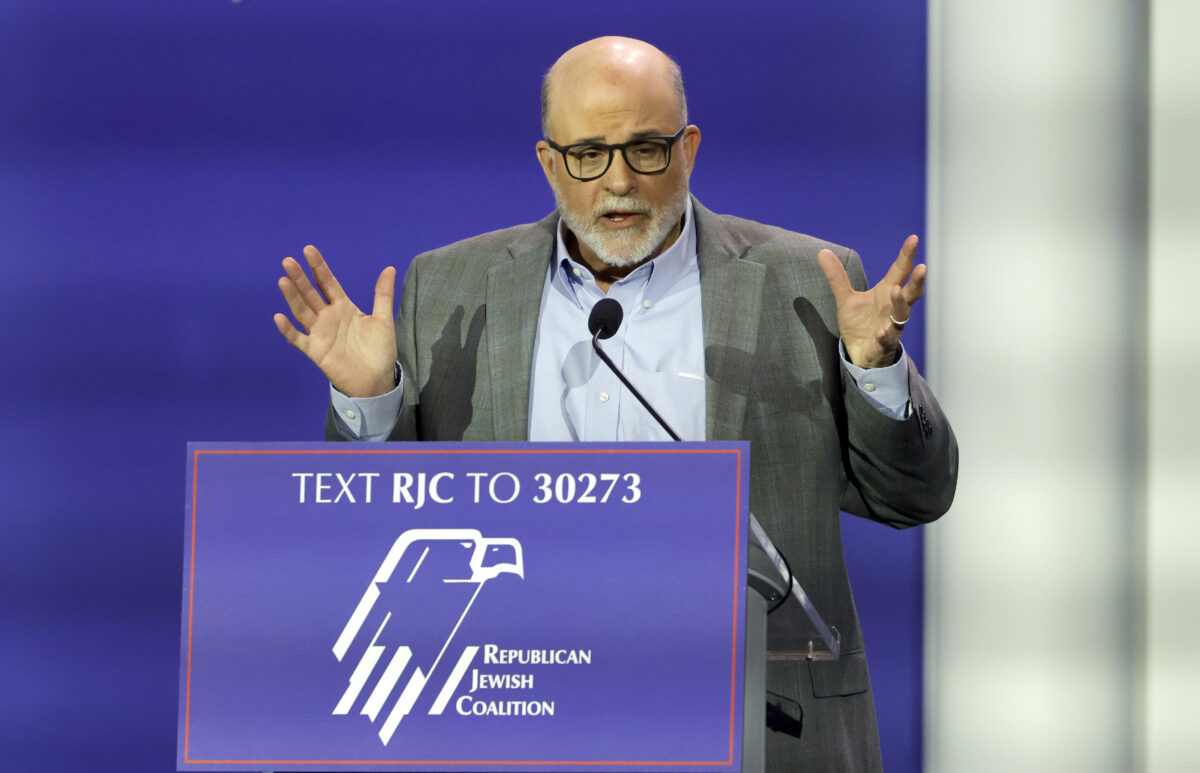
Fox News’ Mark Levin blasted critics of President Donald Trump’s arrest of Venezuelan leader Nicolás Maduro, calling those who deemed the action illegal “pure evil.”
Levin, a vocal supporter of Trump, was quick to laud the administration’s operation to capture Maduro– who was apprehended along with his wife Friday night and charged in federal court in New York with narco-terrorism conspiracy, weapons charges, and cocaine-importation conspiracy.
“Venezuelans are free today!” Levin wrote early Saturday (January 03) morning. “Congratulations and thank you to our tremendous President and Commander-In-Chief, Donald J Trump, our outstanding Secretaries of War and State, DNI, CIA, and all other parts of our military and national security people — and the United States military!”
[Editor’s note: According to VIN News, “Levin, host of the nationally syndicated ‘Mark Levin Show’ and a Fox News contributor, has emerged as one of the most vocal pro-Israel voices in talk radio.”]
Many on the left spoke out against the action– including the president’s claims that the U.S. would “run” Venezuela for the time being. In response, Levin jumped to decry Trump’s critics, reposting a statement from legal scholar Eugene Kontorovich.
Kontorovich argued that Maduro’s capture was not illegal “given the bipartisan U.S. view that Maduro is not actually president.”
[Editor’s note: Kontorich moved to Israel, became an Israeli citizen, lives in an Israeli settlement, and advocates for Israel.]
The U.S. has not recognized Maduro as the legitimate leader of Venezuela since 2019, after an election the U.S. said was rigged.
Levin agreed with Kontorovich’s characterization, writing: “Of course, the abduction and removal of Maduro did NOT violate international law.”
He criticized those who have spoken out against Maduro’s arrest, singling out Sen. Bernie Sanders (I-VT) and New York City Mayor Zohran Mamdani (D) as displaying an “utter ignorance of the law.”
“Nonetheless, the Marxists-Islamists, like Bernie Sanders and Mamdani, and most Democrats, as well as too many in the Woke Reich, insist it did despite their utter ignorance of the law,” he wrote. “They defend totalitarianism regimes against our nation’s own security and interests. Pure evil.”
Both Mamdani and Sanders have called Trump’s recent actions in Venezuela a violation of international law.
“Unilaterally attacking a sovereign nation is an act of war and a violation of federal and international law,” Mamdani wrote on January 03. “This blatant pursuit of regime change doesn’t just affect those abroad, it directly impacts New Yorkers, including tens of thousands of Venezuelans who call this city home. My focus is their safety and the safety of every New Yorker, and my administration will continue to monitor the situation and issue relevant guidance.”
[Editor’s note: Stephen Miller, often considered Trumps most influential advisor, is a longtime Israel partisan.]
Willa Pope Robbins is a reporter for Mediaite.
Maduro: Zionists trying to hand Venezuela to ‘devils’ amid US tensions

“We are the people of David against the Goliaths that we have already defeated in history,” Maduro stated.
By Michael Starr, Reposted from The Jerusalem Post, November 17, 2025
Venezuelan President Nicolás Maduro said Zionists were trying to deliver his country to “devils” in a Saturday Bolivarian Integral Base Committees speech focused on pleading with the US against military escalation in the region.
“There are those who want to hand this country over to the devils – you know who, right? The far Right Zionists want to hand this country over to the devils,” said Maduro. “Who will prevail? The people of [King] David, the people of God, the people of [Simón] Bolívar, or the imperialist demons?”
Maduro cast the image of Venezuela as King David facing an American Goliath, saying that the king had both faith and God’s blessing.
“We are the people of David against the Goliaths that we have already defeated in history,” said Maduro. “If God wills it, we will face them.”
Maduro’s Christian battle
The president repeatedly emphasized that Venezuela was a Christian country, saying he wondered why Americans would want to kill Christians, amid a US military buildup in the Caribbean and strikes on alleged drug trafficking vessels.
“I place at the forefront of this battle our Lord Jesus Christ, to whom our homeland has been entrusted, the only king between heaven and Earth, Jesus of Nazareth, the young child and Palestinian martyr, Jesus of Nazareth,” Maduro repeated.
“I place Jesus of Nazareth as commander-in-chief of the battle for peace and the sovereignty of the Venezuelan people.”
Maduro made repeated appeals in broken English to the American people, urging them to say “no” to war and “yes” to peace, and danced on stage to John Lennon’s “Imagine.”

Anti-Israel groups have also tied Israelis to tensions in the Caribbean. The National Students for Justice in Palestine group announced on Friday a national day of action to “smash imperialism” and “crush Zionism.”
The Wednesday protest day against US military action targeting drug cartels and alleged drug boats asserted that “security” was a pretense for imperialist expansion.
“As students engaged in the struggle for Palestinian liberation, we recognize these strikes as part of the same machinery that arms the Zionist entity’s genocide of the Palestinian people,” said the SJP.
“Our struggle situates itself in a global struggle against imperialism, and we know when we strike the institutions in the belly of the beast, we weaken the chain that props up the Zionist entity’s occupation of Palestine. Likewise, we know that we must engage with anti-imperialist struggles wherever they manifest in order to weaken the chains that wrap themselves around our homelands,” it continued.
Michael Starr is the Diaspora affairs correspondent for The Jerusalem Post, covering global Jewish affairs, antisemitism, and radical anti-Israel activities.
Israel Is Behind Trump’s Escalation on Venezuela – Col. Wilkerson
In this explosive conversation, Colonel Lawrence Wilkerson — former Chief of Staff to Colin Powell — lays out his unfiltered analysis of today’s global flashpoints.
Reposted from India & Global Left, November 15, 2025
Wilkerson explains why the U.S. is escalating against Venezuela, how close Washington is to a possible military intervention, and why he believes Israel is playing a driving role behind Trump’s Venezuela strategy.
We also explore bigger geopolitical questions:
• Does the U.S. have a real grand strategy after losing the tariff war to China?
• Will NATO retreat from its failing venture in Ukraine?
• What does Syria’s effective re-absorption into the U.S. Middle East architecture mean for the region?
• Is Washington reacting to global shifts—or blindly escalating on multiple fronts?
If you want a deep dive into U.S. empire, great-power competition, and the hidden actors shaping today’s conflicts, this interview with Colonel Wilkerson is essential.
India & Global Left has dared experimenting with serious analysis to stem the follow of misinformation and indoctrination.
2025 Nobel Peace Prize recipient close to Israel
Reposted from Quds News Network, October 10, 2025
Venezuelan opposition leader María Corina Machado snatched what Donald Trump desperately wanted: the 2025 Nobel Peace Prize. For months, Trump had made no secret of his desire for the prize, tweeting, speaking, and basically declaring to the world that he alone deserved it. The Nobel Committee, however, disagreed.
On Friday (October 10), the Norwegian Nobel Committee awarded the prize to the staunch Israel supporter for her “relentless fight for democracy and human rights” in Venezuela. The committee praised the zionist leader for a “fair and peaceful transition from dictatorship to democracy.”
White House officials responded with a mixture of incredulity and indignation. Steven Cheung, spokesperson for Trump, insisted that “President Trump will continue making peace deals, ending wars, and saving lives.” He added that the Nobel Committee “proved they place politics over peace.”
Who Is She?
María Corina Machado, 58, is an industrial engineer turned opposition leader. Courts prevented her from running in the 2024 presidential election by a 15-year disqualification, based on her involvement in a corruption plot linked to Juan Guaidó that led to a criminal blockade and seizure of Venezuela’s assets abroad.
She has positioned herself as a key figure in the opposition, advocating for “democratic reforms” while maintaining strong ties with Israel and the West.
Machado has consistently expressed a strong affiliation with Israel. In April 2024, during Israel’s attacks on Iran, she called Iran’s response “unacceptable” and voiced solidarity with the occupation state of Israel and its settlers.
She has highlighted Venezuela’s diplomatic relations with Iran as a potential “global risk”, framing her pro-Israel stance as part of a strategy to strengthen Venezuela’s alignment with the West. In January 2025, she thanked Israeli Foreign Minister Gideon Sa’ar for “support for Venezuela’s sovereignty and electoral situation.”
Machado has publicly stated that if elected president, she would restore full diplomatic relations with Israel, including the possible relocation of Venezuela’s embassy to the occupied Palestinian capital city of Jerusalem.
Reports from 2018 reveal that Machado asked Israeli Prime Minister Benjamin Netanyahu, who is wanted now by the ICC for war crimes in Gaza, to consider military intervention in Venezuela. Other reports reveal that she signed a cooperation agreement with Israel’s Likud Party in 2020.
Machado has repeatedly drawn parallels between her efforts against Venezuela’s elected leadership and Israel’s wars on neighboring countries.
“Venezuela’s struggle is Israel’s struggle,” she once declared, tagging Netanyahu on social media. Her alignment with Israel has drawn praise from pro-Israel groups and attention from international observers who track Western-oriented leadership in Latin America.
In a world where a country committing genocide and attacking its neighbors can still see its allies celebrated with a Nobel Peace Prize, María Corina Machado’s win exposes the stark contradictions of global politics. The award isn’t just about her; it’s a mirror showing how bizarre, and sometimes cynical, the world’s idea of “peace” has become.
Meet Paul Singer, the Billionaire Trump Megadonor [and Fervent Israel Advocate] Set to Make a Killing on Venezuela Oil

By Stephen Prager, Reposted from Scheer Post, January 06, 2026
One of President Donald Trump’s top billionaire donors, who has spent the past several months backing a push for regime change in Venezuela, is about to cash in after the president’s kidnapping of the nation’s president, Nicolas Maduro, this weekend.
While he declined to tell members of Congress, Trump has said he tipped off oil executives before the illegal attack. At a press conference following the attack, he said the US would have “our very large United States oil companies” go into Venezuela, which he said the US will “run” indefinitely, and “start making money” for the United States.
As Judd Legum reported on January 05 for Popular Information, among the biggest beneficiaries will be the billionaire investor Paul Singer:
In 2024, Singer, an 81-year-old with a net worth of $6.7 billion, donated $5 million to Make America Great Again Inc., Trump’s Super PAC. Singer donated tens of millions more in the 2024 cycle to support Trump’s allies, including $37 million to support the election of Republicans to Congress. He also donated an undisclosed amount to fund Trump’s second transition.
Singer is also a major pro-Israel donor, with his foundation having donated more than $3.3 million to groups like the Birthright Israel Foundation, the Israel America Academic Exchange, Boundless Israel, and others in 2021, according to tax filings.
In November 2025, less than two months before Trump’s operation to take over Venezuela, Singer’s investment firm, Elliott Investment Management, inked a highly fortuitous deal.
It purchased Citgo, the US-based subsidiary of Venezuela’s state-owned oil company, for $5.9 billion—a sale that was forced by a Delaware court after Venezuela defaulted on its bond payments.
The court-appointed special master who forced the sale, Robert Pincus, is a member of the board of directors for the American Israel Public Affairs Committee (AIPAC).
Elliott Management hailed the court order requiring the sale in a press release, saying it was “backed by a group of strategic US energy investors.”
Singer acquired the Citgo’s three massive coastal refineries, 43 oil terminals, and more than 4,000 gas stations at a “major discount” because of its distressed status. Advisers to the court overseeing the sale estimated its value at $11-13 billion, while the Venezuelan government estimated it at $18 billion.
As Legum explained, the Trump administration’s embargo on Venezuelan oil imports to the United States bore the primary responsibility for the company’s plummeting value:
Citgo’s refiners are purpose-built to process heavy-grade Venezuelan “sour” crude. As a result, Citgo was forced to source oil from more expensive sources in Canada and Colombia. (Oil produced in the United States is generally light-grade.) This made Citgo’s operations far less profitable.
It is the preferred modus operandifor Singer, whose hedge fund is often described as a “vulture” capital group. As Francesca Fiorentini, a commentator at Zeteo, explained, Singer “is famous for doing things like buying the debt of struggling countries like Argentina for pennies on the dollar and then forcing that country to repay him with interest plus legal fees.”
The hedge fund manager & GOP megadonor Paul Singer’s shady purchase of CITGO has everything to do with this coup. Thanks to @JuddLegum for his reporting on this! pic.twitter.com/qsZh34tLZS
— Francesca Fiorentini (@franifio) January 5, 2026
Venezuelan Vice President and Minister of Petroleum Delcy Rodríguez called the sale of Citgo to Singer “fraudulent” and “forced” in December.
After the US abducted Maduro this week, Trump named Rodriguez as Venezuela’s interim president—and she was formally sworn in Monday—but he warned that she’ll pay a “very big price” if she refuses to do “what we want.”
That is good news for Singer, who is expected to be one of the biggest beneficiaries of an oil industry controlled by US corporations, which will likely not be subject to crippling sanctions.
Singer has reportedly met with Trump directly at least four times since he was first elected in 2016, most recently in 2024. While it is unknown whether the two discussed Venezuela during those meetings, groups funded by Singer have pushed aggressively for Trump to take maximal action to decapitate the country’s leadership.
Since 2011, Singer has donated over $10 million and continues to sit on the board of directors for the right-wing Manhattan Institute think tank, which in recent months has consistently advocated for Maduro to be removed from power. In October, it published an article praising Trump for his “consistent policies against Venezuela’s Maduro.”
He has also been a major donor to the neoconservative think tank Foundation for Defense of Democracies (FDD), serving as its second-largest contributor from 2008-2011, with more than $3.6 million.
In late November, shortly before Trump announced that the US had closed Venezuelan airspace and began to impound Venezuelan oil tankers, FDD published a policy brief stating that the US has “capabilities to launch an overwhelming air and missile campaign against the Maduro regime” that it could use to remove him from power.
Singer himself has acted as a financial attack dog for Trump during his first year back in office. In June, he contributed $1 million to fund a super PAC aiming to oust Rep. Thomas Massie (R-Ky.), who’d become Trump’s leading Republican critic over his Department of Justice’s refusal to release its files pertaining to the billionaire sex trafficker Jeffrey Epstein.
A super PAC tied to Miriam Adelson, another top pro-Israel donor who recently said she’d give Trump $250 million if he ran for a third term, also reportedly helped to fund the campaign against Massie.
Massie has since gone on to be one of the most vocal opponents in Congress to Trump’s regime change push in Venezuela, joining Democrats to co-sponsor multiple failed war powers resolutions that would have reined in the president’s ability to launch military strikes against alleged drug boats in the Caribbean and launch an attack on mainland Venezuela.
As the Trump administration has asserted that American corporations are entitled to the oil controlled by Venezuela’s state firm, Massie rebutted this weekend that: “It’s not American oil. It’s Venezuelan oil.”
“Oil companies entered into risky deals to develop oil, and the deals were canceled by a prior Venezuelan government,” he said. “What’s happening: Lives of US soldiers are being risked to make those oil companies (not Americans) more profitable.”
Massie said that Singer, “who’s already spent $1,000,000 to defeat me in the next election, stands to make billions of dollars on his distressed Citgo investment, now that this administration has taken over Venezuela.”
Fiorentini added that “Paul Singer’s shady purchase of Citgo has everything to do with this coup.”
Stephen Prager is a staff writer for Common Dreams.
Iran’s friends vanishing: Why Maduro’s arrest matters for Israel – analysis

While Venezuela was not an Iranian proxy in the Syrian or Hezbollah mold, it functioned as an enabler, providing funds that helped sustain Iran’s proxies.
By Herb Keinon, Reposted from The Jerusalem Post, January 04, 2025
For Israel, the significance of Washington’s weekend arrest of Venezuelan strongman Nicolás Maduro and his wife goes well beyond the shiver it likely sent down spines in Tehran.
Yes, the spectacle of a US-led operation removing a defiant anti-American autocrat will inevitably sharpen anxieties among Iran’s leaders about their own vulnerabilities, especially at a time when protests are roiling the country.
But further meaning is found elsewhere, in the dismantling of yet another supporting pillar in the global network Iran painstakingly constructed to finance, shield, and sustain its war against Israel. Venezuela was never an Iranian proxy in the way Hezbollah, Hamas, the Houthis, or Bashar al-Assad’s Syria were.
Caracas was not directly under Tehran’s thumb and operational command, nor did it host Iranian forces on the scale seen in the Middle East. Yet, through Hezbollah, Venezuela became something no less important to the ayatollahs – a critical offshore hub that generated cash, laundered funds, moved operatives, and enabled Iran to project power far from the Mideast.
Maduro’s arrest comes on the heels of a series of blows to Iran’s regional position. Israel battered Hamas in Gaza, decapitated Hezbollah in Lebanon, and degraded Houthi capabilities in Yemen. Also, Assad’s regime fell in Syria. Taken together, these developments illustrate Iran’s declining power.

Tehran’s problem today is not restricted to the protests in the streets or the pummeling it absorbed in June, but also the unraveling of far-flung support systems it spent years and billions of dollars putting together abroad.
Investigations by US law enforcement agencies and think tanks such as the Atlantic Council over the last few years have shown that Hezbollah did not operate in Venezuela as a dormant terror cell awaiting activation; rather, it functioned as a crime-terror enterprise intermeshed in the Venezuelan economy and protected by the government.
‘Global Goals’
Hezbollah trafficked cocaine from Venezuela, laundered money, transferred weapons, and helped the Islamic Republic evade US sanctions. Already in 2018, the US Justice Department concluded that Hezbollah rivaled the major Latin American cartels in scale and sophistication. But there was one glaring difference: Revenue generated in South America did not stay there; it was sent to Lebanon, where it helped pay for the terrorist organization’s military buildup.
Beyond being a reliable source of income for Hezbollah – Iran’s senior proxy – Venezuela offered something else as well: a protected air and maritime bridge linking Tehran, Damascus, and Caracas. This allowed the transfer of Iranian personnel, dual-use goods, fuel, and cash. In other words, Venezuela under actively helped Iran pursue its global goals.
While Venezuela was not an Iranian proxy in the Syrian or Hezbollah mold, it functioned as an enabler, providing funds that helped sustain Iran’s proxies. In that sense, it was very much part of Iran’s world.
Just how much a part of that world became clearer on Sunday when Vice President Delcy Rodríguez said in a television address that the US attack had “Zionist undertones.”This claim of “Zionist” involvement was not evidence of Israeli involvement; it was, however, evidence of how closely the regime identified itself with Iran’s worldview. It was a claim aimed both inward and outward.
Inward, it was aimed at supporters of Maduro and his predecessor, Hugo Chávez, who turned Israel into an imperialist villain, steeped in traditional antisemitic tropes, with which to rally supporters. Outward, it was directed at the region, where anti-Zionist messaging has long served as a convenient rallying cry, since Latin America’s political culture still contains reflexive sympathy for anti-American narratives into which Israel is often effortlessly folded.
Rodríguez brought up Israel not because it was involved in the US operation, but because it fit Theran’s ideological template adopted by Venezuela: domestic failures explained through foreign conspiracy, with “Zionism” serving as the all-purpose, go-to scapegoat.
The arrest of Maduro is significant for Israel because it removes yet another important piece from the puzzle that Iran has been putting together for years. Not a piece of the puzzle within striking distance of Israel, but one that played an important supporting role for those who are within that striking distance.
Israel’s struggle with Iran over the years has been about nuclear capability, ballistic missiles, and deterrence. Less attention has been paid to the quieter contest over access, financing, and safe havens.
Venezuela was part of that quieter front – never decisive on its own, but valuable to Iran precisely because it was distant and often overlooked. If, with Maduro’s arrest, Venezuela is removed from Tehran’s orbit, then the Islamic Republic’s options will narrow further, and this precisely at a time when it is coming under considerable strain from within.
‘Piece By Piece’
Venezuela’s next step – what it will become – is uncertain. But what seems certain is that after this US intervention, the days when it provided Iran with a protected foothold in the Western Hemisphere are quickly coming to a close. And for Israel, that is reason enough to smile.
But words in a recent interview from Venezuela’s most prominent opposition figure, Nobel Peace Prize winner Maria Corina Machado, give Israel an even greater reason to grin. She has been explicit in describing Iran, Hezbollah, and Hamas as foreign forces that penetrated Venezuela under Maduro’s rule. In her telling, Venezuela was not merely misgoverned; it was commandeered by external actors whose interests ran directly counter to those of a sovereign country.
She accompanied that framework with warm words toward Israel, rarely heard from Caracas in decades. Asked in a November Israel Hayom interview directly whether a post-Maduro Venezuela would restore relations with Israel and move its embassy to Jerusalem, Machado replied: “Certainly. Venezuela will be Israel’s closest ally in Latin America.” She said that cooperation with Israel would be part of the broader Venezuelan struggle against the “crime and terror” that had characterized the country under Maduro.
For Israel, those words matter less because they guarantee policy outcomes and more because they mark a conceptual break with the worldview that has defined Venezuela since Chávez severed ties with Jerusalem in 2009. Under Chávez and Maduro, hostility toward Israel was a badge of ideological belonging to an anti-American, anti-Western camp aligned with Tehran. Machado’s language signals a rejection of that framework altogether.
For years, Iran sought to demonstrate that its reach was global and its options limitless. Today, the picture looks different. Gaza, Lebanon, Syria, Yemen – and now Venezuela – tell a story not of expansion, but of contraction.
Maduro’s fall does not overhaul Israel’s strategic reality overnight, nor does it end the war
Israel is fighting against Iran’s proxies. But it does represent another incremental setback in Iran’s global posture – a reminder that Iran’s power was built patiently, piece by piece, and is now being dismantled the same way.
Herb Keinon is a senior contributing editor and analyst, writing extensively on diplomacy, politics and Israeli society.
RELATED:
- New neocon manifesto: Keep US troops in the Middle East forever
- WATCH: How Pro-Israel Neocons Pushed for War in Iraq (Alison Weir)
- NeoCon billionaire Paul Singer is sending US tech jobs to Israel
- Israel And Its Supporters Deliberately Foment Hate And Division In Our Society
- Israel Accuses Zohran Mamdani of Antisemitism for Reversing Orders Adams Gave Under Indictment