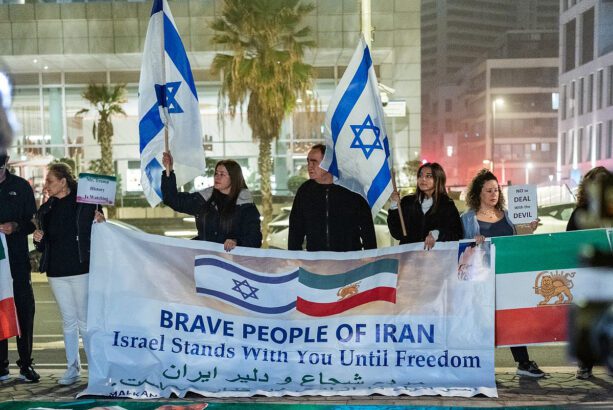
Internationally isolated, restrained in Gaza, and unraveling at home, Israel sees another escalation as the only way to maintain its aggressive regional agenda.
During Israel’s war with Iran in June, Iranian ballistic missiles inflicted damage on Israeli military and civilian infrastructure on a scale Israelis have not experienced in recent memory. Over the course of the 12-day confrontation, Iran launched more than 550 ballistic missiles and over 1,000 drones at Israeli territory, with at least 31 missiles penetrating Israel’s air-defense systems and striking population centers and strategic sites. Twenty-eight Israeli civilians were killed and thousands were wounded. The material toll was substantial as well: estimates put the cost of the war on the Israeli economy at $12 billion.
Yet earlier this month, Israeli Prime Minister Benjamin Netanyahu traveled to the White House, where he urged U.S. President Donald Trump to ensure that any deal reached in the ongoing nuclear talks with Iran also include measures to neutralize Tehran’s ballistic missile program and end its funding for proxy groups such as Hamas and Hezbollah.
These demands are widely viewed as non-starters — less a serious negotiating position than an attempt to derail diplomacy and create a pretext for a joint U.S.-Israeli strike on the Islamic Republic. Such a move could easily trigger a new, prolonged war, one in which both Israel and Iran would likely sustain far greater damage than they did during the conflict in June.
Netanyahu, moreover, is not alone in this posture. Israeli lawmakers across the political spectrum, along with much of the country’s media establishment, seem inclined to pursue another major conflict despite the potentially devastating consequences for Israel and the wider region.
Yair Lapid, the nominal head of the opposition, affirmed this week that “it is time to strike at the foundations of the [Iranian] regime,” and said that there would be “no opposition coalition during war with Iran.” Likud MK Nissim Vaturi even hinted at the possible use of nuclear weapons. “We have weapons we haven’t used. The Iranians have Persian carpets — we have a textile factory,” he said — a thinly veiled reference to Israel’s Dimona nuclear reactor.
Whether or not the current round of U.S.-Iran talks in Geneva produces an agreement, the question still remains: Why does Israel so eagerly push for escalation?

An ongoing defeat
Part of the answer lies in Israel’s shifting position within the emerging regional order. Israel’s once-near-total freedom of action in Gaza is being constrained by developments on the ground in Palestine. Trump’s so-called “Board of Peace,” which the Latin Patriarch of Jerusalem, Cardinal Pierbattista Pizzaballa, has aptly described as a “colonialist operation,” nonetheless contains one redeeming feature that troubles Israeli planners: It redistributes influence away from Israel and toward regional powers whose agendas clash with Israel’s long-standing pursuit of total impunity.
Indeed, Turkey, Qatar, Saudi Arabia, and Egypt — despite their many rivalries — share a growing concern about Israel’s capacity to destabilize the region and, potentially, their own domestic arenas. Even the UAE, a staunch Israeli ally, has condemned the recent statements by U.S. Ambassador to Israel Mike Huckabee regarding Israel’s biblical right to large parts of the Middle East.
While these states have repeatedly demonstrated indifference toward the plight of Palestinians, their prospective role in shaping Gaza’s future could impose practical limits on Israel’s freedom to continue destroying Palestinian life in the enclave as effective as an embargo on weapons shipments.
Israel, after all, cannot easily “renew the fighting” in Gaza — the country’s most enduring euphemism for the genocide — if doing so risks confrontation with a broader regional coalition. Nor is such an escalation likely to attract automatic American backing, particularly at a moment when Trump appears increasingly receptive to the views of leaders in Doha and Ankara and visibly less trustful of Netanyahu. Trump has even warned Israel it stands to lose all American support should it forge ahead with formal annexation of the West Bank, as such a step will ruin American and Israeli relations with Arab states.
Meanwhile, the gradual internationalization of Gaza is proceeding with growing confidence. Despite Israel’s objections, Turkey is pledging to contribute its troops to an international stabilization force with Gaza, and has even begun preliminary reconstruction efforts in the Strip, including reopening mosques and deploying humanitarian personnel. It has taken care to avoid direct confrontation with Israel and has largely refrained from retaliatory rhetoric in response to the ongoing massacre of Palestinians by Israeli forces.
Israeli preconditions intended to obstruct reconstruction — most notably the demand for Hamas’ complete disarmament — seem to be ignored, with the U.S. plan allowing the group to retain small arms. In practical terms, Israel lacks the capacity to disarm Hamas on its own, nor does it appear likely that the powers now attaining control of Gaza will grant it permission to even attempt such an operation.

In short, while Israel has succeeded in inflicting massive destruction on Palestinian society and infrastructure, it has fallen short of its own declared war aims: the destruction of Hamas and the recovery of all 251 hostages, 85 of whom were killed. Yet, curiously, many Israelis continue to view the campaign as a victory. If victory is defined narrowly as maximizing Palestinian suffering and rendering Gaza unlivable, that interpretation may be true. By any other definition — military, political, or moral — Israel was and continues to be defeated.
Domestic disintegration
Beyond Israel’s mounting international isolation, a deepening internal crisis and the hollowing out of state institutions are also narrowing its leadership’s scope for military action. Under these conditions, another war with Iran emerges as the only remaining path to attempt to unify the country and maintain an aggressive regional agenda.
One aspect of this crisis is Israel’s continuing violence against Palestinians in the West Bank as part of its efforts to ethnically cleanse and annex the territory. Although much of this campaign is carried out by settlers, it is enabled and protected by the Israeli army and state institutions. At the same time, Israeli authorities are forced to expend growing political and informational resources to obscure and deny the depth of this collaboration. In other words, the army is simultaneously charged with both defending and repudiating Israeli civilian violence in the West Bank.
A parallel pattern is visible within Israel’s recognized borders. Lethal violence in Palestinian communities inside Israel has surged dramatically, yet Israeli police routinely ignore repeated pleas from Palestinian citizens to intervene meaningfully and stop the wave of killing. The visible failure of policing in Palestinian communities is also eroding Jewish public confidence in the national police force, which is perceived as thoroughly politicized. A police force under National Security Minister Itamar Ben Gvir that devotes substantial resources to advancing an overt political agenda inevitably weakens its broader law enforcement capacity.
More broadly, Israeli society is experiencing an unprecedented normalization of violence that extends well beyond the physical sphere. Across the political spectrum, more Israeli Jews have internalized the belief that they are fundamentally on their own and must therefore “take care” of themselves and their immediate communities. Open contempt for long-revered state institutions — including the Israeli army, once considered the sanctum sanctorum of Israeli civic life — is surfacing in increasingly unlikely places.
For instance, even Finance Minister Bezalel Smotrich, the political architect of the current push to ethnically cleanse the West Bank, has publicly stated that he would encourage his daughter to refuse military service. The remark was partly tactical, aimed at strengthening alliances with ultra-Orthodox parties and consolidating his hardline religious-settler base. Yet the underlying dissonance is striking: A senior minister who repeatedly frames the Gaza war as part of a divinely mandated redemption campaign that must be pursued until “total victory” now openly signals personal disengagement from the very military effort he demands others sustain.

The contradictions are becoming harder to ignore, and they place significant strain on the long-term coherence of state institutions. A police force that enables state-sponsored settler terrorism and lethal crime while attempting to deny such support is a failed police force. A political movement that defines itself through the imperative of destroying its enemies, yet shies away from military service itself, exposes its own structural fragility.
Nor are these tensions confined to the Jewish-Israeli right. The Zionist left — which continues to brand itself as Israel’s liberal camp — exhibits the same inconsistencies. The tens of thousands who regularly protest Netanyahu’s leadership are often the same constituencies that have powered the genocide in Gaza and support the ethnic cleansing in the West Bank by serving in the army, where they defend and sometimes abet settlers.
Their critique typically centers on Netanyahu’s personal corruption, the incompetence of his fanatical coalition, and the allocation of blame for Israel’s military failures on October 7. But they will never refuse to take part in fighting yet another “necessary” war — whether in Gaza or against Iran — undertaken to eliminate “terror threats” or confront supposed “existential dangers.”
Naftali Bennett, who briefly served as Israel’s prime minister in 2021-22 and is currently marketed as the Zionist opposition’s “liberal” alternative to Netanyahu, illustrates the depth of the problem. Bennett has recently ruled out forming a coalition with Palestinian-Israeli parties, and has claimed that seven out of 10 Palestinians in Gaza and under the PA seek to murder all Israeli Jews. This is the same Bennett that, as economy and trade minister in 2013, famously remarked, “I already killed lots of Arabs in my life, and there is absolutely no problem with that.”
When the opposition echoes the coalition’s own genocidal logic, where the purported threat to Israeli life provides a license to kill without end, the longstanding claim that Israel is a “robust and diverse democracy” rings even more hollow.
The cumulative effect is a steady deterioration in everyday life inside Israel itself. The physical public sphere is increasingly marked by harassment, social friction, and conflict, from “activists” who stalk public figures to the proliferation of fraudulent disability permit schemes that directly harm genuinely disabled citizens. The cost of living continues to climb. Cultural and leisure sectors — from the arts to the restaurant industry — are contracting while becoming less affordable.

At the same time, Israelis are encountering a growing backlash abroad. Professional unions, private businesses, and cultural institutions in a growing number of countries are reluctant to engage with Israeli counterparts. Air travel has become more expensive and less reliable, with routes narrowing and cancellations mounting. Public discourse inside Israel has also grown more toxic and violent, frequently insisting that the country’s conduct bears no relationship to the resurgence of antisemitism around the world. The space for nuance has collapsed: If you are not “for us,” you are our mortal enemy.
Much of this frenetic political and social energy is now directed inward, leading to the gradual hollowing out of Israel’s own state institutions and the fraying of Jewish-Israeli social cohesion itself. What Israel desperately needs is a unifying distraction — which brings us to Iran.
Playing the Iran card
In the years preceding the October 7 attacks, Israel invested enormous political and financial capital in persuading the international community that Iran constituted an existential threat, not only to Israel but to regional and global stability. Tehran was cast as “the head of the snake,” bent on orchestrating an Islamist takeover of the “moderate” Middle East and committed to Israel’s destruction through its network of “proxies.” So long as Iran could be framed as the primary destabilizing force, Israel could more easily position itself as the responsible counterweight.
That framing, however, has grown less persuasive. Even after the Islamic Republic brutally suppressed a domestic uprising and killed thousands of its own citizens, Iran is now engaged in negotiations toward a comprehensive agreement with the United States.
Israel, by contrast, finds itself with few remaining arenas in which to channel its war machine. Its immediate regional environment no longer generates sufficient vitriol to obscure the structural contradictions destabilizing the Israeli state. In other words, there is too much peace: Reality has grown less amenable to Israel’s preferred narratives of necessary war. Iran alone continues to function, in Israeli discourse, as an embodiment of “political Islam” locked in a civilizational struggle with the “Judeo-Christian” global order.

Under these conditions, a confrontation with Iran takes on outsized importance in Israeli thinking. It represents perhaps the last available chance for Israel to claim broadly acknowledged rectitude; in effect, a final opportunity to present itself as disciplined and aligned with even its most committed international supporters.
But Israel’s June 2025 clash with Iran produced no meaningful shift in the regional balance of power. And today, appetite for another war appears limited almost everywhere apart from Israel — especially among emerging regional powers and even in Washington, despite Trump’s saber-rattling.
Israel’s military establishment, yet to “win” decisively in any one of its forever wars, continues to rely on its qualitative and quantitative weapons advantage over its neighbors and its entrenched preference for demonstrative force. At the same time, for Netanyahu, beleaguered by domestic pressures, the prospect of escalation offers an obvious political diversion from the ongoing genocide in Palestine. His continued political survival has long depended on presenting himself as the only adult in town, the indispensable “Mr. Security” of the Israeli state.
That strategy, however, is showing signs of strain across multiple fronts of Israeli public life. Netanyahu appears to lean toward a “double-or-nothing” confrontation with Iran that might, in theory, reset Israel’s regional position and his own domestic standing. Yet his chances of beginning a second round of sustained hostilities now appear even slimmer, with the chairman of the U.S. Joint Chiefs of Staff warning the Trump administration about a severe lack of equipment and capabilities for a prolonged war.
Editor’s note: This was published 2 days ago… unfortunately, it turns out that Netanyahu got his way.
Ori Goldberg is an independent Israeli analyst and commentator. He holds a PhD in Middle Eastern Studies and has taught and lectured at universities worldwide. He is the author of four books on Shi‘i revolutionary thought in Iran.
RELATED:
- Did Netanyahu just ask Trump for another war — and get it?
- The Israeli Influence Operation Aiming to Install Reza Pahlavi as Shah of Iran
- How Israel and the US are exploiting Iranian protests
- On Iran’s protests, Israeli hypocrisy knows no limits
- The US is on the brink of a major new war that Trump has not even bothered explaining