Villagers said that the settlers killed one of the donkeys after Israeli forces, who arrived an hour and a half after the incident, left the scene shortly after. ‘People are very afraid now; they saw what was done to the donkey,’ one resident said.
by Matan Golan, reposted from Haaretz, December 9, 2025
Seven Israeli settlers stole three donkeys from the West Bank village of Jaba’ near Ramallah on Monday and slaughtered one of them, according to Palestinian reports and a village resident who spoke to Haaretz.
Settlers stole the donkeys from a Palestinian child in Jaba’ and killed one of them in Gur Aryeh, a nearby illegal outpost, according to a witness account.
“They took the donkeys, and the child ran away in fear,” one of the residents said. According to him, residents contacted the police and the army, who arrived at the outpost about half an hour later, claimed no one was there, and left the scene.
After their departure, residents testified, the settlers slaughtered one of the donkeys. The IDF and police did not respond.
“They slaughtered the donkey with a knife and tied it up,” one resident described. “They apparently stoned its head with rocks.” Footage published on social media shows the donkey’s head tied to a rock, and blood streaming from several parts of its body.
“It’s inhuman to do such a thing. The donkey wasn’t part of any dispute or quarrel between people,” said a resident. “People are very afraid now; they saw what was done to the donkey.”
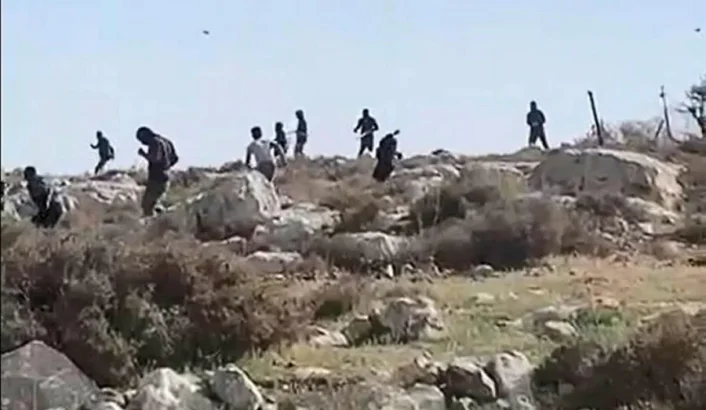
A few hours after the incident, settlers from the outpost went to Jaba’ and threw stones at residents, who repelled them. By the time the army and police arrived, the settlers had already fled.
מתנחלים מיידים אבנים בכפר ג’בע השוכן מדרום־מזרח לרמאללה.
שימוש לפי סעיף 27א’ לחוק זכויות יוצרים pic.twitter.com/BAfUHq1nGc— הארץ חדשות (@haaretznewsvid) December 8, 2025
Israeli settlers throwing stones in the West Bank Village of Jaba’, Monday. Used in accordance with Section 27A of the Copyright Law
“That’s usually how it goes,” a village local said. “The police say, ‘We want to catch them, but we can’t.’ We don’t know what to do.” The resident complained that he had nowhere else to go.
“If the government wanted, it could put all the settlers who attack us in prison,” he said. “We keep telling the police, ‘Just as you arrest us, come arrest the settlers who attack us too.’ But no one is arrested, and the attacks don’t stop.”
According to the local, most of the attacks occur on Saturdays. “I once worked for religious people on the Sabbath [Saturday, the Jewish day of rest] – they don’t drive, don’t smoke, don’t light fires – but here, on Saturday, they set houses on fire and come to cause trouble,” he said.
“On Saturday night, they came and threw stones at my house. I called the police, who said, ‘We’ll come.’ Ten minutes later, the police called and asked if they were still there. They had already left, so I said no, and no one came.”
The Gur Aryeh outpost serves as a hotbed for attacks against Palestinians, including arson of buildings and stone-throwing by the settlers who inhabit it. It was dismantled by the IDF’s Civil Administration last week, but according to Palestinians and footage distributed by settlers, it was rebuilt this past Saturday.
In recent weeks, the IDF has frequently arrived at the village, mainly on Saturdays. A week ago, the army used tear gas to separate Palestinians from settlers who had invaded the community, but no one was arrested in the incident.
According to a villager, the army’s presence does not always ensure their safety. “It depends on the soldier. Some soldiers sit here nearby, patrol, and make their presence known. Others stand two kilometers away from the houses,” he explains.
“You can hope they’ll come in time, but they sit and don’t see what’s happening in front of them,” the resident said. “I told one of them this week, ‘At 1 A.M., they’ll come and burn the house down on top of my children and me. And you won’t know about it until you see the fire.'”
According to the resident, the soldier said he could signal him with his flashlight if trouble arose. “The army is here, but I still have to stay up all night to make sure they don’t set my family on fire while they sleep.”
Matan Golan is a journalist based in Jerusalem.
Related:
- West Bank: Israel Emptying Refugee Camps a Crime Against Humanity
- State-Sanctioned Jewish-mob Terror in the West Bank
- Israeli forces kill three Palestinian children in the occupied West Bank
- ‘No Human Logic in What Happened’: After an Israeli Settler Attack, West Bank Palestinian Farmer Wakes From Coma to a Life Upended