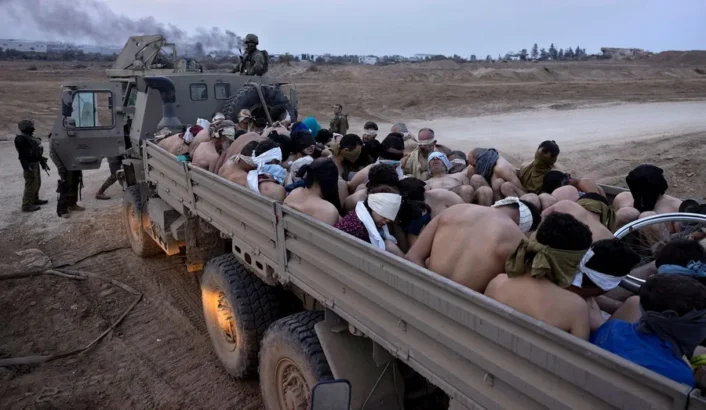
The report submitted to the UN notes that detainees received medical treatment while shackled and blindfolded, were forced to use diapers to relieve themselves, and were starved, with ‘an official diet of approximately 1,000 calories daily’
by Nir Hasson and Matan Golan, reposted from Haaretz, November 26, 2025
Since October 7, 2023, Israel has intensified its violations of the UN Convention Against Torture, according to a detailed report submitted last month by Israeli human rights organizations to the UN Committee Against Torture.
The report, filed as part of the committee’s periodic review of states that are party to the convention, was authored by the Adalah Legal Center, the Public Committee Against Torture in Israel, Parents Against Child Detention, HaMoked: Center for the Defence of the Individual and Physicians for Human Rights–Israel.
“Israel has dismantled existing safeguards and now employs torture throughout the entire detention process – from arrest to imprisonment – targeting Palestinians under occupation and Palestinian citizens, with senior officials sanctioning these abuses while judicial and administrative mechanisms fail to intervene,” the report says.
According to the report, Israel justifies the detention of Palestinians by relying on legal frameworks that do not comply with international law. The primary tool is the classification of Palestinians as “unlawful combatants.”
This designation is not recognized in international law, yet it allows Israel to detain Palestinians for long periods without trial, while also denying them the rights afforded to prisoners of war.
Throughout the war, Israel detained more than 4,000 Gaza residents under this classification and also made extensive use of administrative detention. Before the war, Israeli prisons held some 1,100 Palestinian administrative detainees.

By September 2025, the number had risen to 3,500. The average length of administrative detention has doubled compared to the pre-war period.
Detainees from Gaza were held in military detention facilities under extremely harsh conditions. “For extended periods, detainees were confined in open-air corrals, exposed to the elements, shackled and blindfolded around the clock, forced to kneel for most of the day and compelled to sleep on the ground,” the report says.
“They endured inadequate sanitation, lack of healthcare, and ongoing abuse. These harsh conditions persist,” the report continued.
The report also notes that detainees received medical treatment while shackled and blindfolded, and were forced to use diapers to relieve themselves. Food policy in the detention facilities, it adds, amounted to starvation, with “an official diet of approximately 1,000 calories daily with barely 40 grams of protein.”
The authors conclude that the testimonies “account for severe abuse at every stage, including: The use of batons; pouring of boiling water, causing severe burns; Dog attacks on detainees; Use of a ‘Disco Room’ employing intense sensory manipulation with painfully loud music; Rape with objects.”
According to the report, Israel Prison Service facilities also employed policies of starvation and systematic abuse, including “punching, kicking, ramming with batons, painful shackling, dog attacks, threatening of and urinating on detainees as well as acts of sexual violence and rape with objects.”

As a result of these practices, the report documents at least 94 deaths in Israeli detention facilities since the start of the war, along with dozens of cases of irreversible health damage.
According to the report, the number of complaints of torture during interrogations rose sharply, from 66 in the two decades preceding the war to 238 in the past two years. The report also notes the deaths of three detainees during Shin Bet security service interrogations.
The Shin Bet does not acknowledge the use of torture, but it does admit to employing “special interrogation methods,” which include sleep deprivation, painful shackling, shaking, exposure to cold, loud music, interrogation while naked, and threats against family members.
Despite the large number of complaints and documented abuses, the number of investigations opened remains negligible. Of the 238 complaints submitted regarding torture by the Shin Bet, the security service recommended opening an investigation in only two cases, and even in those, no indictments were ultimately filed.
In the IDF, 58 investigations were launched against soldiers for their treatment of detainees, 44 of them related to detainee deaths. Only two investigations into abuse resulted in indictments.
One was the widely publicized case against the five soldiers who served at the Sde Teiman detention facility. In the other case, a soldier was convicted of abuse and sentenced to seven months in prison.
Within Israel’s Prison Service, 36 investigations were opened for abuse of detainees, six of which led to indictments. None of the investigations involved cases of death or sexual violence.

According to the report, the dire state of the detention system has effectively been endorsed by the Supreme Court. Of the 20 petitions submitted to the High Court of Justice regarding detention conditions, 18 were rejected, mostly on procedural grounds or after the justices accepted the state’s position without challenge.
Two petitions were accepted, though only after long delays. In the first, the justices ordered the closure of the Sde Teiman facility; in the second, concerning food policy, the petition was partially granted after 17 months.
The report further states that Israel Prison Service facilities use the denial of medical care as a method of torture, citing, among other examples, scabies outbreaks affecting thousands of detainees. It also notes that the fate of hundreds of detainees from Gaza remains unknown.
In addition, the report states that security detainees are at times held in complete isolation and are even prevented from meeting with lawyers, Red Cross representatives, journalists or family members.
About two weeks ago, the UN Committee Against Torture held a session on the matter. Representatives from the Foreign Ministry, the Justice Ministry and the Prison Service appeared before the committee and rejected allegations that Israel has violated the convention or international law in its treatment of detainees.
The Israeli representatives described the conditions in detention facilities and the rights granted to detainees, arguing that the State Prosecutor’s Office and the Israeli judicial system provide oversight of what occurs in prisons and detention centers.
Nir Hasson is a journalist with Haaretz and Matan Golan is a freelance photojournalist based in Israel
RELATED:
- Israeli crowd applauds soldiers accused of raping Palestinian prisoner
- In Israel, raping Palestinian prisoners is justified. Leaking the footage is betrayal
- Freed Palestinian prisoners tell of horrific rape, torture in Israeli detention
- Hostages, captives, prisoners: Western media still privileges Israeli over Palestinian lives