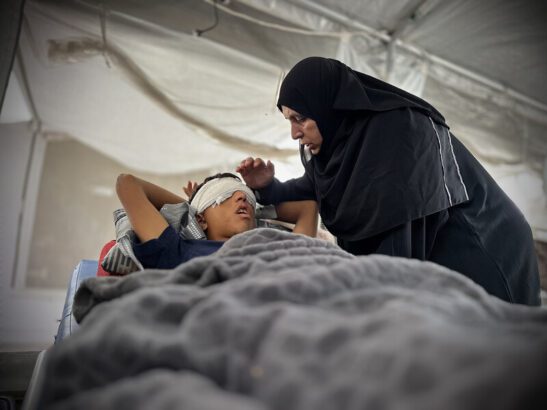
The Israeli blockade of Palestine deprives the more than 1,500 people who have become blinded or visually impaired since October 2023 of aid, according to the health ministry in Gaza.
Before the genocide erupted in the Gaza Strip, specialized institutions for people who were blind or had limited vision worked actively despite the tight siege on the enclave.
The UN agency for Palestine refugees (UNRWA) ran a Rehabilitation Center for the Visually Impaired, offering programs to children aged 8 to 12.
UNRWA’s rehabilitation center also provided braille machines, canes, visual aids and recreational activities like sport and music.
Another governmental school located in al-Zahra neighborhood, in the central Gaza Strip, offered people who were blind or with limited vision middle and secondary education.
The Islamic University of Gaza also embraced blind students.
It provided them with accessible facilities, specialized technical tools, dedicated staff and an adapted inclusion approach.
Ahmed Abu Aljidian, who is completely blind and a close friend of this writer, earned distinction in some courses as a student of English at the Islamic University.
“The Islamic University was the spark that guided our hearts to enlightenment,” Abu Aljidian said.
In November 2021, a few months before his graduation, Abu Aljidian was able to write a play and, alongside other classmates, perform it before a large audience within the university.
After graduating in 2022, Abu Aljidian started working as a freelance content writer in digital advocacy.
Upended lives
In October 2023, Abu Aljidian’s life was upended when he and his family were forced to flee their house in Jabaliya refugee camp in northern Gaza, relocating to a tent in Deir al-Balah, central Gaza Strip.
In May 2024, Abu Aljidian received news that, he said, he “couldn’t bear” – their house was destroyed.
As a blind person, Abu Aljidian struggled to get food aid and medicine he used to get before the genocide due to the displacement and the lack of communication with the specialized centers which had previously helped him.
Abu Aljidian also couldn’t continue his job as the connection to the internet in the tent was scarce, and he had already lost his laptop in his house back in Jabaliya.
“Even in the ceasefire now, life lost its meaning,” Abu Aljidian said, adding that the October ceasefire is a “fragile” one.
It wasn’t only Abu Aljidian’s life that was upended. So were the lives of the other 10,000 pre-genocide people who were blind or had limited vision in Gaza.
The Electronic Intifada interviewed Ali Tuaima, the director of the Gaza Forum Association for the Visually Impaired, a place aiding people who are blind or have limited vision.
“Many people with visual impairments were killed during this war, while some suffered double disability – a visual and physical one,” Tuaima said. “Many others remain imprisoned and were tortured by the occupation.”
Tuaima said that currently, there is not a single rehabilitation center for blind people in Gaza.
From the first days of the genocide, Israel bombed the Islamic University of Gaza and later in February 2024 rendered the UNRWA’s rehabilitation center out of service.
Israel also, Tuaima said, obliterated schools or institutions for blind people – including the building that housed Tuaima’s association.
In April, Tuaima conducted a study to examine the aspects of the lives of blind people during the genocide, from access to food and water to assistive devices and mobility during displacement.
“The results were very harsh and difficult to comprehend,” Tuaima said of the results that came out in July.
More than 450 persons who are blind or have limited vision participated in the survey.
Some of the challenges faced by blind people during the genocide included losing their homes; struggling to follow new Israeli displacement orders and being displaced repeatedly from one tent to another, where each time they had to relearn and memorize the tent’s layout.
“Some blind individuals have been displaced at least 15 times, each time trying to familiarize themselves with the new location,” Tuaima said.
“The challenges faced by females with visual impairments could be greater than those faced by males – how they manage their medical supplies, personal hygiene and their private lives, going to the bathroom and ensuring their privacy,” Tuaima added.
Blind people also lived in constant fear when hearing bombardment, had their education interrupted, lacked access to medical treatment and faced famine, as reaching distribution points was often impossible.
The Gaza Humanitarian Foundation – a US-Israeli militarized aid scheme – already placed its distribution points out of reach for people who are blind or with limited vision.
Muhammad Mahani, who has an eye condition, said that he “reached a degree where I could die from starvation.”
Mahani, 23, was forced to evacuate Jabaliya refugee camp to Deir al-Balah in October 2023.
In August 2024, Mahani started working as a vendor in Deir al-Balah’s market, selling identity card cases, bags and wallets to earn a modest income and assist his family’s needs.
“I forced myself to work to keep my family alive. We didn’t have any help at all,” Mahani said. “We still face difficulties – no financial support or a job opportunity.”
No intervention
In September, the Ministry of Health in Gaza reported that since October 2023, more than 1,500 people were added to the 10,000 people who are blind or with limited vision in Gaza before the genocidal war began.
As Israel still prevents the entry of eye drops and treatments, nearly 4,500 people were at risk of having eye conditions – up from 4,000 in May.
That increase aligns with accounts Tuaima, the director of the association for blind people, received from several doctors, who told him that some of the people with pre-existing eye conditions or diseases lost their sight due to the lack of proper surgical instruments and treatments while the vision of others deteriorated.
Tuaima also received numerous pleas from blind people about their need for eye drops and treatments for various ailments.
Jehad Alshaqra, 25, has glaucoma, an eye condition that damaged Alshaqra’s optic nerves when he was 5, leading to complete sight loss.
After his home in eastern Khan Younis was bombed in February 2024, Alshaqra has been living in a tent in the al-Mawasi area west of Khan Younis in southern Gaza.
“I didn’t feel a difference between the war and the ceasefire,” he said. “Our suffering has not ended.”
“The pain in my eyes is unbearable,” he said, referring to the severe optic nerve pain caused by glaucoma, which affects around 4,000 patients in Gaza who are at high risk of losing their vision due to shortages of necessary treatment.
“There has been no medicine at all since the war started,” Alshaqra said.
Tuaima and his association were unable to provide the necessary treatments for people with eye conditions as Israel hinders the entry of essential medicines.
“Everything related to the lives of the blind has become piles of rubble. There is no training, no rehabilitation, no education, no employment, no assistive devices and a shortage of medications,” Tuaima said.
“We call upon local and international community organizations and human rights organizations to take serious action to assist people with disabilities in general, and those with visual impairments in particular.”
Said Alsaloul is a Gazan who lives among the rubble. Formerly he was an English trainer for Arabic speakers, but now, his life path involuntarily deviated to journalism, through which he exposes the massacres, genocides, and ethnic cleansing committed by the occupying army in Palestine.
RELATED:
- ‘Nothing has changed’: Gaza health workers report almost no medical aid entering the strip
- Child Amputees in Gaza Use Makeshift Prosthetics as Israel Restricts Medical Supplies
- In Gaza’s collapsing hospitals, mothers watch their babies fight for life amid the ruins of a post-genocide medical system
- 100+ NGOs’ joint statement: Israel must end weaponization of aid to Gaza
- ‘Millions of dollars’ of Gaza aid stranded in warehouses as Israel rejects NGO requests for entry