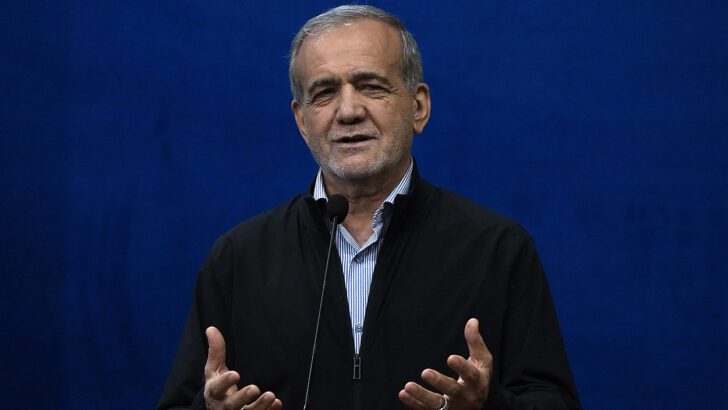
Iranian President Masoud Pezeshkian has penned an open letter to the American public, in which he appealed to them to “look beyond” what he characterized as “the machinery of misinformation” amid the U.S.-Israeli war with his country.
This is the second letter to the American people from Iranian leaders.
The first was in June 2015 and was from Ayatollah Seyyed Ali Khamenei. This received almost no news coverage.
Khameini, 86, was assassinated on February 28, 2026 by US-Israeli air strikes aimed at high officials. Khamenei’s daughter, granddaughter, son-in-law and daughter-in-law were also killed in the strikes.
A previous plan to assassinate Khamenei by Israel during the Twelve-Day War on June 15, 2025 was vetoed by Trump.
The full text of both letters is at the bottom of this post.
Iranian President Pens Open Letter to American People
By Chantelle Lee, Reposted from Time, April 2, 2026
“Portraying Iran as a threat is neither consistent with historical reality nor with present-day observable facts,” he wrote. “Such a perception is the product of political and economic whims of the powerful—the need to manufacture an enemy in order to justify pressure, maintain military dominance, sustain the arms industry, and control strategic markets. In such an environment, if a threat does not exist, it is invented.”
Pezeshkian’s open letter, which he shared on X on Wednesday afternoon, comes a little over a month after the U.S. and Israel launched the initial military strikes on Iran that began the war. President Donald Trump is expected to share an update on the conflict in a speech to the American public on Wednesday evening.
Pezeshkian did not mention Trump’s claim in his letter. But he said that “the Iranian people harbor no enmity toward other nations, including the people of America, Europe, or neighboring countries.”
“Despite its historical and geographical advantages at various times, Iran has never, in its modern history, chosen the path of aggression, expansion, colonialism, or domination,” he asserted. “Even after enduring occupation, invasion, and sustained pressure from global powers—and despite possessing military superiority over many of its neighbors—Iran has never initiated a war. Yet it has resolutely and bravely repelled those who have attacked it.”
He went on to say that the U.S. has deployed a significant portion of its military forces in the area surrounding Iran, adding that “recent American aggressions launched from these very bases have demonstrated how threatening such a military presence truly is.”
“Naturally, no country confronted with such conditions would forgo strengthening its defensive capabilities,” Pezeshkian said. “What Iran has done—and continued to do—is a measured response grounded in legitimate self-defense, and by no means an initiation of war or aggression.”
Pezeshkian questioned whether the war was truly in the interest of the American people, and accused the U.S. of entering the war “as a proxy for Israel.” He alleged that Israel, “by manufacturing an Iranian threat, seeks to divert global attention away from its crimes toward the Palestinians.”
“Is ‘America First’ truly among the priorities of the U.S. government today?” Pezeshkian said. “I invite you to look beyond the machinery of misinformation—an integral part of this aggression—and instead speak with those who have visited Iran. Observe the many accomplished Iranian immigrants—educated in Iran—who now teach and conduct research at the world’s most prestigious universities, or contribute to the most advanced technology firms in the West. Do these realities align with the distortions you are being told about Iran and its people?”
Israel and the Trump Administration have offered shifting and at times contradictory explanations for why they launched the war on Iran in the weeks since it began. But Trump and Administration officials have previously denied that the U.S. was pushed into the war by Israel, and both the U.S. and Israel have claimed that the strikes were defensive or preemptive, though neither has shared any evidence that Iran was preparing to attack them.
Asked days after the initial strikes if Israeli leadership pulled the U.S. into the conflict, Trump stated that he decided to attack because he believed that Iran would otherwise do so first.
“Based on the way the negotiation was going, I think they were going to attack first. And I didn’t want that to happen. So, if anything, I might have forced Israel’s hand. But Israel was ready and we were ready,” Trump said on March 3.
Polls indicate that most Americans have disapproved of the war since the beginning and that it remains widely unpopular in the U.S. a month in, despite the support of many Republicans.
To the people of the United States of America pic.twitter.com/3uAL4FZgY7
— Masoud Pezeshkian (@drpezeshkian) April 1, 2026
Iranian President Masoud Pezeshkian’s letter in full:
In the name of God, the Compassionate, the Merciful
To the people of the United States of America, and to all those who, amid a flood of distortions and manufactured narratives, continue to seek the truth and aspire to a better life:
Iran – by this very name, character, and identity – is one of the oldest continuous civilisations in human history. Despite its historical and geographical advantages at various times, Iran has never, in its modern history, chosen the path of aggression, expansion, colonialism, or domination.
Even after enduring occupation, invasion, and sustained pressure from global powers–and despite possessing military superiority over many of its neighbours – Iran has never initiated a war. Yet it has resolutely and bravely repelled those who have attacked it.
The Iranian people harbour no enmity towards other nations, including the people of America, Europe, or neighboring countries. Even in the face of repeated foreign interventions and pressures throughout their proud history, Iranians have consistently drawn a clear distinction between governments and the peoples they govern. This is a deeply rooted principle in Iranian culture and collective consciousness–not a temporary political stance.
For this reason, portraying Iran as a threat is neither consistent with historical reality nor with present-day observable facts. Such a perception is the product of political and economic whims of the powerful – the need to manufacture an enemy in order to justify pressure, maintain military dominance, sustain the arms industry, and control strategic markets. In such an environment, if a threat does not exist, it is invented.
Within this same framework, the United States has concentrated the largest number of its forces, bases, and military capabilities around Iran – a country that, at least since the founding of the United States, has never initiated a war.
Recent American aggressions launched from these very bases have demonstrated how threatening such a military presence truly is. Naturally, no country confronted with such conditions would forgo strengthening its defensive capabilities. What Iran has done – and continues to do – is a measured response grounded in legitimate self-defense, and by no means an initiation of war or aggression.
Relations between Iran and the United States were not originally hostile, and early interactions between the Iranian and American people were not marred with hostility or tension. The turning point, however, was the 1953 coup d’etat – an illegal American intervention aimed at preventing the nationalization of Iran’s own resources. That coup disrupted Iran’s democratic process, reinstated dictatorship, and sowed deep distrust among Iranians towards US policies.
This distrust deepened further with America’s support for the Shah’s regime, its backing of Saddam Hussein during the imposed war of the 1980s, the imposition of the longest and most comprehensive sanctions in modern history, and ultimately, unprovoked military aggression – twice, in the midst of negotiations – against Iran.
Yet all these pressures have failed to weaken Iran. On the contrary, the country has grown stronger in many areas: literacy rates have tripled – from roughly 30 per cent before the Islamic Revolution to over 90 per cent today; higher education has expanded dramatically; significant advances have been achieved in modern technology; healthcare services have improved; and infrastructure has developed at a pace and scale incomparable to the past. These are measurable, observable realities that stand independent of fabricated narratives.
At the same time, the destructive and inhumane impact of sanctions, war, and aggression on the lives of the resilient Iranian people must not be underestimated. The continuation of military aggression and recent bombings profoundly affect people’s lives, attitudes, and perspectives. This reflects a fundamental human truth: when war inflicts irreparable harm on lives, homes, cities, and futures, people will not remain indifferent toward those responsible.
This raises a fundamental question: Exactly which of the American people’s interests are truly being served by this war? Was there any objective threat from Iran to justify such behavior? Does the massacre of innocent children, the destruction of cancer-treatment pharmaceutical facilities, or boasting about bombing a country “back to the stone ages” serve any purpose other than further damaging the United States’ global standing?
Iran pursued negotiations, reached an agreement, and fulfilled all its commitments. The decision to withdraw from that agreement, escalate toward confrontation, and launch two acts of aggression in the midst of negotiations were destructive choices made by the US government – choices that served the delusions of a foreign aggressor.
Attacking Iran’s vital infrastructure – including energy and industrial facilities – directly targets the Iranian people. Beyond constituting a war crime, such actions carry consequences that extend far beyond Iran’s borders. They generate instability, increase human and economic costs, and perpetuate cycles of tension, planting seeds of resentment that will endure for years. This is not a demonstration of strength; it is a sign of strategic bewilderment and an inability to achieve a sustainable solution.
Is it not also the case that America has entered this aggression as a proxy for Israel, influenced and manipulated by that regime? Is it not true that Israel, by manufacturing an Iranian threat, seeks to divert global attention away from its crimes toward the Palestinians? Is it not evident that Israel now aims to fight Iran to the last American soldier and the last American taxpayer dollar–shifting the burden of its delusions onto Iran, the region, and the United States itself in pursuit of illegitimate interests?
Is “America First” truly among the priorities of the US government today?
I invite you to look beyond the machinery of misinformation – an integral part of this aggression – and instead speak with those who have visited Iran. Observe the many accomplished Iranian immigrants – educated in Iran – who now teach and conduct research at the world’s most prestigious universities, or contribute to the most advanced technology firms in the West. Do these realities align with the distortions you are being told about Iran and its people?
Today, the world stands at crossroads. Continuing along the path of confrontation is more costly and futile than ever before. The choice between confrontation and engagement is both real and consequential; its outcome will shape the future for generations to come. Throughout its millennia of proud history, Iran has outlasted many aggressors. All that remains of them are tarnished names in history, while Iran endures–resilient, dignified, and proud.
The letter from the Ayatollah Seyyed Ali Khamenei:
In the name of God, the Beneficent the Merciful
To the Youth in Europe and North America,
The recent events in France and similar ones in some other Western countries have convinced me to directly talk to you about them. I am addressing you, [the youth], not because I overlook your parents, rather it is because the future of your nations and countries will be in your hands; and also I find that the sense of quest for truth is more vigorous and attentive in your hearts.
I don’t address your politicians and statesmen either in this writing because I believe that they have consciously separated the route of politics from the path of righteousness and truth.
I would like to talk to you about Islam, particularly the image that is presented to you as Islam. Many attempts have been made over the past two decades, almost since the disintegration of the Soviet Union, to place this great religion in the seat of a horrifying enemy. The provocation of a feeling of horror and hatred and its utilization has unfortunately a long record in the political history of the West.
Here, I don’t want to deal with the different phobias with which the Western nations have thus far been indoctrinated. A cursory review of recent critical studies of history would bring home to you the fact that the Western governments’ insincere and hypocritical treatment of other nations and cultures has been censured in new historiographies.
The histories of the United States and Europe are ashamed of slavery, embarrassed by the colonial period and chagrined at the oppression of people of color and non-Christians. Your researchers and historians are deeply ashamed of the bloodsheds wrought in the name of religion between the Catholics and Protestants or in the name of nationality and ethnicity during the First and Second World Wars. This approach is admirable.
By mentioning a fraction of this long list, I don’t want to reproach history; rather I would like you to ask your intellectuals as to why the public conscience in the West awakens and comes to its senses after a delay of several decades or centuries. Why should the revision of collective conscience apply to the distant past and not to the current problems? Why is it that attempts are made to prevent public awareness regarding an important issue such as the treatment of Islamic culture and thought?
You know well that humiliation and spreading hatred and illusionary fear of the “other” have been the common base of all those oppressive profiteers. Now, I would like you to ask yourself why the old policy of spreading “phobia” and hatred has targeted Islam and Muslims with an unprecedented intensity.
Why does the power structure in the world want Islamic thought to be marginalized and remain latent? What concepts and values in Islam disturb the programs of the super powers and what interests are safeguarded in the shadow of distorting the image of Islam? Hence, my first request is: Study and research the incentives behind this widespread tarnishing of the image of Islam.
My second request is that in reaction to the flood of prejudgments and disinformation campaigns, try to gain a direct and firsthand knowledge of this religion. The right logic requires that you understand the nature and essence of what they are frightening you about and want you to keep away from.
I don’t insist that you accept my reading or any other reading of Islam. What I want to say is: Don’t allow this dynamic and effective reality in today’s world to be introduced to you through resentments and prejudices. Don’t allow them to hypocritically introduce their own recruited terrorists as representatives of Islam.
Receive knowledge of Islam from its primary and original sources. Gain information about Islam through the Qur’an and the life of its great Prophet. I would like to ask you whether you have directly read the Qur’an of the Muslims. Have you studied the teachings of the Prophet of Islam and his humane, ethical doctrines? Have you ever received the message of Islam from any sources other than the media?
Have you ever asked yourself how and on the basis of which values has Islam established the greatest scientific and intellectual civilization of the world and raised the most distinguished scientists and intellectuals throughout several centuries?
I would like you not to allow the derogatory and offensive image-buildings to create an emotional gulf between you and the reality, taking away the possibility of an impartial judgment from you. Today, the communication media have removed the geographical borders. Hence, don’t allow them to besiege you within fabricated and mental borders.
Although no one can individually fill the created gaps, each one of you can construct a bridge of thought and fairness over the gaps to illuminate yourself and your surrounding environment. While this preplanned challenge between Islam and you, the youth, is undesirable, it can raise new questions in your curious and inquiring minds. Attempts to find answers to these questions will provide you with an appropriate opportunity to discover new truths.
Therefore, don’t miss the opportunity to gain proper, correct and unbiased understanding of Islam so that hopefully, due to your sense of responsibility toward the truth, future generations would write the history of this current interaction between Islam and the West with a clearer conscience and lesser resentment.
Seyyed Ali Khamenei
21st Jan. 2015
Chantelle Lee is a reporter at TIME. She covers U.S. news with a focus on health and reproductive rights.
RELATED:
- How Israel and the US are exploiting Iranian protests
- The Big Lie of Weeks/Months to an Iranian Nuke
- A Journalist Reported From Palestine. Youtube Deleted His Account Claiming He’s An Iranian Agent.
- Leaked documents reveal US intel cutout’s Iranian counter-revolution plans
- Experts warn of possible use of nukes against Iran