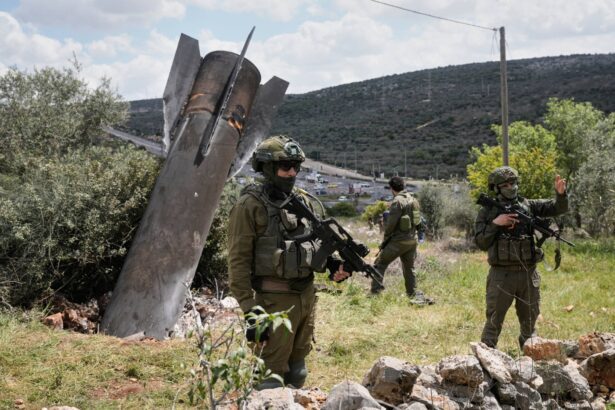
By helping Israel demolish what’s left of international legal constraint, the Iran war is hastening the dissolution of the Palestinian question.
By Jonathan Shamir, Reposted from Jewish Currents, March 24, 2026
In 1993, Israeli Prime Minister Benjamin Netanyahu—then a lawmaker in the Knesset—was working on A Place Among the Nations, a foundational text of his political ideology. In the book, written at a moment when the Palestinian cause was back on the international agenda amid the start of a partition process, Netanyahu sought to reframe the conflict as a broader civilizational struggle in a bid to justify Israel’s own rejectionism. “The PLO [Palestine Liberation Organization] is a Pan-Arab Trojan horse . . . that the Arabs have been trying to coax the West into accepting for over twenty years,” he wrote.
Netanyahu’s contention was that Palestine was a symptom, not the cause, of Arab and Muslim hostility toward Israel, and that negotiating any territorial compromise with the PLO would be fruitless when it was actually external powers that had their hands on the reins: first the Soviet Union and Egypt, and now Iraq. In this telling, it was Saddam Hussein who was “the Middle East’s, and Israel’s, number one problem.”
But by the time of the book’s publication, the Gulf War and subsequent sanctions had already eliminated any threat Iraq could have posed. Netanyahu’s narrative was now urgently missing a compelling puppet master to frame as the “number one problem.” Netanyahu found his answer in Iran. Throughout the 1990s, he began casting Iran’s increased support of Hamas, Palestinian Islamic Jihad, and Hezbollah as evidence that two-state solution negotiations rooted in territorial concession would not bring peace. “Iran is the center of world terrorism today,” he wrote in 1996.
By then, he was preaching to Congress that Iran was “the most dangerous” of the regimes in the Middle East. As with Iraq before it, Iran now served to lift the Palestinian question out of the colonial frame and into the civilizational one—taking it off the negotiating table and putting it onto the battlefield.
Today, three decades after he first cast Iran as the engine behind anti-Israel sentiment, Netanyahu has finally gotten his war. Israel posits the war as defense against an existential threat, but as ever, what is driving it is the impulse to suppress and displace the Palestine question.
Seen this way, the Iran war once again reveals Israel’s most fundamental interest, which has remained unchanged for decades: to prosecute the question of Palestine on its own terms, whether through the continued system of apartheid or outright genocide. Netanyahu is once again proving that he would sooner redraw the map of the Middle East than push back Israel’s borders—preferring to crater Tehran and Isfahan than concede a single dunam in the West Bank.
Israel’s war on Iran is an excellent vessel for advancing the erosion of international law, which had recently begun to show its potential as a mechanism for constraining Israel. While international law has traditionally served rather hindered Israel, the horrors inflicted on Gaza since October 7th, 2023, reopened it as an arena of contestation.
In December 2023, South Africa initiated a genocide case against Israel at the International Court of Justice (ICJ), and in January 2024 the ICJ issued binding orders requiring Israel to prevent genocide against Palestinians in Gaza. In July 2024, the Court issued an advisory opinion that found Israel’s occupation of Palestinian territory unlawful, and another ruling in October 2025 ordered Israel to facilitate the operations of the United Nations Relief and Works Agency (UNRWA) in the occupied Palestinian territories.
The International Criminal Court issued arrest warrants against Prime Minister Benjamin Netanyahu and then-Defense Minister Yoav Gallant in November 2024, and grassroots organizations have since mobilized international law to prevent state and corporate complicity and prosecute individual soldiers for involvement in war crimes.
Despite the shortcomings of the international legal system—both in the law itself and its selective implementation—the Gaza genocide has helped Palestinians make the case to expand its letter to fully grasp the ongoing Nakba, and has prompted some Global South states take steps to close the enforcement gap.
But the project of reclamation from below is being challenged from above. American military lawyers are positioning Israel’s war on Gaza as a legal precedent for the US’s own future wars, including its attacks on Iran. Israeli legal scholars are arguing that the threshold to launch a war—which has done little to inhibit Israel anyway—needs to be lowered altogether. Both in the legal domain and on the ground, US and Israeli intransigence has garnered little more than a shrug from complicit European allies—in large part thanks to Israel’s success in manufacturing the Iran bogeyman.
When the UN Security Council finally passed a resolution on the Iran war, it was an overwhelming condemnation of Iran’s response against America’s allies in the Gulf. Israel has taken this acquiescence to try to usher in a world of de facto lawlessness—where it can operate freely across the region as the dominant military power, and where it finally has the leeway it desires to settle the question of Palestine without challenge or compromise.
Indeed, in the chaos of a collapsing legal order, Israel has accelerated its campaigns of cruelty against the Palestinians. In the Gaza Strip, it has re-imposed the near total siege that previously raised international alarm bells, exacerbating the already dire shortage of food, shelter, fuel and gas, and medical supplies.
The Israeli military has falsely claimed that the “substantial quantities of goods that have entered since the beginning of the ceasefire amount to four times the nutritional needs of the population,” and that “therefore, the existing stock is expected to suffice for an extended period.” The humanitarian situation is exacerbated by the fact that Israel has banned 37 humanitarian organizations from operating in Gaza starting March 1st. (Just one of the organizations, World Central Kitchen, provides around one million meals per day.)
Under the cover of war, as Maya Rosen has reported, Israel has also sped up its seizure of Palestinian land in the occupied West Bank and tightened its lockdown there, introducing new roadblocks and closing checkpoints. Settlers, on the other hand, remain free to exploit their own freedom of movement to attack dozens of communities, either with the tacit approval or active support of the army.
Consequently, in the early weeks of the war, settlers killed an average of one Palestinian every other day, and the attacks have not relented since. In this atmosphere of terror, the residents of the Palestinian villages of Duma, al-Shqarah, al-Khirbe, and al-Aqaba have mostly packed their bags and left, with top-down orders also initiating and consolidating displacements elsewhere.
These “successes” stand to confirm Netanyahu’s longstanding hypothesis that producing civilizational enemies offers Israel an ideal way to continue colonizing Palestine without the attendant scrutiny, not least by weakening the deterrent threat posed by the Axis of Resistance. And so long as there is no meaningful challenge to this strategy, Israel is likely to keep repeating it, forever trying to sidestep the Palestine issue by manufacturing a new bogeyman.
In fact, that process has already begun. Even before the most recent war, which began when Iran was already significantly weakened, the mantle of Israel’s existential enemy was starting to be passed onto a new “radical Sunni axis” consisting of Turkey and Qatar. In particular, for the past two years, Israel’s political and media class have been working overtime to dub Turkey in particular as an “existential threat,” “the new Iran,” “Islamic Brotherhood monster,” and even gained the nickname internally in the Israeli military of the “Ikhwan Axis,” referring to the Muslim Brotherhood ideology that they believe animates Turkey and Qatar.
“Within ten years, perhaps even less, the Sunni, terror-supporting regime in Ankara will try to take control of the Middle East,” Amit Segal, one of Israel’s most prominent journalists, said on January 23rd of this year. “It too will have proxies, and it too will try to encircle Israel . . . it is not yet too late to act.”
It is not just Netanyahu and his immediate allies advancing this narrative. Given the currency that Netanyahu has gained from the Iran narrative, opposition leaders are racing to conjure the next nemesis. For these politicians, so-called “Qatargate”—the scandal where Netanyahu staffers allegedly received money from representatives from Doha—has presented an opportunity to kill two birds with one stone.
Once the story broke, it was opposition leader Yair Lapid who proposed the bill to designate Qatar as an enemy state (despite its tireless mediation for a ceasefire and hostage deal), and the liberal Zionist hero Yair Golan who rallied European politicians against Turkey and Qatar.
Israel’s target this time around is even less convincing. Turkey has the second-largest army in NATO and touts itself to Europe as a bulwark against migrants, while Turkish President Recep Erdogan enjoys close personal ties with US President Donald Trump and has even taken up a position on his Board of Peace. Given its pro-Western position, Turkey is hardly looking to launch a war with Israel.
But Israel is concerned less with the plausibility of its claims than with their effect, and for decades, its strategy of externalization has enabled it both to consolidate its position as the region’s dominant military power and establish deadly facts on the ground in Palestine. It remains to be seen whether this strategy will continue to work with Israel’s old allies in the West or whether it will need to turn further toward new partners with even less liberal pretensions, such as India and the UAE.
Regardless, Israel’s project of preempting Palestine is set to keep fueling the advent of a “might makes right” international order. When states and international institutions legitimize Israel’s war against its latest bogeyman, they accelerate the creation of this world.
Jonathan Shamir is a reporter for Jewish Currents.
RELATED:
- Blaming the Israeli far right lets a genocidal society off the hook
- Don’t Be Fooled. Zionist Leaders Have Always Wanted to Control Southern Lebanon
- ‘Burn the lawn’: Israel pursues ‘Rafah model’ in southern Lebanon
- Mossad’s promises helped Netanyahu convince Trump that Iran could be toppled
- ‘Forever live by the sword’: Understanding Israelis’ massive support for Iran war