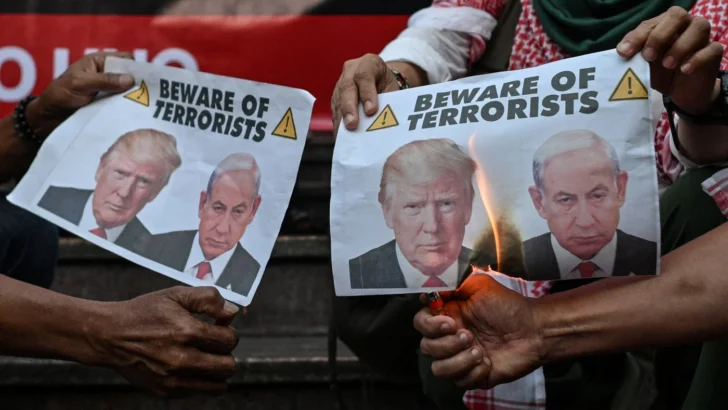
The embers of resistance – in Gaza, Iraq, Lebanon, Syria, Yemen – have not been snuffed out. With the attack on Iran, they are being fanned into a fire
By Jonathan Cook, Reposted from Middle East Eye, March 05, 2026
It is near impossible to make sense – at least from the justifications on offer – of what US President Donald Trump really hopes to achieve with his and Israel‘s blatantly illegal war of aggression on Iran.
Is it to destroy an Iranian nuclear weapons programme for which there has never been any tangible evidence, and which Trump claimed just a few months ago to have “completely and totally obliterated” in an earlier lawbreaking attack?
Or is it intended to force Tehran back to negotiations on its nuclear energy enrichment programme that were brought prematurely to an end when the US launched its unprovoked attack – talks, we should note, that were made necessary because in 2018, during his first term, Trump tore up the original deal with Iran?
Or is the war supposed to browbeat Iran into greater flexibility, even though Trump blew up the talks at the very moment Oman, the chief mediator, insisted that Tehran had capitulated on almost every one of Washington’s onerous demands and that a deal was “within our reach“?
Or are the air strikes designed to “liberate” Iranians, even though the early victims included at least 165 civilians in a girls’ school, most of them children aged between 7 and 12?
Or is the aim to pressure Iran to give up its ballistic missiles – the only deterrence it has against attack, and which would leave it utterly defenceless against US and Israeli malevolent designs?
Or did Washington believe Tehran was about to strike first, even though Pentagon officials have confided to congressional staff that there was zero intelligence an attack was about to happen?
Or is the goal to decapitate the Iranian regime, as the strikes have already achieved with the assassination of Iran’s supreme leader, Ali Khamenei? If so, to what purpose, given that Khamenei was so opposed to an Iranian nuclear bomb that he issued a religious edict, a fatwa, against its development?
Might Khamenei’s successor – having seen how utterly untrustworthy the US and Israel are, how they operate as rogue states unconstrained by international law – now decide that developing a nuclear bomb is an absolute priority to protect Iran’s sovereignty?
No clear rationale
There is no clear rationale from Washington because the author of this attack is not to be found in either the White House or the Pentagon. This plan was cooked up in Tel Aviv decades ago.
The Israeli prime minister, Benjamin Netanyahu, admitted as much on Sunday. He gloated: “This combined effort allows us to do what I have hoped to achieve for 40 years: to crush the regime of terror completely. That’s my promise and this is what is going to happen.
Those four decades, let us note, were also the timeframe for an endless series of warnings from Netanyahu and other Israeli leaders that Tehran was only months away from developing a nuclear bomb.
Netanyahu has been peddling this same urgent, nonsensical pretext for attacking Iran all that time. For 40 years, each year has been proclaimed the very last opportunity to stop the “mad mullahs” from obtaining a bomb – a bomb that never materialised.
And all the while, Israel’s own arsenal of nuclear weapons, undeclared and therefore unmonitored, has been an open secret.
Europe helped Israel develop its bomb, while the US turned a blind eye, even as Israeli leaders espoused a suicidal doctrine known as the “Samson Option“, which posited that Israel would rather detonate its nuclear arsenal than suffer a conventional military defeat.
The Samson Option implicitly rejects the idea that any other state in the Middle East can be allowed to acquire a bomb and thereby level the military playing field with Israel.
It is that very premise that, for decades, has guided Israeli policy towards Tehran. Not because Iran has shown an inclination to develop a weapon. Nor because its supposedly “mad mullahs” would be foolish enough to fire them at Israel were they ever to acquire them.
No, it was for other reasons. Because Iran is the largest and most unified state in the region, one with a rich history, a strong cultural identity and a formidable intellectual tradition. Because Iran has repeatedly shown itself – whether under secular or religious leaders – unwilling to submit to western, and Israeli, colonial domination.
And because it is looked to as a source of authority and leadership by Shia religious communities in neighbouring countries – Iraq, Lebanon, Syria, Yemen – that have a history of similarly refusing to bow to Israeli hegemony.
Israel’s fear was that, were Iran to follow North Korea and acquire a nuclear weapon, Israel would be finished as the West’s most useful militarised client state in the oil-rich Middle East.
Stripped of its ability to terrorise its neighbours, stoke sectarian division and help project US imperial power into the region, Israel would lose its rationale. It would become the ultimate white elephant.
Israeli leaders – grown fat on endless military subsidies paid for by US taxpayers and given licence to plunder the Palestinians’ resources – were never going to willingly step off their gravy train.
Which is why Iran has rarely been out of Israel’s sights.
‘Birth pangs’
The extent of Israel’s extraordinary deception over the case for war on Iran can be gauged by comparing it to the hoax perpetrated by the George W Bush administration in launching its invasion of Iraq in 2003.
Iraq was another strong military state – if one more inherently fragile because of its deep sectarian and ethnic divisions – that Israel feared could develop a nuclear capacity that would wreck its top-dog status.
In the build-up to this illegal war – again cheered on by Israel – Bush claimed Iraqi leader Saddam Hussein had large, secret stockpiles of weapons of mass destruction that predated the introduction in 1991 of a United Nations weapons inspection regime.
The inspectors, who enjoyed extensive powers in Iraq, assessed that to be improbable. They also pointed out that, even had some of Iraq’s known chemical weapons eluded their inspections, they would by then have been so old as to have turned into “harmless goo“.
After the invasion, no WMD were ever found. Nonetheless, western politicians and media readily bought into the big lie. At least on that occasion, they could claim to have had only months to assess the credibility of the allegations.
In the case of Iran, by contrast, the politicians and media have had 40 years to investigate and weigh the plausibility of Israel’s claims. They should long ago have worked out that Netanyahu is an utterly unreliable narrator of a supposed Iranian “threat”.
And that does not even factor in that he is also a fugitive war crimes suspect who has spent more than two years lying about Israel’s genocidal destruction of Gaza. No one should trust a word that comes out of his mouth.
As with the ongoing eradication of Gaza, and the earlier occupation of Iraq, the current attack on Iran is another US-Israeli criminal co-production – in fact, a continuation of the same project.
The sales pitch is clear.
Netanyahu talks of wishing to “crush the terror regime”, just as he earlier spoke of “eradicating” Hamas in Gaza.
Trump similarly claims a defeated Iran is the key to a “totally different Middle East“. After the launch of air strikes at the weekend, he urged Iranians to overthrow their “repressive theocracy” and build a “free and peace-seeking Iran”.
Jonathan Cook is the author of three books on the Israeli-Palestinian conflict, and a winner of the Martha Gellhorn Special Prize for Journalism. His website and blog can be found here.
RELATED:
- Israel is using the ‘Gaza doctrine’ in Lebanon and Iran
- US troops were told war on Iran was ‘all part of God’s divine plan’, watchdog alleges
- Mass Expulsion in Lebanon as Israel Expands War: “We Don’t Know Where to Go”
- Lies, distortions, and propaganda: how the U.S. mainstream media coverage on Iran hides the truth
- The Neocons: First in War, Last in Peace