Israel is spending millions targeting the evangelical right, allegedly “to fight antisemitism.”
But the effort is actually part of a bid to revive Israel’s standing among Christians who are no longer among the country’s most staunch supporters.
By Omer Benjakob, Reposted from Haaretz, February 22, 2026
About two months ago, reports began appearing on Reddit from Americans receiving strange text messages. “Is anyone else getting these weird SMSes from ‘Partners for Peace’?” one user asked. “I got two messages from ‘Rachel’ and ‘Emma’ who wanted to talk to me about Israel. When I asked them what the organization was and who funds it, they stopped responding.”
This woman’s question received more than 250 replies, with many users reporting similar messages from people who identified themselves as representatives of an organization called Partners for Peace.
Users said they were asked for their views on U.S. involvement in Israel; they were also queried about what they thought would “help more people understand and support Israel.”
Some users got curious and managed to trace the source – a public relations firm owned by media consultant Brad Parscale, who ran Donald Trump’s digital campaign in 2016 and 2020 until he was replaced. The firm, Clock Tower X, is running a pro-Israel campaign that targets the American evangelical right and says it aims to fight antisemitism. But this effort is actually part of a bid to revive Israel’s standing among Christians who are no longer among the country’s most staunch supporters.
Through official filings in the United States, Haaretz published in November that Israel had hired international companies, among them American firms, for campaigns, including one producing pro-Israel content for millions of churchgoers. The contracts outlined planned campaigns and were revealed through documents filed with the U.S. Justice Department under the Foreign Agents Registration Act (FARA, which requires the registration and disclosure of entities operating in the United States on behalf of foreign principals.

The largest contract – worth $6 million – was signed with Parscale’s firm, which states its objective: “planning and executing a U.S. campaign to combat antisemitism.” Now the firm’s first products are out: websites pushing a pro-Israel and anti-Palestinian message, and the antisemitism efforts are negligible.
The SMS campaign is just the start. Documents recently filed under FARA show that the projects pitched last year are now materializing; the documents reveal that Parscale’s firm set up a network of at least seven websites pushing a pro-Israel narrative. The content, a Haaretz review of all the content found, is frequently aligned with the foreign and domestic agenda of Prime Minister Benjamin Netanyahu‘s government.
Some Reddit users who responded to the thread reported that their interlocutor directed them to one of the websites. The sites argue that the Palestinian Authority must not be allowed to run Gaza. They also encourage recognition of the settlements “in the name of historical accuracy,” and explain their belief that the Palestinian national entity is a mere invention rooted in Cold War-era politics. This extensive operation is funded entirely by Israeli taxpayer money.
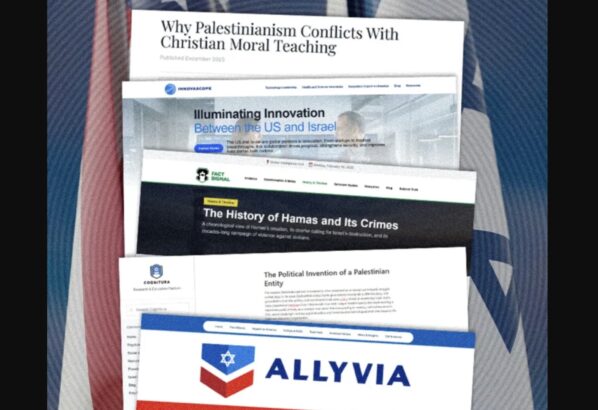
The website Culturavia, for example, is dedicated to U.S-Israeli cultural ties. One of its blog posts carries the headline “Why Palestinianism Conflicts With Christian Moral Teaching.” Its conclusion: “Palestinianism conflicts with Christianity by denying Jewish peoplehood, rejecting Israel’s legitimacy, and promoting selective moral concern. … Christians committed to biblical teaching should support Israel’s right to exist while seeking peace that respects the dignity of all people.”

Pro-Israel PR courtesy of AI
The campaign plies pro-Israel PR to address the war in Gaza, but it also deals with new challenges raised in the era of artificial intelligence.
The websites are designed to help penetrate the content that AI-driven chatbots generate for users, so that pro-Israel messaging also informs the answers provided on issues like the conflict. While past campaigns – both political and commercial – featured websites posing as news outlets, the sites in the current campaign strive to resemble think tanks publishing position papers or neutral factual overviews.

Their format as repositories of specialized knowledge is designed in a way that engines like ChatGPT can draw from, and their pages resemble Wikipedia entries more than news analyses. Each “entry” includes a table of contents divided into subheadings, providing a structured and seemingly neutral form, and ending with a “conclusion.” But unlike the Wikipedia entries that this new network draws inspiration from, its posts on websites forgo references or footnotes.
The shift in the PR, or hasbara, model, is part of a broader transformation that artificial intelligence has brought to online campaigns and pretty much everything related to content promotion (whether news or commercial).
Until recently, promotion efforts focused on getting to the top of Google search results – an effort known as SEO, search engine optimization – breaking into social media feeds and amplifying messages. Today, the effort focuses on penetrating AI tools (so-called generative engine optimization, GEO, or AIEO). AI also probably played a key role in creating the campaign’s websites, which have a very similar look and format.
At the bottom of these sites is the fine print that the content is “distributed by Clock Tower X LLC on behalf of the State of Israel.” But this disclosure is absent from the campaign’s entries on social media and in AI-based chats.
Parscale and ClockTowerX did not respond to a request for comment for this article.

Seven websites, one narrative
The documents that Parscale’s firm filed revealed that at least seven websites were established for the PR campaign, now in full swing. Haaretz found that each has slightly different branding, but the connecting thread is clear. Each site is dedicated to a different area (legal or cultural, for example), with a clear anti-Palestinian narrative.
A website called Allyvia focuses on the U.S.-Israeli security alliance. The site seems intended as a direct response to the growing calls – including from the American right – to cancel the tens of billions of dollars in defense aid to Israel. Allyvia depicts Israel as an equal partner in the effort to “defend Western values” and stresses shared strategic interests.
The site also argues against calls to reduce military aid and quotes people who laud the U.S. commitment to Israel’s security. Allyvia frames calls to reexamine American support for Israel as naive or dangerous, and stresses that U.S. technological and security cooperation with Israel is important “for anyone who values national security.”

The site’s homepage features a YouTube video that appears to be produced by the conservative Christian media network Salem Media Group – “Salem Partners In Peace Digital Master” is written at the top. Parscale is the network’s chief strategy officer, and the contract underlying the PR campaign stipulates that the messaging will be integrated into the network’s channels.
The video launches the Partners for Peace brand – the same name cited by Reddit users. The video describes how, under Trump, a form of peace has been achieved, and Israel is fulfilling its part.
The website Cognitura calls itself “a research and education platform that explores how extremist groups like Hamas exploit psychology, social dynamics, and propaganda to radicalize followers and how the US and Israel use truth, education, and moral resilience to prevent it.”
A site called Justorium is dedicated to the legal aspects of the Israeli-Palestinian conflict and of Israel-U.S. relations. The site claims that criticism of Israel is a cynical exploitation of Western values and the international legal system, and that such criticism originates from a campaign by the Palestinians and their supporters in an “axis of evil.” Alongside the site’s fight against an alleged pro-Hamas bias on Wikipedia, it argues that international support for the Palestinians stems from an attempt by leaders to hide “failures” at home.
The website Innovascope is devoted to innovation and its role in U.S.-Israel relations; the site explores Israeli tech’s contributions to various sectors of the American economy, from agriculture to defense. The homepage states: “From startups to medical breakthroughs, this collaboration drives progress, strengthens security, and improves lives across both nations.” One entry presents the story of the Israeli company UVision, whose Hero-90 drones were selected to take part in a U.S. military project.
The site Culturavia addresses U.S.-Israeli cultural ties. Alongside “articles” proudly presenting the success of Israeli creators in America, most of the site deals with religion and faith. The term “Judeo-Christian values” repeatedly appears in articles with titles like “Christmas, the Judeo-Christian Tradition, and the Duty to Defend Western Civilization,” “The Judeo-Christian Roots of the U.S.-Israel Relationship,” and “An Ancient Inscription and the Biblical Foundation of Judeo-Christian Civilization.”
One page addresses a vital question at the heart of the overall campaign: “Why Evangelical Christians Remain Among Israel’s Most Reliable Allies.” Another does seem to try to address the campaign’s core goal – antisemitism, in this case on the right – with a page that says Trump drew a line against antisemitism in MAGA; the headline is “‘We Don’t Need or Want Them’: Trump Draws a Line Against Antisemitism Inside MAGA.”

According to the site, Palestinian culture stands in opposition to Western Judeo-Christian values. One page is dedicated to the question “Why Palestinianism Conflicts With Christian Moral Teaching.” It argues that “Palestinianism elevates one group into a moral absolute while assigning collective guilt to another.”
It adds that Palestinian ideology “frames the Jewish state as a moral offense rather than a nation with legitimate national rights,” and that “this ideology demands political outcomes that would eliminate Israel as the national homeland of the Jewish people.”
Israel or entities acting on its behalf have previously promoted content stressing the Jewish-Christian common ground and the struggle to defend Western values. This was done, for example, in an influence operation early in the Gaza war aimed at a liberal-Democratic American audience, first exposed by Haaretz.
Now, as the PR effort focuses on the conservative Christian right, the messaging is escalating into a theological attack on “Palestinianism,” apparently in an attempt to appeal to the soft underbelly of the evangelicals.
Another website in the network, PaxPoint, presents “Israel’s Pursuit of Peace & Coexistence.” But instead of seeking a peace deal with the Palestinians, it details the Abraham Accords, surveys other peace agreements that Israel has signed, and selectively showcases civil society groups working for coexistence. Other articles portray the Palestinian Authority as an extremist, terror-supporting organization. Another article on the site explains the PA’s “hypocrisy” in its approach to Taiwan’s demand for independence, while another justifies Israel’s recognition of Somaliland’s struggle for independence.

Influence against influence
A motif shared across all seven websites is the focus on media coverage of the Israeli-Palestinian conflict and the narrative wars around it – part of the campaign’s attempt to “expose disinformation.” As the sites cast it, support for the Palestinians, their national claims, and international criticism of Israel are all baseless and the product of influence efforts, usually by Qatar.
Though a number have sections dedicated to disinformation and anti-influence, one website explicitly focuses on it, FactSignal. This seventh site in the network purports to “reveal the truth.” “Our mission is to restore clarity through credible sourcing and verifiable facts,” it says, seemingly embracing Wikipedia’s rules. Yet there is an article on “Wikipedia’s Quiet Crisis: How Activism and Authoritarian Influence Distort the World’s Largest Encyclopedia.”
Somewhat ironically, given the Qatargate revelations that exposed Netanyahu aides helping lead a pro-Qatar campaign, in the Israeli state-funded operation targeting American Christians, one website contains a page on “the danger of influence and propaganda” by Palestinians, Iranians, and Qataris.
The Allyvia site contains a “Disinformation Watch” project that purports to expose “Foreign Influence Operations: How Qatar and Iran Target American Audiences.” The site also fights “the lie that Jesus was a Palestinian,” under a section on “The Truth About Zionism.” It also explains how attacking Israel has become the quickest path to “fame” on social media.
Meanwhile, a Cognitura page designed to look like an encyclopedia entry is titled “Qatar, the Muslim Brotherhood Network, and the Money Flowing Into U.S. Universities,” offering a take on Israel’s position on the United Arab Emirates.
Another entry explores “The Political Invention of a Palestinian Entity.” It asserts that “the modern Palestinian political movement was shaped by Arab state strategy and Cold War alliances” and that the 1960 Arab League meeting “outlined a plan to create a Palestinian entity as a weapon against Israel in diplomatic and military arenas.”
Despite the high cost and scope of the operation, it’s unclear how well the campaign is influencing hearts and minds. The websites’ pages are not being widely shared on social media and have not received significant exposure.
It’s unclear if the Foreign Ministry authorized the particular content in the campaign; the ministry declined to comment for this article.
But Israel’s Diaspora Ministry, which fights antisemitism and was not involved in the campaigns, recently launched webpages clearly marked as Israeli and using official government domains. This effort also aims to influence the information informing AI chatbots.
These pages are built in a similar way but are clearly marked as belonging to Israel, something officials say helps their standing in chatbot searches, as they are deemed an official source. The websites noted above are made to appear like independent entities. The ministry said recently that its content had been successfully scraped by Grok, the AI engine of Elon Musk’s xAI.
Omer Benjakob is an Israeli reporter for Haaretz.
RELATED:
- Hundreds of Former Israeli Spies Are Working in Big Tech, Database Shows
- What Google’s largest-ever acquisition of an Israeli software company tells us about Big Tech’s complicity in genocide
- ‘Christians Out’: Jerusalem Church Tagged With Hate Graffiti, Police Investigating
- Tucker Carlson sheds light on Christian-Muslim harmony in Palestine, Jordan
- Mike Huckabee’s distorted theology does not speak for Christians worldwide