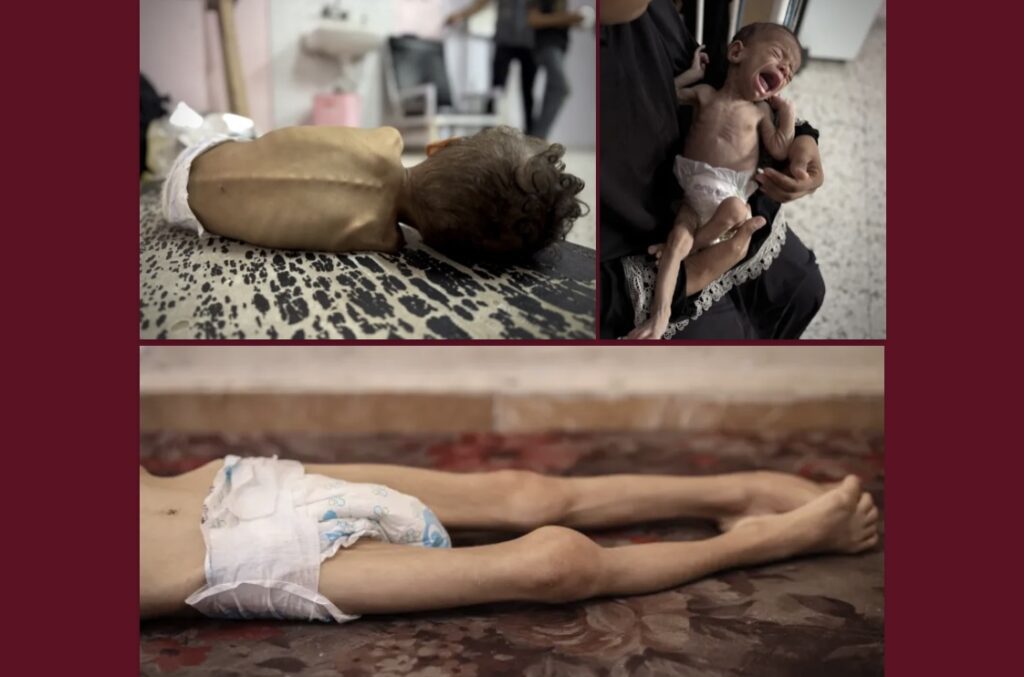
In just 24 hours, five more people died of starvation. The total number of recorded deaths from hunger in Gaza has reached 188, including at least 94 children.
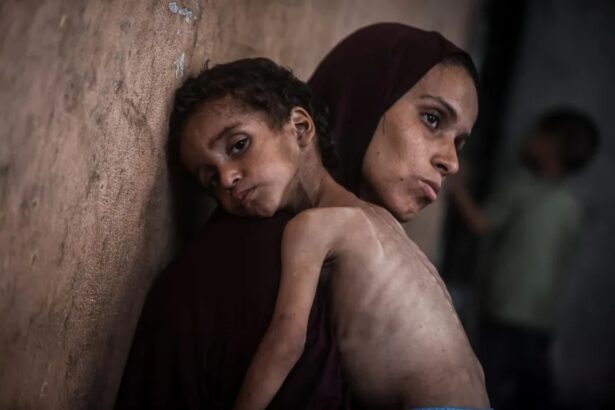
In a narrow alleyway of Khan Yunis refugee camp, 26-year-old Yasmin Abu Soltan cradles her daughter’s frail body. One-year-old Wateen no longer cries; she only gasps. Her skin is blotched, her ribs protrude, and her fingers can no longer curl.
“She used to hold my finger so tightly. Now her hand just slips away. I only dream of keeping her alive one more night,” Yasmin Abu Soltan remarked in The New Arab.
Wateen was born during Israel’s ongoing war on Gaza, in a UN school-turned-shelter. “There was no light, no doctor; just me, but without milk,” her mother recalls. “She survived her birth under bombardment. I thought she would survive anything.”
But in Gaza, survival is not about strength. Her baby, once full of life, is now wasting away. “Even powdered milk is gone. My body stopped producing milk. The doctors said her organs are shutting down,” Abu Soltan said.
In the same area, Umm Zainab Abu Halim clutches a tiny blanket once wrapped around her daughter Zainab, who died of hunger three days earlier at just six months old.
“She cried for milk. I had nothing to give. She died in my arms. Her eyes were open, staring at me, as if still pleading,” the grieving mother said to TNA.
The infant had no illness, no defect, only hunger. Her mother, herself malnourished, had lost the ability to breastfeed.
“Hospitals are empty. Shelves are empty. We are dying silently, one by one,” Umm Zainab said.
In just 24 hours, five more people died of starvation. The total number of deaths from hunger in Gaza has reached 180, including at least 93 children, according to the Gaza-based health ministry. These are not isolated incidents. They are the grim outcome of siege, deprivation, and international paralysis over Israeli actions and policy.
Twelve-year-old Huda Abu al-Naja no longer speaks. Once, a vibrant girl weighing 30 kilograms, she now lies on a thin mattress, reduced to 19 kilograms only. Her cheeks are sunken, her hair has fallen out, and her limbs are brittle.
“She only sleeps now. Her body can’t tolerate food. Even water makes her vomit,” her mother, Umm Mohammed, told TNA while she was stroking her forehead.
Huda suffers from celiac disease. “I can’t feed her bread like the rest of us. Every time she smells it, she cries. And I cry too,” Umm Mohammed said, adding, “Where can I find gluten-free food in Gaza?”
Doctors told Umm Mohammed that Huda’s organs were rapidly failing. “She’s disappearing in front of me. Every night, I fear I’ll wake up and find her gone,” the mother lamented.
The scenes repeat across Gaza: children whose eyes remain open even in death, infants too weak to cry, toddlers whose bones press through thin skin.
In Gaza City, Abeer Abdul Aal, a local nurse at al-Shifa hospital, described children arriving at the hospital as “barely breathing, already beyond saving.”
The famine has robbed Gaza’s children not just of nutrition but of identity. They are no longer toddlers learning to walk or infants discovering the world. They are skeletal forms, silent and shrinking, waiting for death in cold tents, while their mothers sit helpless beside them.