Gaza used to have one of the highest literacy rates in the world. Since October 2023, more than 64,000 children have reportedly been killed or maimed; many who survived are now orphans, trying to stay alive. Education is a distant memory.
By Eman Abu Zayed, Reposted from Truthout, January 03, 2025
Israel’s genocidal war has destroyed families and livelihoods across Gaza, leaving more than 39,000 children orphaned, while the widespread destruction has deprived over 80 percent of the workforce of their sources of income. Amid deepening poverty and the absence of alternatives, an increasing number of children have been forced into the streets, resorting to begging as their only means of survival.
Some estimates indicate that hundreds of children in Gaza currently engage in street begging, a direct reflection of economic collapse, the loss of breadwinners, and weak social protection networks, amid the ongoing war and the destruction it has wreaked on families and the economic infrastructure alike.
In Al-Maghazi refugee camp I met 11-year-old Ahmed, who lost his home in northern Gaza after it was completely bombed. The house was part of the land seized by the occupation, preventing his family from erecting their tent in the original location of their home, forcing them to move to the southern part of the territory.
Ahmed has now become the sole provider for his small family after his father was killed in July while going to collect U.S.-backed humanitarian aid. He stood in one of the camp’s streets on the day I met him, begging passersby as rain fell and his feet remained bare. When asked why he was on the street, he quietly told me: “I need three shekels to buy a loaf of bread.”
His sad gaze and young age reflect a harsh reality in which children are forced to beg to meet their families’ basic needs after losing their breadwinner and witnessing most of their families’ sources of income destroyed by the war.
During our conversation, Ahmed showed visible frustration when asked why he was on the street. He said, in a childlike tone of anger: “Why do I have to go out asking for shekels when I’m supposed to be studying and playing like other kids?” This candid response reflects his sense of frustration and anger at the situation imposed on his small life — a feeling shared by many children in the camps who have had to shoulder responsibilities for which they are far too young.
At the bus stop, my attention was drawn to 8-year-old Noor, whose sadness was immediately apparent. She lost her parents in an Israeli airstrike that destroyed their home, and after their death and the loss of her siblings, Noor now lives with her uncle under extremely difficult circumstances.
Her clothes were tattered, and she wasn’t wearing a jacket despite the rainy weather. Noor explains that any funds she receives are saved to invest in small projects, such as selling water bottles to passersby, to help her uncle and provide for the family — a clear example of child labor prompted by war and poverty.
Noor’s uncle, a married man with a family of seven, lost his source of income during the war and now lives with his entire family in a small tent within the camp. Despite his own family’s hardships, he took on the responsibility of caring for 8-year-old Noor after her parents and siblings were killed in the bombing.
He described daily life for the family: “We live on aid, but it’s never enough to cover our basic needs. My seven children need food and clothing, and Noor needs care, and I can’t provide everything.”
He added about Noor’s role: “Any money she earns from begging or selling small items is saved to help the family. Sometimes she sells water bottles or anything small she can manage. This is the only way we can survive.”
He continued: “Noor is very young, yet she has become the family’s small provider. Every day brings new challenges — rain, a cramped tent, limited hope — but she tries to contribute in any way she can.”
This testimony illustrates the daily suffering of children who have lost their caregivers and the role of relatives who attempt to fill the gap, despite their own difficult circumstances. It also highlights how children like Noor are forced to take on responsibilities far beyond their age due the destruction of Gaza’s economy and the mass murder of their guardians.
Children like Ahmed and Noor were supposed to be in school, attending lessons in a safe and stable environment. Before the war, Gaza had approximately 625,000 students with over 22,000 teachers, achieving high rates of 95 percent enrollment in primary education and 90 percent enrollment in secondary education, and a literacy rate of 97 percent, which is among the highest globally.
Amid the genocide, many schools were damaged or used as temporary shelters for displaced families, leading to a halt in regular education. Thousands of children lost access to schooling, directly affecting their academic achievement and daily routines. For Ahmed, being out of school means he is forced to beg to provide for his family, while missing even the most basic lessons, such as learning letters and numbers.
The damage that this unprecedented education loss has caused the children of Gaza is not limited to schooling; it also has long-term implications for their future and their ability to escape poverty.
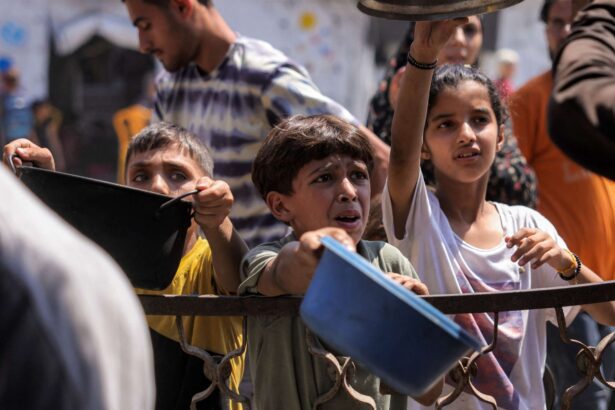
Amid the narrow tents and muddy streets, the daily reality of children in the camps comes into focus. In every corner, children stand waiting for passersby, wearing tattered clothes and mostly barefoot, trying to obtain a small amount of money for food or other basic needs.
Samia, a resident of the camp who has witnessed the children begging, told me, “Many of these children don’t know what it means to play or study. Their lives are focused solely on survival. Even the simplest things, like buying a loaf of bread or a bottle of water, have become a daily struggle.”
These recurring scenes in the camps reflect the scale of the crisis facing children in Gaza, where so many have lost their families, their homes, and their basic means of survival. For some, the streets have become a temporary solution to meet daily needs, robbing them of their childhoods.
The impact of begging is not limited to the loss of childhood; it also exposes children to exploitation, harsh labor, illiteracy, and psychological trauma that can have long-lasting effects. As the number of children forced into street begging increases, their opportunities for a normal and secure life diminish. Homes and infrastructure can be rebuilt, but a generation deprived of education and hope for the future cannot be restored as easily.
The international community has been aware of what has been happening in Gaza over the past two years, but has consistently failed to act to protect Palestinians. Human rights organizations stress the urgent need to intervene and ensure children’s rights in accordance with the UN Convention on the Rights of the Child, including the right to food and water, health care, education, a safe environment, and protection from violence and abuse. Immediate action is required to reduce the daily risks faced by Gaza’s children. Global inaction allows their suffering to continue.
Eman Abu Zayed is a writer and journalist from Gaza who believes in the power of words to change reality.
RELATED:
- Once Again, the New York Times Sells Israel’s Genocide in Gaza as Law Enforcement
- No one fully survived: Shocking statistics expose the devastating scope of Israel’s genocide in Gaza
- Israel’s genocide in Gaza impossible without global complicity, UN report says
- Israel’s genocide in Gaza: Whatever happened to South Africa’s case at the ICJ?
- Israel committing genocide in Gaza, world’s top scholars on the crime say