by Kathryn Shihadah
World leaders have rushed to gush about the new “peace” plan that will supposedly make the impossible happen: bring “eternal peace in the Middle East.” Maybe it’s wishful thinking, or merely relief that the genocide may finally end – and with it, the relentless protests against morally bankrupt governments by ethical masses. But to anyone who knows about the conflict and the Palestinian people, the plan is deeply flawed and not likely to fly.
Here are excerpts from nine opinion pieces that expose (some of) the profound defects in Trump’s scheme.
Mohammad Nazzal, leader of Hamas’ political wing, points out in an interview with Drop Site News that the whole premise of the plan is absurd:

How Hamas Is Navigating Trump’s Gaza Ultimatum
“Trump is dealing with us as if we have to accept this plan based on the well-known English phrase: Take it or leave it. This is unacceptable in political practice. It cannot be a matter of either accepting or rejecting an agreement outright.”
“It is clear that the plan is a broad and vague outline that, by its nature, requires negotiation. Every point mentioned in the plan needs a negotiation process. We do not want to proceed on the basis that what is presented in the plan represents a final, non-negotiable position,” Nazzal said.
“This plan was formulated without the participation of Hamas or any Palestinian party, including the Palestinian Authority. So how can the U.S. administration reach an agreement with one side of the conflict while excluding the Palestinian side?”
“There are no guarantees [built into the plan],” Nazzal said. “That’s why I believe that when we delve into the details of the plan, we must include guarantees that ensure the agreement is fully implemented and not cut short. There must be guarantees that the release of all captives in those initial hours will not allow the Americans and Israelis to walk away from fulfilling the rest of the deal” (continue reading here).
Soumaya Ghannoushi, an expert in Middle East politics, calls out the no doubt intentional vagueness of Trump’s plan, as well as the historical patterns that are repeating themselves today:
Palestine is now the conscience of the world. No deal will change that
Strip away the theatre, and the plan is thin gruel. There’s one concrete item: the return of hostages. Everything else is smoke. No guarantees of withdrawal, no binding commitments – only vague promises, while Israeli troops remain entrenched.
Netanyahu has assassinated or attempted to kill negotiators before, from Hamas leader Ismail Haniyeh to those targeted in Doha as they sat to discuss Trump’s draft deal. His policy has always been clear: eliminate the negotiators, eliminate the negotiations, and then stand beside Washington to announce a plan crafted by genocide partners.
History will not be kind to this moment. A ceasefire plan that excludes the occupied is not a peace plan. It is a colonial diktat – the language of mandate and tutelage revived for the 21st century. It is the same conceit that promised away Palestinian land in their absence, without their consent, in the Balfour Declaration of 1917. Mandates, protectorates, trusteeships – all the euphemisms of empire are recycled to deny Palestinians their voice.
Political reporter for The Intercept, Jonah Valdez, recalls recent history and, like Nazzal, concludes that Israel cannot be trusted. He offers several expert opinions to back up his verdict: pulled together opinions from several experts, both of whom are skeptical:

The Trump–Netanyahu Gaza Peace Deal Promises Indefinite Occupation
Allowing Israel to maintain a security perimeter around Gaza all but guarantees Israel the opportunity to indefinitely occupy the territory in a similar manner to the decades-long blockade that rendered Gaza an open-air prison preceding Hamas’s October 7, 2023, attacks.
In 2005, Israel withdrew its military from and dismantled its settlements within Gaza, but the Israeli military remained in control of its borders [and periodically attacked gaza.] Experts said the new proposal promises a similar chokehold on the territory, along with the possible resumption of Israel’s military campaign.
Amjad Iraqi, a senior analyst on Israel/Palestine with the International Crisis Group, says, “This is a continuation of the occupation, if not a continuation of the war by other means. Palestinians might be able to stay in Gaza, but they will not be able to really govern its affairs.” Iraqi predicts that under Trump’s plan, Gaza would be rendered “a fiefdom for other overlords to manage,”
Netanyahu’s government has hardly been a trustworthy partner in peace agreements in recent years: Israel has repeatedly bombed Lebanon even after signing a deal with Hezbollah last November, and in March, it broke the U.S.-brokered peace deal with Hamas by blocking all humanitarian aid into Gaza and resuming its bombing campaign, blaming Hamas for not releasing enough hostages, and falsely accusing the group of preparing new attacks on Israel.
Tariq Kenney-Shawa, a U.S. policy fellow at Al-Shabaka, points out, “If Hamas rejects the ceasefire proposal, that’ll give Israel the pretext to just steamroll Gaza City and do it in the way that Smotrich and Ben-Gvir want, which is all at once in one fell swoop.” But even if Hamas were to follow all of Israel’s demands of disarmament and return of hostages, Kenney-Shawa says, there is little guarantee that Israel would not renege on the deal as it has in the past.
[FACT: Israel unilaterally shattered the ceasefire with Hamas in March without warning, killing hundreds. Even during the two-month ceasefire, Israel killed at least 170 Palestinians; Palestinians did not kill any Israelis during that time. Israel has also killed over 100 – and counting – in Lebanon during a ceasefire. These are just two of many examples of Israel’s propensity toward untrustworthiness.]
Commentator Ismail Patel sees the plan as conspicuously imperialist and favorable to Israel:

Why Trump’s ‘peace plan’ is a disaster for the Palestinians
While some Arab leaders, including the Palestine Mission in the UK, have welcomed Trump’s 20-point “peace plan,” an analysis of the proposal shows it is fundamentally harmful to Palestinians.
It is characterized by profound asymmetry, conditional rights, and the imposition of external control, reflecting a continuation of colonialist logic rather than a genuine pathway to self-determination.
Trump, in the shoes of previous imperialists, imposed the plan as an ultimatum.
The plan was unveiled during a joint press conference with Trump and Netanyahu, without any Palestinian representatives in attendance. This approach is reminiscent of the imperial tactics used by the British with the Balfour Declaration in 1917 and the UN in 1947, when the partition of Palestine was imposed without consulting the Palestinian people.
The plan is inherently asymmetrical. It demands that Hamas, which was not invited to negotiate the terms, accept the conditions or face the threat of Israel “finishing the job.”
While the present proposal asks Hamas to surrender its weapons, it essentially means that all future Palestinians relinquish their right to self-defense, in effect surrendering Palestinian security to the Israelis.
This demand, coupled with the insistence that Hamas and other factions have no role in Gaza’s governance, amounts to a call for political submission and disarmament in exchange for acknowledging Israeli colonization.
Ammiel Alcalay, a Jewish Middle East scholar, makes several salient observations:
Trump-Netanyahu deal: A new recipe for Palestinian subjugation
While the new plan seeks to “de-radicalize” and “re-educate” Palestinians – the people who have been displaced, occupied, tortured and continuously massacred – Israelis continue to play the victim.
With the requisite number of mentions of 7 October 2023, nary a word was said during the Trump-Netanyahu news conference about the genocide, as the destruction of Gaza – one of the world’s oldest cities – continued apace, with buildings detonated and rescue teams attacked.
Mohamad Elmasry, Professor of Media Studies at the Doha Institute for Graduate Studies and frequent commentator for Al-Jazeera, is troubled by the lack of agency imposed on the Palestinians and the open-endedness of the power conferred upon Israel and Trump’s “Board of Peace”:
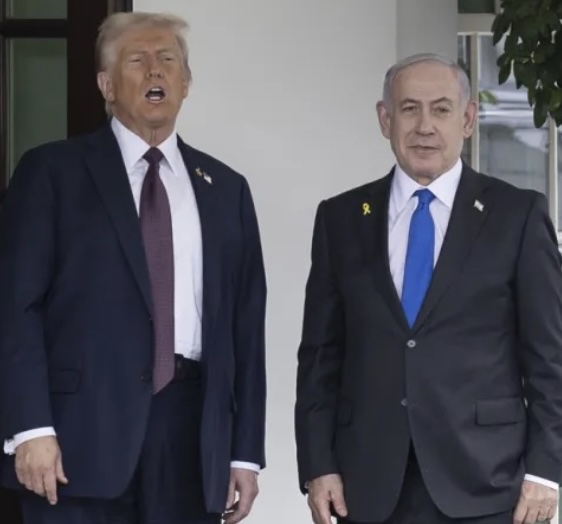
Trump’s 20-point plan for ‘peace’ is a call for Palestinian surrender
Chief among its problems is the plan’s call for Gaza to be governed not by Palestinians but by international actors working in the service of Israel. It also demands that Palestinians disarm while Israel maintains its blockade and military presence, and leaves aid and governance in the hands of outside institutions – a formula that has already proved catastrophic in the case of the infamous Gaza Humanitarian Foundation (GHF).
The absence of a concrete timeline for Israeli withdrawal is especially telling. While Palestinian actors are expected to act “within 72 hours”, Israel is afforded open-ended flexibility and never required to carry out a full military withdrawal.
Israeli media have celebrated this aspect, with the Times of Israel noting that the final withdrawal would merely move troops to a massive “security buffer zone” inside Gaza. Netanyahu said on Tuesday that Israel would remain in “most of Gaza.”
Journalist Rayhan Uddin notes not just what the Trump plan says, but what it doesn’t say, as does Annelle Sheline, a former US State Department official who resigned over the Gaza war:
A corporate occupation: Trump’s plan is no guarantee the Gaza hell will end
Towards the end of the 20-point plan, an interfaith dialogue is suggested that would be held to promote peaceful co-existence “to try and change mindsets and narratives of Palestinians and Israelis”.
Meanwhile, while acknowledging the Palestinians’ will for an independent state, nothing is tying the Israelis to helping establish one.
The appetite for peaceful co-existence and some form of Palestinian statehood among Israelis is low, particularly in its government. Netanyahu has repeatedly promised to scupper any chance of a Palestinian state being set up.
“Given that the conditions set up provide for ongoing occupation and no form of justice or restitution for the abuses and violence that Palestinians have been subjected to for decades, to say nothing of the genocide of the past two years, it is a complete fantasy to imagine that resistance will cease to exist in Gaza,” Annelle Sheline says.
“There has been little to no discussion of the need to ‘de-radicalize’ Israeli society, the majority of which remains in favor of the genocidal policies of mass murder and starvation that their government has inflicted upon Palestinians in Gaza,” she adds.
Dylan Williams, Vice President for Government Affairs at the Center for International Policy (CIP), also sees the pattern of imposing American (and Israeli) will on the Palestinians:
‘Colonial thinking’: The pitfalls of Trump’s 20-point Gaza plan
“It really does seem like the typical American approach over decades to making peace in the Middle East, which is to cook up a plan with Israel and then present it to the Palestinians as a fait accompli… any counterproposals by a Palestinian party are immediately characterized as rejection, obstructionism.”
Middle East Eye reports that Trump and Netanyahu meddled with the text of the plan after securing approval from Arab leaders. Again, what the plan doesn’t say is troubling:
Key Middle Eastern leaders shocked by Israeli rewrite of Gaza plan but still back it
For weeks, drafts of a US-backed Gaza peace plan have circulated in Middle Eastern capitals. The leaders of key regional countries felt confident about its contents even hours before it was released on Tuesday.
And yet, when US President Donald Trump unveiled his 20-point plan, those same leaders were caught off-guard by major differences between the initial drafts and the final version. Trump appeared to have adjusted the plan to align more closely with Israeli Prime Minister Benjamin Netanyahu’s wishes.
One unresolved issue concerns Hamas members who may choose to leave Gaza under Trump’s plan.
Israel has vowed to pursue and kill all Hamas leaders regardless of where they reside. A strike on Doha on 9 September failed to kill the Hamas figures it was targeting, but nonetheless rattled Gulf Arab states, which rallied around Qatar.
Egypt also uncovered Israeli attempts to assassinate Hamas leaders on its soil.
If Trump’s plan is accepted by Hamas, some of its members are expected to relocate to Turkey, Egypt, or possibly Saudi Arabia.
Yet regional sources told MEE that those states have not received assurances that Israel will refrain from staging attacks on Hamas there in the future.
Kathryn Shihadah is an editor and staff writer for If Americans Knew.
RELATED:
- Israel’s Peace Plan: Assassinate The Ceasefire Negotiators – 3 articles on the Doha attack
- Netanyahu thwarted seven Gaza ceasefire deals, Israeli report finds
- Netanyahu Says It’s Antisemitic For Israeli Soldiers To Describe Their Own Atrocities
- “The Deception Game”: Trump Is Scrambling to Make a Gaza Deal on Israel’s Terms
- Trump sanctions on UN Special Rapporteur Francesca Albanese are illegal and represent further U.S. complicity in genocide
- The Iran war is Trump’s unconditional surrender to Israel