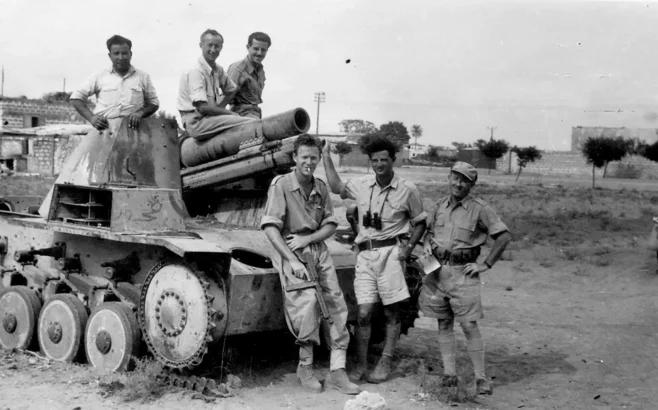
In their first years of statehood, Israelis were well aware of the ethnic cleansing they had perpetrated, They had watched bulldozers destroy ancient villages, and planted trees that covered up the crime…
S. Yizhar was the pen name of Yizhar Smilansky, an intelligence officer in Israel’s Givati Brigade during the 1948 war and a founding father of modern Hebrew literature. Khirbet Khizeh, a novella based on his experience in the war, is a parable about the destruction and erasure of a Palestinian village.
The narrator is an Israeli soldier whose unit invades the eponymous village, drives out its inhabitants, and burns it to the ground. As he watches weeping mothers, bawling children, and pleading old men being marched out of the village and loaded onto trucks, he grapples with the morality of the expulsion—and of Zionism itself. Yizhar was thirty-two years old when he wrote the book, in May 1949, before the final Israeli-Arab armistice was signed. He was then a newly elected member of Israel’s parliament, the Knesset, representing the ruling Mapai party of David Ben-Gurion.
Though he maintained that the story was a work of fiction and refused to identify the actual village that he had called Khirbet Khizeh, he insisted on its accuracy. “Everything I wrote about…is, sadly, reality,” he asserted in a 1978 essay about the book. “Everything…is reported accurately, meticulously documented, from the operation order on a specific date right down to the last details.”
The true Khirbet Khizeh was revealed three decades after the war. In 1978 Yizhar’s commander, Yehuda Be’eri, identified the village—Khirbet al-Khisas, in present-day Ashkelon, just north of the Gaza Strip—and named himself as the man who had given the expulsion order. On November 25, 1948, he directed units to enter Khirbet al-Khisas and eight other villages between northern Gaza and the coastal town of al-Majdal. There they were to search the villages, round up the inhabitants, and expel them all to Gaza, after which the houses were to be “burned and razed.” The orders were carried out five days later. The residents of Khirbet al-Khisas have remained stateless and exiled ever since.
It is no accident that what for many years was regarded as the only Israeli work of fiction to confront the Nakba was written in May 1949, when the graves were still fresh, most of the churches and mosques still standing. In their first years of statehood, Israelis were well aware of the ethnic cleansing they had perpetrated, the swift reduction of a Palestinian majority into a minority. They had seen the columns of haggard refugees. They had looted the furniture and valuables left behind. They had helped new immigrants move into emptied Palestinian homes. They had watched bulldozers destroy ancient villages, and they had planted trees that covered up the crime. Their own army intelligence assessment of June 1948 had determined that most refugees were driven out by “Jewish military action” and not by calls from Arab leaders to flee, as later Israeli propaganda asserted. Denial had not yet taken hold.
And so it was that Khirbet Khizeh could become an acclaimed and best-selling book when it was published in September 1949. The subject of expulsion was not yet taboo, and most of the critics didn’t focus on it. One of the few who did—David Maletz, writing in the Mapai-affiliated newspaper Davar—objected not to the accuracy of the novella’s details, which he called “powerful and cruelly truthful,” but to the sanctimony of those who condemned Israeli actions: “Why single out Khirbet Khizeh?… We all had a hand in the expulsion, all grabbed what we could.” All Israelis, including Yizhar,
Nathan Thrall is an American writer living in Jerusalem. His most recent book, A Day in the Life of Abed Salama, won the 2024 Pulitzer Prize for Nonfiction.
RELATED:
- When Presbyterians Fought Christian Zionism
- ‘Terror Was Needed to Make Arabs Leave’: What the Israeli Army Did in 1948, Revealed
- Are the Jews indigenous to Palestine?
- In Honor of My Friend, Mary Hughes Thompson
- Playful Post on Tel Aviv Park Omits That It Was Built on Ruins of Palestinian Neighborhood