Aid workers are wondering if they are complicit in Israeli policy
In the last week of April 2024, six months into the war between Israel and Hamas, Gavin Kelleher, a security manager for a French humanitarian organization, passed through the crossing from Egypt into Rafah. Kelleher, on the verge of turning 30, had worked in Bangladesh, Somalia, and South Sudan – but this was his first time in Gaza.
For 45 minutes, he was aggressively questioned by Hamas border guards: had he ever been to Israel? Had he ever been in the British Army? Was he working for an intelligence service? Palestinian colleagues vouched for him. Barely had he been let through when he heard his first air strike. “And then closer strikes. The drones were so loud that I thought, ‘I am never going to get used to this.’”
In Rafah, a city at the very south of the Gaza Strip, the first floor of a health clinic was being used as a hub for humanitarian workers. “There would be an air strike that shook the building, and people would continue talking,” Kelleher told me. “Very quickly, I wouldn’t stop a sentence if the building was shaking. If the windows came through, fine, you would react to that. You begin zoning out air strikes altogether.”
Distributing aid to Gazans is exceptionally hard. Aid workers are forced to operate in the middle of a war zone; over 400 have been killed. Over the past 21 months, the UN estimates that more than 90% of the housing in Gaza has been destroyed or damaged. People cannot flee, as they can in other conflicts: a perimeter fence surrounds the entire strip, and Egypt and Israel have closed their borders. Despite the immensity of the challenge, aid workers have striven to provide for Palestinians.
From very early on, the Israeli government explicitly argued that restricting aid was part of its military strategy. In January 2024, Benjamin Netanyahu said, “If we want to achieve our war goals, we give the minimal aid.” Since the start of the war, the Israeli government has sought to discredit aid agencies, even banning some of them. Now Israeli officials lament that the lawlessness in Gaza is responsible for the catastrophic shortage of food. But aid workers say that Israel’s own actions have exacerbated the chaos.
In the face of growing international pressure, the Israeli government has attempted to manage the delivery of aid itself. But its recent attempt to create distribution sites in the centre and south of the enclave has proved bloody, ineffectual, and a public-relations disaster. Hundreds of people have been killed trying to obtain food. (The IDF contends these numbers are exaggerated but says they are “looking into” the issue. It blames Hamas provocateurs and maintains that its soldiers fire warning shots at people who approach their troops.)
In recent days, as reports of starvation and images of emaciated children have proliferated, Israel has also allowed some aid to be driven in and airdropped. But it is woefully inadequate to the needs of the population.
Behind all the changes in aid policy, a larger plan is taking shape. The Israeli government has floated plans to corral hundreds of thousands of Palestinians in a “humanitarian city” in the south of Gaza, ostensibly to facilitate aid distribution. Ehud Olmert, Israel’s former prime minister, described the proposal as “ethnic cleansing” and the proposed city as a “concentration camp”.
Aid workers now face an ethical dilemma. Should they continue to try to get food and supplies to desperate Gazans, despite restrictions that many feel have made them complicit with Israel’s tactics? Or should they stop operating altogether?
Much of Gaza’s population has relied on aid for decades. Though dozens of NGOs operate in the territory, the primary distributor of aid has been UNRWA, a UN agency that has supported Palestinian refugees since the establishment of the state of Israel in 1948. Before the war, it provided food parcels for over 60% of Gazans classified as refugees.
Gaza has been under Israeli blockade since Hamas, an internationally designated terrorist organization, won elections in 2006 (there has been no subsequent vote). Israel controls the supply of fuel, electricity and most of the water into the enclave as well as the movement of people and goods. Before the war, between 600 and 700 lorries entered Gaza every day. After the October 7th attacks, Israel sealed the border crossing and all supplies were stopped. When lorry crossings resumed, the numbers fell far short of pre-war tallies.


UNRWA had a well-established network inside Gaza and contingency plans in case of an Israeli invasion; it figured it could shelter 150,000 displaced people. These plans were blown away by the intensity of the Israeli assault. Within a week, the Israelis issued a mass evacuation order for the whole of northern Gaza – including Gaza City, home to over a million people. For the first time, UNRWA personnel had to flee too. “We had to make decisions blind,” said Sam Rose, a no-nonsense Brit who served as one of UNRWA’s deputies in Gaza and is now the director.
The main crossing for goods coming from Israel, at Kerem Shalom in southern Gaza, was damaged in the October 7th attacks by Hamas and remained closed for several weeks. UN agencies and NGOs pivoted to the Rafah crossing on the border with Egypt. But this presented logistical difficulties: Northern Sinai is a closed military zone with multiple checkpoints, and Egyptian smugglers had been running rackets for years.
In early May 2024, soon after Kelleher arrived in Gaza, the IDF began an offensive in Rafah. The crossing was closed and has only reopened in the last few days. Following the example of other NGOs, Kelleher moved ACT’s operations to Deir al-Balah, a city in central Gaza within an area the Israelis had designated a “humanitarian zone”.
Kelleher chose a house to live in that was close to the coastal road but behind the dunes, out of the line of sight of the patrolling Israeli gunboats that sometimes fired at fishermen and people on the beach. (The IDF says that Hamas fighters made use of fishing boats on October 7th, so restrictions were placed on the “maritime area” and Gazans were warned about them.)
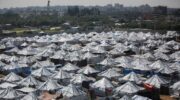
It had been quiet there until the mass exodus from Rafah: “We saw a million people settle around us, thousands of thousands of families in every direction,” said Kelleher. Encampments of makeshift shelters made from tarpaulins and sticks encroached on the road, which had become the major thoroughfare from north to south. The traffic of donkey carts, motorbikes jerry-rigged to run on cooking oil, and cars missing doors with people piled into the boot, slowed to a crawl. Through the spring, Israeli forces cleared a buffer zone on either side of the Netzarim corridor that bisects Gaza.
The house was a beautiful stone cottage with a garden that had a vegetable patch. Kelleher bartered electricity from a neighbor who had a generator for water from his ground well. International aid workers brought their own food with them – meal-replacement powder, jars of pesto, packet noodles – and supplemented it with whatever they could find in the markets. In the summer, the dates ripened on the palms, and Kelleher remembered a harvest of delicious peaches.
Aid was now coming in from Kerem Shalom, where the Israelis had scanning equipment to check cargo. There were, nevertheless, lengthy hold-ups. Regular Israeli protests near the crossing tried to block aid convoys from entering the enclave. Lorries waited on the Israeli side for days; goods were rejected and sent back; pallets could sit in the loading area on the Gaza side of the fence for more days, waiting to be taken away.
Canned food spoiled under the sun and arrived unfit for consumption. The Norwegian Refugee Council (NRC), which Kelleher had begun to work for in September 2024, reported that hundreds of thousands of dollars could be spent on aid and transport, without a single meal being provided.
Even before October 7th, Israel had imposed “dual-use” prohibitions on goods that it deemed could be used for military purposes. These were now tightened, though the items that were refused entry seemed arbitrary. One aid official told me that lorries of educational supplies, such as books, school bags and felt-tip pens, were rejected four times.
In other cases, sleeping bags were sent back because they were green; hygiene kits containing sanitary pads were refused because nail clippers were included. Often no reason was given for these rejections.
One aid worker told me there was a “no gifts” policy; when her suitcase was searched, she had to send back a necklace she had brought with her for a Palestinian colleague. International aid workers were frequently denied visas to enter Israel, and therefore couldn’t get into Gaza. This happened even with people who had entered the territory a number of times.
Jonathan Whittall, a senior UN official who helped coordinate the humanitarian response of agencies and NGOs operating in Gaza, told me they had asked many times for rules to be made clear in writing, to no avail. “We’ve been gaslit at every point along the way,” he said.


A senior Israeli security official said that Hamas took a cut of the goods coming into Gaza, using the money to pay salaries and continue their war effort. Throughout the war Israel has accused Hamas of diverting aid for its own gain, but has provided little proof that it has been systematic. According to a report published by the International Crisis Group this May, “David Satterfield, the Biden administration’s humanitarian envoy, reported that Israeli officials did not even allege theft in confidential briefings.”
Distributing aid within Gaza was becoming harder than getting it across the border in the first place. Because much of Gaza was an active battle zone, there was a notification process to allow aid convoys to move safely. This was managed through COGAT (Coordination of Government Activities in the Territories), the division of the defence ministry responsible for civilian affairs in the occupied territories.
Within the humanitarian zone, NGOs had to notify COGAT of the GPS coordinates of their destination. After a few hours, or overnight, the cogat would reply “acknowledged” to indicate they could go ahead, or “not recommended”, if there was, say, a strike nearby. But, said Kelleher, “there were also a lot of no responses. So there were mornings when the WhatsApp groups were full of everyone posting at 8 am saying: no responses, no responses. What are you doing? Shall we move, not move? It paralysed us quite frequently.”
Moving outside of the humanitarian zone was much harder and required permission from the IDF. The aid organizations had to submit an agreed route and time, photographs of their vehicles, licence plates, and the names and ids of passengers. Vehicles would be stopped regularly. The green light to continue could come after 15 minutes or four hours, or not at all.
Whittall told me procedures were constantly changing: sometimes all staff were asked to get out of the vehicles; sometimes only Palestinians; sometimes a drone would hover overhead, inspecting; at other times, they had to open the doors while soldiers walked up and down the convoy.
There was one incident when UNRWA reported that one of their convoys heading to the north of Gaza was physically buffeted by Israeli military vehicles. un staff were questioned before being released. (The idf says they had intelligence that Hamas operatives were hiding in the convoy.) ngo vehicles frequently came under fire. Perhaps the most notorious example came in April 2024, when a convoy of three vehicles from World Central Kitchen, an NGO that provides meals, was attacked by Israeli drones. Seven aid workers were killed. The number of lorryloads entering Gaza went up and down – some days around 40, others over 100. But it was never enough.
Smugglers took advantage of the turmoil to hide non-essential items in the lorries that were still able to enter. Sam Rose of UNRWA remembered a glut of chocolate croissants, and through the summer of 2024, the strange sight of avocados and pineapples that no one could afford. Most of all, there were contraband cigarettes, not permitted by the Israelis (the price of a single cigarette in Gaza could at times reach $30).
According to the senior Israeli security official I spoke to, smuggling was a Hamas profiteering scheme. To humanitarian workers on the ground, looting by armed gangs – a predictable outcome of scarcity – was the main problem. Rose, who was in and out of Gaza until March of this year, told me that in the early months of 2024, the Kerem Shalom crossing was “just chaos.
There were forklifts zooming about all over the place, and some Bedouin families would ransack the place every now and then. Our colleagues would come back with black eyes and concussions because they would get into fist fights.” On one occasion, he was waiting in an armored car to leave Gaza while watching men climbing on lorries “and throwing bags of flour onto the ground looking for cigarettes, which were worth tens of thousands of dollars”.


The police, run by Hamas, were targeted by Israelis and are no longer operating. Local mukhtars, or mayors, had only limited authority over thousands of displaced people. Gangs proliferated, and clan rivalry, once suppressed by Hamas, flared up amid the scrabble over scarce resources. Lorry drivers were beaten, sometimes tied up and detained for hours. Kelleher told me he often heard gunfire at night in areas where he knew the IDF was not operating.
Much of the looting was going on in sight of IDF forces. Whittall of the United Nations Office for the Coordination of Humanitarian Affairs (OCHA), which responds to crises, said he had often seen looters block roads with debris to hold up lorries. They were “visibly armed, and there was an Israeli tank maybe 50 metres or 100 metres away”.
Aid officials begged the IDF to let them move cargo in enclosed lorries, rather than open flat-beds, but their requests were refused. The usual reason given was “security”. Some Gazans took out their frustration on aid organizations, erecting roadblocks and stoning vehicles.
As winter approached, conditions became even harsher. In November and December 2024, the Israelis were issuing evacuation orders for parts of the humanitarian zone. There was a severe lack of tents, blankets, fuel and cooking oil. At morning briefings, Kelleher would receive updates about the children dying of exposure.
Kelleher remembered a terrible day of heavy rain that washed sewage and mud through makeshift tents. He went to visit a displacement site of perhaps a hundred families. “It was blisteringly cold, and kids were huddled under tarpaulin. Talking, you couldn’t hear for the wind. There was rubbish and open defecation all around. They were so kind and even made coffee for us.” He and his team stayed 25 minutes. He was ashamed to be relieved to get back into the car.
Looting eventually got so bad that hardly anything was getting through to warehouses. Because of this, the UN suspended picking up aid from Kerem Shalom altogether in December. Supplies entering the territory fell precipitously.
The relationship between the Israeli authorities and the aid organizations deteriorated. Humanitarian workers grew to believe that the complicated and ever-changing constraints were setting them up to fail. Some NGOs became increasingly vocal, blaming the Israelis for limiting aid entering Gaza and hampering its distribution once inside. Others, worried about staff being banned, avoided public comment.
The Israelis said the problem lay with the aid organizations’ lack of capacity. But, as Whittall of OCHA pointed out, the moment there was a ceasefire in January, aid convoys were able to move with relative freedom, and several hundred lorries a day drove into Gaza. “We were able to demonstrate what we could do.”
Peter Lerner, a former COGAT spokesman, who returned to uniform as a reservist for several months in the wake of the October 7th attacks, told me there had been a regrettable miscommunication between the Israeli authorities and aid organizations from the start. He thinks the Israeli side should have explained at the beginning of the war that this was going to be an operation of a completely different magnitude from those that had gone before.
In previous conflicts, there had been joint operations rooms set up with COGAT and humanitarian organizations. That hadn’t happened this time, although there were ad hoc meetings. Lerner contended that the UN agencies and NGOs should not have wasted their energies protesting about IDF policies such as the mass displacement of people and the evacuation of certain hospitals, and instead spent the time preparing to deliver aid within the constraints of the situation.


Over the months, mistrust turned to acrimony. The Israeli government felt particular antagonism towards UNRWA, which they had always believed was too amenable to Hamas. Yaakov Amidror, a former national security adviser to Netanyahu, told me that UNRWA “built a kind of symbiotic life with Hamas”.
In October, the Knesset, Israel’s parliament, passed laws that banned official Israeli contact with UNRWA, much diminishing its ability to operate in Gaza and the West Bank. The last of its international staff in Gaza, Rose among them, left in early April. America, which provided half of the agency’s $800m annual budget, had pulled its funding under the Biden administration. (UNRWA continues to employ 15,000 people in Gaza and deliver services as best it can.)
NGOs are required by September 8th this year to complete a new, onerous registration process with the Israeli authorities in order to continue their work in Gaza and the West Bank. Many believe the information requested is intrusive, including biographical details about the staff, such as the names of their children. An NRC official told me he worried that they would not be permitted to hand over the necessary documents under Norwegian data-protection laws.
UNRWA believes it was targeted, in part, for publicly deploring civilian casualties in Gaza. Some humanitarian organizations felt it was better to keep quiet and deliver what they could in the circumstances. Those circumstances got ever more trying. In November and December of 2024, when almost no aid lorries were getting through the gangs of looters, Kelleher remembers “days when the overwhelming helplessness seeped through in every single update”. People asked themselves, “What else can I do? And the reality was there was nothing else any of us individually could do.”
When he met other ngo international staff in Gaza on Fridays for coffee, they discussed these issues: “Should we stop pretending that we are able to operate in this context? Or should we put our hands up to the world and say, ‘We are not being allowed to operate’?”
When the warehouses became empty this April, such conversations resumed. “What was the value of having international staff still stay inside Gaza?” asked Kelleher, when the risk to life was so high and the food supply so restricted. Several international staff members I talked to said they felt a moral imperative not to abandon their local employees and Palestinians in need, even if all they could do was bear witness. As Kelleher put it, “It was important to be able to say, ‘We are on the ground, we can see things up close and we can advocate.’”
After months of negotiation, a ceasefire came into effect on January 19th 2025. Hundreds of thousands of people sheltering in the humanitarian zone walked back to their homes in Gaza City and the north, many of which had been destroyed. Every day, hundreds of lorries crammed with humanitarian aid and commercial goods flowed into the enclave. When there was a political will from Israel to let the goods in, there were few logistical problems, un officials told me while rolling their eyes.
Within days, food shops had reopened, selling chicken, meat, fish and vegetables at reasonable prices. “Things were affordable for a time,” said Rose, adding that restaurants also reopened. “You could get pizza.”
Kelleher said commercial goods were coming in, too. “I remember seeing a horse cart fully loaded with boxes of Twixes and Mars bars, and Pringles. You couldn’t help smiling. And the kids are so excited they had chocolate for the first time in a year and a half.” UN agencies and NGOs ramped up their number of international staff. Warehouses filled up again.


Kelleher told me he was always sceptical that the ceasefire would hold, but his Palestinian colleagues were “highly reluctant to believe that anything bad was going to happen”. On March 2nd, Israel closed the crossings and cut off all supplies. War resumed on March 18th.
Kelleher was in Gaza City. “It was two in the morning, and the whole building started vibrating with these massive bombs.” According to the Hamas-run Ministry of Health, hundreds of people were killed that first night. “It was horrendous. Palestinian colleagues were blank-eyed. They sat in the corridor making cups of tea, calling staff and relatives, trying to check if people were still alive.”
As war returned, the notification process, which coordinated the movement of humanitarian vehicles, was not restarted outside IDF buffer zones. Messages were sent to COGAT, but there was no response. Kelleher and many other NGOs could move with even less ease than they had been able to before the ceasefire. “We were paralysed.”
The bombardments were heavier than ever. In the area around Kelleher’s house in Deir al-Balah, there were multiple air strikes each day, “many more than pre-ceasefire levels”. At night, the walls shook with the impacts of huge explosions. The Israelis frequently imposed evacuation orders at short notice.
Offices and buildings used by aid workers had been damaged in strikes before, but the threat now seemed omnipresent. In April, Kelleher received a phone call telling him that one of the NRC offices was in danger from a strike. A “nice, chatty” woman IDF officer told him they had 15 minutes to evacuate the building.
An hour later, a missile landed 20 metres away. The office windows were smashed, and their cars were hit with flying debris. Two weeks later, he got another call to evacuate another NRC site. “You are constantly on edge,” he told me. “Even now, I sleep badly because I think I have to keep checking my phone.”
As the total blockade continued, stocks of food dwindled. The situation was worse than it had ever been. In June, I talked to Gazans who told me they were grinding pasta and lentils to make bread, and people were eating one meagre meal a day.
The few canned goods in the markets were priced beyond the reach of most. The Gazans I spoke with in June said that flour cost $28 a kilo, an all-time high; tomatoes, wan and underripe, $20 a kilo. Kelleher told me that by May, “mainly I was living on instant noodles and tins of peas and beans, pasta.” Rats had got into his meal-replacement drink. “I was sleeping really badly, eating really badly. I had a lot of headaches. My patience was thin.”
The NRC had given out almost all the tents they had got through during the ceasefire and were reduced to distributing e-vouchers – credit on phones – for a few hundred families to buy clothes with. UNICEF helped 10,000 families with malnourished children to buy food in the markets when they couldn’t gain access to one of their main warehouses.
One UNICEF worker I talked to in June described seeing children covered with scabies. “Even babies have rashes.” There were signs of malnutrition everywhere: children with lighter than normal hair, loose folds of skin around their limbs and faces that seemed creased with age.
A new plan to distribute aid in Gaza was announced. It involved a small number of sites in the south of Gaza operated by a previously unknown entity called the Gaza Humanitarian Fund (ghf), with security provided by American mercenaries.
The scheme seemed designed to further sideline humanitarian organizations. Why start up something new, they argued, when there was already an existing network for getting aid in? NGOs, suspicious of its origins and purpose, refused to work with it. One international aid co-ordinator told me that the GHF had called around asking for organizations to serve as partners. “They were desperate to legitimize the attempt but were unable to do so.” According to the co-ordinator, “We all said no.”


One aid worker departing the strip observed the preparations of one of the GHF distribution sites: a flat square area surrounded by huge sand berms, around six metres high, that created narrow alleys. These were lined with chain-link fencing topped with lights and what seemed like surveillance cameras. “It made my blood go cold,” the aid worker told me.
At the crossing point, the aid worker saw an injured child, missing a leg and with shrapnel wounds to his head, waiting to be evacuated. They offered him a chocolate bar, but an IDF soldier shouted, “It’s not allowed!”
On May 19th, after 80 days of total blockade, Israel, without warning or explanation, began to let in a tiny number of aid lorries. Only some items were permitted – flour, rice, tomato paste, medicine, nutritional pouches for children and baby formula – and they could only be unloaded at community kitchens and bakeries and a few select warehouses.
A handful of lorries were available to collect pallets from the Gaza side of the fence. But delivery was almost impossible. Many roads were blocked by toppled buildings. Debris ripped the lorry tyres. Whittall of OCHA showed me a photograph on his phone of a huge heap of sand – the lip of a bomb crater – in the middle of the road.
The lorry, which was carrying supplies to a hospital, had to turn back. How is it going? I asked him in early June. “Terribly,” he replied. Almost all the lorries were being set upon by desperate people. “Self-distributed” was the euphemism I heard from different aid workers.
On May 26th, GHF started handing out boxes of food – 20kg each of basic staples, supposed to be enough to feed a family of five for around five days – from three sites in the south of Gaza and one in the centre of the strip. In the weeks since, there have been shootings of civilians by the IDF almost every day around sites. Hundreds have been killed and wounded. The IDF says it has been improving signage “to minimize potential friction”.
An Israeli security official I talked to said the new system was necessary, “because we must dismantle Hamas, not just military-wise, but economically and in terms of governance”. He said, “There is no IDF between the population and the distribution sites, none, zero.”
I said that people heading to the sites seemed to be getting close enough to Israeli soldiers that the soldiers felt the need to defend themselves. “That’s exactly what I told you,” the official replied. “There are people who are not following instructions,” He said that Hamas was doing everything they could to sabotage the GHF sites. By mid-June, there were reports of shoot-outs near the distribution hubs between Hamas and gangs that Israel admitted to arming.
In the middle of all this chaos, it emerged, as had been suspected, that the GHF was a joint Israeli-American initiative, formed at the behest of Netanyahu’s office. Netanyahu has talked of concentrating Gazans in “sterile” areas in the south and encouraging “voluntary migration”. International diplomats and aid officials condemned the Ghetto Project as an attempt to cordon off the Gazan population.
Amidror, the former national security adviser to Netanyahu, shrugged off international opprobrium. “If we paid attention to the international publicity, we wouldn’t have a state.” Lerner, the former COGAT officer, was more equivocal. “The strategic decision to stop aid going into Gaza for so long was a poor decision, from the government’s perspective. The political and diplomatic fallout from it is devastating and will be for years to come.”
With UNRWA banned from bringing in supplies, warehouses empty and only a handful of international staff remaining, the humanitarian co-ordinator told me: “We are hitting a wall, it could be the end of principled humanitarian assistance in Gaza.” By July, the UN said that aid workers were fainting from hunger. The Hamas-run health ministry has reported dozens of deaths that it attributed to malnutrition. Many aid workers I talked to believe that aid delivery has now explicitly become what they had suspected it had been all along: “It’s starving people as a military tool.”
Kelleher left Gaza at the end of April. He was burnt out. He’d known he needed a break but hadn’t wanted to go. When we met at the end of May in London, he was still processing all that he had seen. He felt the inadequacy of the humanitarian response keenly. Too often, he told me, they had gone to a displacement site to evaluate basic needs, ticking off a checklist of shelter, water, food, cooking facilities, hygiene, and sewage. In focusing on the bigger picture, he was unable to help individuals who told him their terrible stories of loss and pain.
One of these was seared on his memory: a 70-year-old woman who had arrived at a displacement site in Gaza City, with a baby and an old man with an injured arm. Twelve of their relatives had been killed in a strike that morning, and the three of them had escaped on a donkey cart. “They had arrived with nothing, just the clothes on her back. She asked for milk for the baby. And we couldn’t do anything for her.”
Wendell Steavenson won the Orwell Prize for Journalism in 2024 for her reporting for 1843 from Ukraine and Israel.
RELATED:
- How Israel is engineering Gaza’s social collapse
- 100+ NGOs’ joint statement: Israel must end weaponization of aid to Gaza
- ‘Millions of dollars’ of Gaza aid stranded in warehouses as Israel rejects NGO requests for entry
- Israel has always used food as a weapon against Palestinians
- I saw many atrocities as a senior UN aid official in Gaza. Now Israeli authorities are trying to silence us.