Government-sponsored violence by Israeli settlers, ‘apartheid roads’ and Palestinians being displaced from their homes. Peace Now provides a somber day trip in the occupied West Bank
Two children were dragging a wooden chair and two large bundles on a tin mat. One of the kids waved hello to us. A white pickup truck whizzed by, raising a cloud of smoke.
The children covered their faces for a moment and went on lugging the tin mat to a truck, onto which an adult loaded the bundles and chair. The children dragged the mat back, glancing at the three photographers following them.
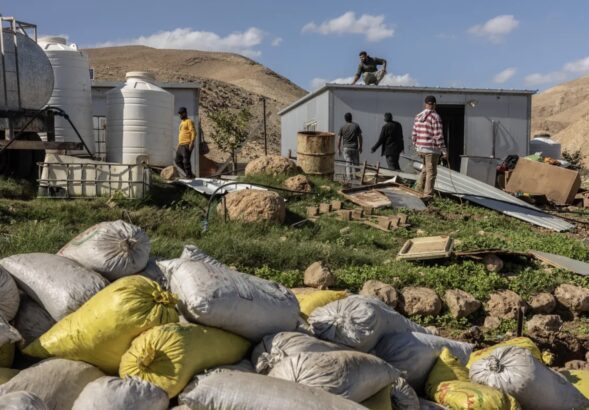
We got to Ras Ein al-Auja north of Jericho in the West Bank on a day when several families were leaving. The scene was awful. People were packing their few belongings and heading elsewhere. A few men strained to load a large, heavy oven. Two men were taking down white walls, apparently to be used to build a house who knows where.

Displacement is always painful, but the air here was thick with despair. Nobody could say with any certainty where they were going. Probably to Area A of the West Bank, a few people said. There isn’t much land or water there – it’s mostly cities – but there’s also no daily harassment by settlers.
The Nakba pictures were in black and white. This month they came in color. We saw no military presence there, no soldiers or police. Somebody pointed to a far-off pickup truck and said that this was the security chief of the Mevo’ot Yeriho settlement about a kilometer to the south. The houses of the settlement of Havat Omer were visible a few hundred meters to the southeast.

Not a great day out
I glanced at my watch. It was 12:10 P.M., Monday January 12. Three hours before, I boarded a comfortable bus outside Tel Aviv’s main train station. This was a tour by Peace Now for Haaretz employees. There were 12 of us and it felt strange because we were going on a day trip that wasn’t a day trip.
Israel looks great this winter; everything is green and fresh after the heavy rains. The air that Monday was clean and the visibility was excellent. A tour of the West Bank isn’t a fun day, but as we left the city, I was happy in a way.
In Haaretz every day, Matan Golan, Amira Haas, Yaniv Kubovich and Gideon Levy write about the Palestinians’ painful life in the West Bank. For years these reporters have devotedly described the hardships of life under occupation and alongside settlements. The tour that Monday was offered to amateurs like myself who want to know what has been going on not far from their homes.

Hurtling east down Route 5, we crossed the Green Line without realizing it. The separation barrier is a little further to the east in these parts. We saw the houses of the Palestinian town of al-Zawiya, then the settlement of Ariel’s large industrial zone and the city’s buildings.
Exactly 50 minutes after setting off, we arrived at Tapuah Junction on a hill in the middle of the West Bank. I used to think that this was the end of the earth because there were hardly any settlements past here. That Monday, Tapuah Junction seemed near my Israeli home, surrounded by Israeli flags and real-estate billboards.
“Houses at Ma’aleh Dani,” read one large billboard. Stars of David and a map of greater Israel were painted in black on a cement wall. Huge menorahs and Stars of David made out of pipes were planted on the roadside. Every bus stop featured two armed soldiers wearing protective vests and helmets.
Dozens of settlements, mainly farms and illegal outposts, sprouted up around the settlement of Kfar Tapuah. According to the data, there are currently 147 settlements in the West Bank, as well as 191 unauthorized outposts, including some 100 farms. All told, around 478,000 settlers live in these communities, compared with the 2.8 million or so Palestinians in the West Bank, excluding East Jerusalem.

The one good thing I can say about the communities around Kfar Tapuah is that they’ve been given beautiful names. There is Palgei Mayim (Water Brooks), Nof Harim (Mountain View), Givat Haktoret (Incense Hill), Shomrei Ha’emek (Guardians of the Valley) and Havat Malachei Hashalom (Angels of Peace Farm). Who wouldn’t want to live in a placed called Angels of Peace?
At one point, we stopped between Havat Malachei Hashalom and the new Havat Metzudat David, at the Palestinian village of al-Mughayyir. The tour’s organizers seemed a little worried. They asked us to hurry, because if we stood there for more than a few moments, near the access road to Havat Metzudat David, “settlers will come down to us and there’s going to be trouble.”
The road next to where we were standing led to al-Mughayyir, but the road was blocked by an iron gate. The eastern approach to the village has been blocked to force the residents to exit on the western side, greatly lengthening their way and forcing them to pass slowly through several other villages.
This also reduces the number of vehicles on the main road east of the village, making it possible for residents of Shiloh’s Shvut Rachel neighborhood or the Esh Kodesh outpost to drive safely to visit their neighbors to the south, some of whom live at Kochav Hashahar (Morning Star) and Ahavat Hayim (Love of Life).

Those are the names, I swear. Eliezer Ben Yehuda and George Orwell are drinking arak together in heaven. Anyway, we didn’t see a single white Palestinian license plate, just yellow-gold Israeli ones. And nobody came down to us from the farm. We took a few pictures, got on the bus and went on our way.
We drove by Ein Samiya, the largest spring between the northern West Bank and the Jordan Valley, considered to be Ramallah’s most important water source.
South of the spring stands the Bedouin village of Ein Samiya that has suffered a raft of attacks by right-wingers. In May 2023, 37 families left the village after repeated attacks by settlers from Kochav Hashahar and the Baladim outpost.
We drove on south to the village of Taybeh, about midway between Jericho and Ramallah. Taybeh has 1,300 people, all of them Christians. This is where the Christian-run Taybeh Brewing Company operates, next to a large vineyard.

A few years ago, I spent a pleasant weekend there, staying at the local hotel, but the place is closed now. Its owner, Nadim Khoury, explained on the tour that there are no more tourists. Instead, settlers have been vandalizing vineyards and making movement on the roads difficult.
He feels that there’s nobody to complain and nothing to be done. Some of his children have relocated to the United States. Others are still here, insisting on producing their delicious beer.
At one point during our talk, Khoury pointed to the window and said: “You see this herd grazing on the hill across from here? This is totally new and that’s the whole story. They were in the valley and had to flee because [the settlers] were harming their sheep, so now they come to graze here.”
It was pleasant enough in Taybeh, but we took the winding road east to Ras Ein al-Auja. This is the end of Wadi Auja, which is around 24 kilometers (15 miles) long beginning at Ein Samiya.

This is where we met the children dragging the tin mat. As Haaretz’s Matan Golan wrote on January 13, over 100 residents were forced to leave Ras Ein al-Auja after an outpost was set up next to their homes.
She wrote: “Since the outbreak of the war, settlers have prevented them from going out to pasture, forcing them to buy fodder for the sheep with their own money. Apart from fearing their neighbors living in the nearby outpost, Ras Ein al-Auja residents say they cannot continue living like this financially.
“‘We have no future,’ said one local. … ‘After cutting us off and preventing us from making a living, there is no choice.'”
We spent about an hour there and didn’t speak to Palestinians. They were busy loading trucks that would take them elsewhere. The atmosphere was harsh. The only person who came over to speak to us was Amir Pansky of the group Looking the Occupation in the Eye.
He and his comrades were staging “protective presence” vigils around the clock, trying to protect the local Palestinians from harassment by settlers, police and soldiers. Pansky looked very tired and his face was sunburned, but the task kept him energized.
“The situation now is that there are hundreds of minors, settlers, in the area acting like an army,” Pansky said. “They have herds and everything is planned and organized. There are no improvisations here. There’s an ongoing, daily violent takeover – documented attacks that nobody investigates.

“Everybody who’s active here came down from the Kochav Hashahar area, where the takeover has been completed as far they’re concerned. The Jordan Valley Regional Council has been welcoming them.
“What has been going on here is, to me, just like the Germans’ actions in Poland between 1939 and 1943. The IDF can expel the residents – poor, weak shepherds – in one week, but the state has been doing it by proxy through an army of minors and criminals, some of them sheep thieves. There are no police.
“This is the best documented ethnic cleansing in history. We’re recording everything in real time. The sense right now is that in Area C, settlers are allowed to do anything, and we’re acting out of a deep realization that people here can’t help themselves and have to be helped.
“The difference between what has been happening here and Gaza is that there are no drones here. Offenses are personal. People here commit crimes against people they know, and they look them in the eye.”
Haaretz’s Yaniv Kubovich wrote that morning that since October 7 there has been a sharp increase in the number of crimes by Jews against Palestinians in the West Bank – 1,720 incidents. Last year there were 845 such incidents by settlers, with four people killed and 200 wounded.
The army says these are no longer attacks by individuals but by large, organized groups that enjoy political support.

Animal farm
Hagit Ofran and Yoni Mizrachi, Peace Now’s settlement watch team, were the guides for our tour. In a few hours they tried to pass on the wealth of knowledge they collected over the years. It was obvious that they’re deeply concerned about what they’ve been seeing in the West Bank every day.
Mizrachi is an archaeologist who founded the group Emek Shaveh, which strives to defend cultural heritage rights. Ofran has been keeping an eye on settlements for Peace Now for nearly 20 years and is considered an expert on the subject. I read on Wikipedia that she’s the granddaughter of the philosopher Yeshayahu Leibowitz.
According to Ofran and Mizrachi, in the last three years we’ve been seeing “an annexation on steroids,” which includes the expulsion of the local people, the building of hundreds of kilometers of roads and mammoth funding for settlements.


“It’s important to look reality in the eye,” Ofran said. “It’s important to come up with credible reports about what we’ve been seeing on the ground. It’s important to follow up and get into the public debate what has been happening in the territories.”
Ofran and Mizrachi say that in recent months they’ve had a hard time coping with the pace of change in the West Bank. Every week an outpost is set up, or two. The big story is the 100 farms that have been established. The number of settlers in the West Bank isn’t on the rise, but the number of points on the map is.
How is this happening? One or two families establish a farm. They take over huge swaths of land, sometimes thousand of dunams, using them to graze sheep. In just a few hours we saw dozens of these farms; they hardly have any structures, certainly not houses.
Still, they’re reshaping reality in the West Bank. Each is accessible by a dirt road that will soon be paved; one family per road.

According to Ofran and Mizrachi, the Palestinians have no recourse. The government has approved the construction of 40,000 housing units in the West Bank in the last three years, whether expansions of existing settlements or in new settlements.
Then there’s the building of roads. The common assumption is that if there are good roads that don’t go through Palestinian communities, it will be easier to attract new residents to the settlements.
Huge budgets make this possible. The new road system also often makes it possible to separate Palestinian traffic from Israeli traffic. “Apartheid road” is no longer something pejorative or unimaginable for Israelis. We saw such roads ourselves, with everything justified by security considerations.
The maps of the West Bank we received at the beginning of the tour said: “Settlements are bringing Israel closer to the reality of a binational state in which Israelis have rights and Palestinians do not. Settlements are harmful to Israel’s security and international standing. It is time for two states for two peoples.”
By the end of one brief tour of the West Bank, I admit that I have a hard time figuring out if the two-state vision is achievable. Sometime during our ride, I asked Ofran if the process we were witnessing was reversible.
She answered without hesitating: “Of course. These are the resolutions of the current government. You can adopt other resolutions, and reality will change.” I hope she’s right.
Moshe Gilad is an Israeli writer and journalist with Haaretz.
RELATED:
- As genocide continues in Gaza, the West Bank is pushed into a new Nakba
- Israeli settlers beat elderly, deaf Palestinian man in West Bank attack, video shows
- Israel is quietly erasing Palestinian refugee camps from existence in the West Bank
- In occupied West Bank, Israel is seizing Palestinian homes and transforming them into military outposts
- Ha’aretz: Free the Palestinian Activist Who Dared to Document Israel’s Crimes in the West Bank