14-year-old Nazih Masalma's eye was torn out, and he is deeply traumatized by the incident
14-year-old Nazih Masalma’s eye was torn out, and he is deeply traumatized by the incident
by Gideon Levy and Alex Levac, reposted from Haaretz via Archive, November 15, 2025
A boy gets up early in the morning, washes his face, brushes his teeth, eats a light breakfast, grabs his backpack and a cookie, and heads outside to the school bus with his older sister. It’s still early – 6:40 A.M. Three minutes later, a convoy of three Israeli army jeeps and a police car suddenly pulls up outside, from the direction of the nearby village, probably after some nighttime activity. The street, everyone insists later, was quiet and deserted.
The door of the last jeep opens, the driver aims his rifle at the boy who’s holding the cookie. From a range of less than five meters he fires a tear-gas canister straight into the child’s face. A cloud of gas spreads, it’s hard to see anything.
As the cloud dissipates the picture gradually comes into focus. The boy is lying on the ground, blood streaming from one eye, dangling from its socket, and from his nose. He has lost consciousness and his sister has also fainted and collapsed to the ground, probably as a result of shock combined with tear gas.
The Israel Defense Forces soldier quickly closes the door of the jeep and the convoy speeds off.
That was how the morning of the Masalma family began on Monday, October 27. The parents, Iyad, 45, and Rula, 34, were both home when their two children left for school. They live in squalid conditions in the remote West Bank village of Beit Awwa, south of Hebron, whose inhabitants subsist mainly from collecting and selling scrap metal, bottles and other junk.
The walls of the Masalma home are not plastered inside or outside; to reach it one must navigate a dark area whose construction hasn’t been completed and perhaps will never be. Iyad barely ekes out a living the way most of the townspeople do; Rula was forced to marry him when she was 13. The couple has five children; 14-year-old Nazih, in 10th grade, is the middle child.
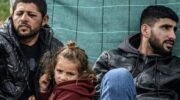
Nazih Masalma with his mother and sister. After the canister was fired, a cloud of tear gas spread around them and they couldn’t see much. Credit: Alex Levac
When we visit this week we see Nazih lying on the sofa in the living room, his face swollen and with a transparent plastic patch over his closed right eye, the one that was torn out and will, obviously, never see again. His face is contorted in pain as light and unknown guests enter the room. Since being wounded he is trying to avoid contact with people and prefers darkness. He returned home last Thursday after two weeks in hospital, half of it in intensive care, and after undergoing three operations on his face and eye.
What prompted IDF troops to stop at an early morning hour next to the brother and sister who, the two maintain, were standing innocently next to their home and waiting for transportation to school? What prompted the driver of one of the jeeps to fire a tear-gas canister into the face of a boy who was standing so close to him? Does the soldier even know what happened?
Manal al-Ja’bri, a field researcher for B’Tselem – The Israeli Information Center for Human Rights in the Occupied Territories, related that neighbors have footage from the security cameras of their house that shows what happened at the Maslamas’. However, they are refusing to hand it over to the IDF, for fear that soldiers will take revenge on them.
The IDF Spokesperson’s Unit this week stated, in response to a query from Haaretz: “The allegation has been examined in depth, as of the time of this response, is not known to us.”
This puzzling response marks a new development: It’s quite possible that the soldiers involved didn’t even bother to report the incident to their commanders. They blinded a boy in one eye and didn’t think they were obligated to explain their shocking conduct. Like, what’s the big deal?
The route from Tel Aviv to Beit Awwa took three hours this week, more than twice the usual time, because of the permanent blockages of roads in the West Bank. We were met by Rula and her daughter Reina, 17, the one who was standing next to her brother that morning; they do most of the talking. Iyad is withdrawn. Nazih groans as he lies on the sofa.
Nazih Masalma. He barely leaves home now. Credit: Alex Levac
The military convoy arrived from the neighboring village of Deir Samet, Rula says. The vehicles slowed down but did not come to a complete stop when the door of one jeep opened and the projectile was fired. After the incident Reina told her mother that when the driver aimed his weapon, the soldier sitting next to him grabbed the steering wheel. They didn’t utter a word.
Nazih collapsed, blood pouring out, and his sister was certain he had been killed. She shouted that her brother was dead and her parents rushed out, distraught. First came Iyad, who managed to see the last IDF vehicle leaving the site but was also apparently in shock. He sat down on the ground, throwing dirt and dust on his head, shouting, “Nazih is dead! Nazih is dead!” That’s how Rula found him when she emerged; she was the only member of the family who kept her wits about her.
At first, she tells us, she didn’t see anything because of the fog of gas but had heard the shouts of her husband and her daughter, just before Reina collapsed. Advancing through the gas toward Iyad, she tripped over her son. Reeling at the sight, she shouted to the neighbors for help.
They arrived quickly and with the help of Iyad, bundled the boy into a car, which sped toward the local medical clinic a few hundred meters away. The physician there could do nothing and an ambulance was summoned that took Nazih initially to the hospital in the nearby town of Dura, then to Al Ahli Hospital, in Hebron.
On the way, Nazih spat out a great deal of blood and did not regain consciousness. The physicians in Al Ahli told the traumatized parents that they would have to remove Nazih’s eye the next day in order to stop the bleeding completely and also to save his other eye. They performed those procedures and in the days that followed, he underwent surgery two other times: once to remove fragments from below the eye, and again to correct a jaw fracture.
When he returned home last Thursday, he refused to enter via the front door near the place where he had stood, waiting for the school bus. He burst into tears and was taken inside through another door and has barely left the house ever since. This week I tried to tell him that Israel once had a famous defense minister with only one eye. For the first time a faint smile crossed his face but it was obvious that he wanted us to leave already.
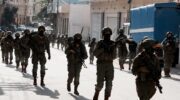
IDF soldiers in the West Bank this week. The puzzling response from the IDF spokesperson signals a new development. Credit: Nasser Nasser/AP
Nazih relates that his head, eye and neck are still very painful. He hardly sleeps at night. His mother asks us how to get him an artificial eye.
This past Sunday his classmates came for the first time to visit him, but all he wanted was for them to leave, and he remained silent. Why?
Nazih: “They made noise. It makes pressure in my head. I don’t want to see people.”
His uncle, a former employee of Israel’s defense establishment and a resident of Israel, who speaks in fluent Hebrew about the IDF’s vaunted intelligence Unit 405, where he says he served, convinced the boy to go for a drive with him this week, just to get him out of the house. It was a short ride; Nazih just wanted to go home and be alone in the dark.
Nazih ended up spending six days in intensive care and only regained consciousness on the seventh; he was then transferred for six more days of recovery to a regular ward before being released.
In the meantime, Reina has recovered at home; she still cannot bring herself to go to school for a whole day.
During the first few days after the incident she could not bring herself to visit her brother in the hospital.”I was afraid to see him,” she says, adding that a few minutes after her brother was evacuated to the clinic, two of the jeeps returned. The neighbors who had gathered near the Masalmas’ home fled in a panic at the sight of the vehicles. The soldiers didn’t get out, only opened the door and looked at the bloodstains they had left behind.
Gideon Levy and Alex Levac are an Israeli journalist and an Israeli photojournalist respectively.