By Bilal Ghaith Kisswani, reposted from IMEMC, September 09, 2025
The longest emergency call from Gaza’s genocide becomes a global symbol of Palestinian children’s suffering and the sacrifice of humanitarian workers under genocidal assault.
Neither Rana Al-Faqih nor Omar Alqam, two humanitarian workers with the Palestinian Red Crescent Society, could have imagined that a routine emergency call would become a defining moment of global conscience amid Israel’s ongoing genocidal war on Gaza.
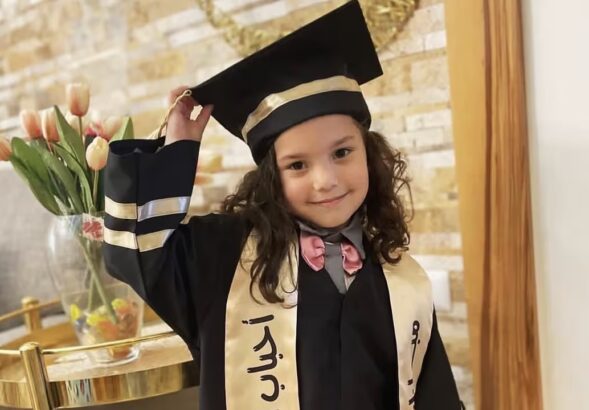
Al-Faqih, stationed at the PRCS headquarters in Al-Bireh, was on the receiving end of a desperate call from five-year-old Hind Rajab in January 2024.
Hind had just witnessed the massacre of her family inside a vehicle that was targeted by Israeli occupation soldiers in Tel Al-Hawa, southwest of Gaza City. Her voice trembled with fear as she pleaded for help.
Omar, a volunteer in the PRCS central operations room, and Rana, its former coordinator, spent agonizing minutes trying to calm Hind, offering words of hope as explosions and gunfire echoed around her. But her breath grew faint, her voice faded—and then the line went dead.
Twelve days later, Hind’s body was found inside the bullet-riddled vehicle alongside six of her relatives.
According to Forensic Architecture, Israeli forces had fired 335 rounds at the car where Hind had spent her final hours, clinging to the phone and begging PRCS medics to save her.
On February 10th, the PRCS confirmed the discovery of Hind’s remains. Nearby, they found the bodies of two paramedics, Ahmad Al-Madhoun and Yousef Zino, killed when Israeli forces targeted the ambulance dispatched in response to Hind’s call.
Al-Faqih recalls the call with anguish:
“I tried to be her voice of hope, though I felt utterly helpless. I’d never experienced such pain. I focused entirely on Hind, hearing tanks, gunfire, and drones overhead. She was trembling and sobbing as she spoke.”
“She kept saying, ‘Please come get me.’ I tried to reassure her. She was terrified. She said the tank was approaching her. Then the call dropped. I thought she had died, like her cousin Layan, who was killed beside her.”
They managed to reconnect briefly. Hind was still alive. “She begged me not to leave her. As night fell, she said she was scared of the dark. We kept talking. She told me her family had ‘fallen asleep’—not realizing they had all been killed.”
“I asked her to recite Al-Fatiha. We played hide-and-seek to distract her from the darkness. Then the line cut again. It stayed silent for 12 days until the occupation forces withdrew. Our teams rushed to the site, hoping to find survivors. Instead, we found Hind, her family, and the two paramedics all martyred.”
Tunisian filmmaker Kaouther Ben Hania captured Hind’s final hours in her documentary The Voice of Hind Rajab, using original audio recordings of the emergency calls. She first heard Hind’s pleas by chance and immediately contacted the PRCS.
“I spoke at length with Hind’s mother and those who tried to help her. I listened, I cried, and I wrote,” Ben Hania shared on Instagram.
View this post on Instagram
The film premiered at the 82nd Venice International Film Festival, receiving a 22-minute standing ovation and winning the Silver Lion. Accepting the award, Ben Hania said:
“Cinema cannot bring Hind back or erase the horrors committed against her. But it can preserve her voice. Her story is not hers alone—it is the tragic story of an entire people facing genocide under an occupation that enjoys impunity.”
Al-Faqih reflected:
“This film documents one of hundreds of crimes. Hind was not an isolated case—she was one of thousands of children killed without cause in Gaza and the West Bank. Her voice is a message to every child in the world.”
“My experience with Hind left a deep psychological scar, but it strengthened my sense of duty toward innocent children. Palestinian humanitarian work is a message to the world: humanity can endure, even under siege and destruction.”
“Hind wasn’t just with me—I carry her with me still. Her voice never leaves me. It haunts me. I remember her, and I will never forget her suffering as she waited for death from a merciless occupier.”
Omar Alqam, after watching the film, said:
“It was deeply emotional—a mix of sorrow and pride. Pride that her story reached the world. Sorrow that she lost her life. The applause was for the entire Palestinian people, not just Hind.”
“I shared my testimony because it’s a humanitarian duty to tell the truth. My call with Hind will stay with me forever. Her innocent voice and story are a responsibility we must carry to the world.”
“The film proves that every human has a voice, a dream, a story. Hind reminds us that we have faces, memories, and families. This isn’t just a tribute—it’s a message of humanity and hope.”
The Venice jury described the film as “a painful moment in Gaza’s history and an unprecedented humanitarian testimony to the resilience of children and medics.”
PRCS spokesperson Nibal Farsakh emphasized:
“Hind’s story embodies the suffering of civilians in Gaza—especially children—and the systematic targeting of humanitarian workers. This was the longest emergency call in our history. Despite prior coordination with Israeli forces, the ambulance sent to rescue Hind was bombed upon arrival. Twelve days later, we mourned Hind, her family, and our colleagues Yousef Zino and Ahmad Al-Madhoun.”
Farsakh added:
“Since the first day of Israel’s war on Gaza, our teams, facilities, and hospitals have been deliberately targeted. Fifty-four of our staff have been killed—while wearing the Red Crescent emblem that should protect them.”
She renewed her urgent appeal to the international community to act immediately to protect civilians and humanitarian workers under international humanitarian law, which Israel continues to violate with impunity.
“How many medics, doctors, and aid workers must be killed before the world intervenes to stop these crimes against Palestinian health workers and civilians?” she asked.
According to official Palestinian reports, nearly 20,000 children have been killed in Gaza since the genocide in Gaza began on 7 October 2023. In the West Bank, including occupied Jerusalem, at least 212 children have been killed.
UN reports document over 1,200 violations against children since the start of 2025, including killings, injuries, arrests, and forced displacement, underscoring the scale of the catastrophe facing the Palestinian people.
The tragedy of Hind Rajab and the testimonies of Rana Al-Faqih and Omar Alqam remain a living testament to a suffering that has yet to end.
Bilal Ghaith Kisswani is a reporter from IMEMC News.
RELATED:
- Israel’s War in Gaza Has Killed Over 17,000 Children. These Are the Stories of 28 of Them
- It Took 24 Hours to Speak the Names of 12,000 Children Israel Killed in Gaza – A Fraction of the Total
- The most precarious place in the world to be a child: Israel’s year of war on children
- ‘One of the most heartbreaking tragedies’: Gaza doctor’s last goodbye before nine children killed in airstrike
- The hunger we face in Gaza is Israel’s weapon of war. Please don’t look away.